
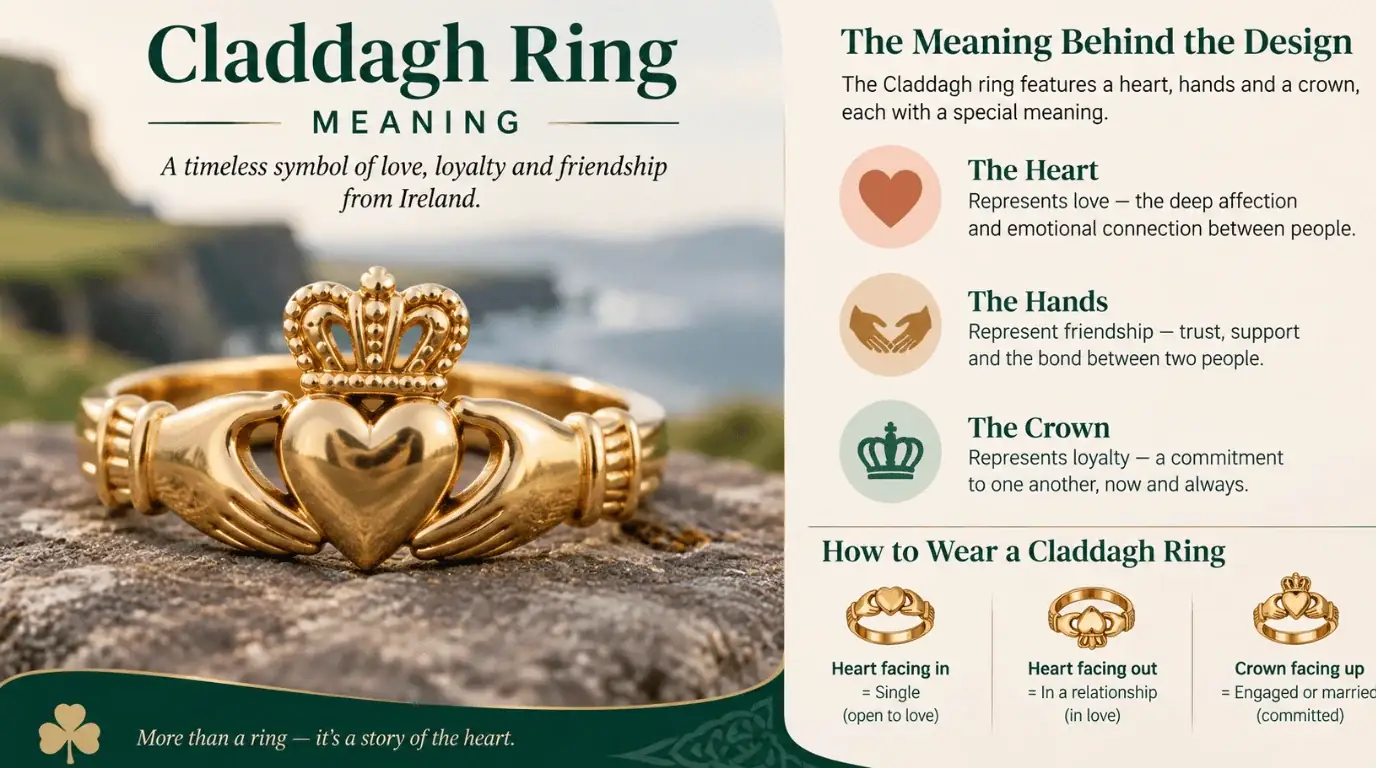
The claddagh ring meaning comes from three simple symbols: a heart for love, two hands for friendship, and a crown for loyalty. How you wear the ring can add another message. By tradition, the hand you choose and the direction of the heart can suggest whether you are single, dating, engaged, or married.
A traditional Claddagh design combines a heart, hands, and crown to represent love, friendship, and loyalty. Wearing it on the right or left hand, with the heart facing inward or outward, can also communicate relationship status. These customs remain popular, though families and wearers may follow their own variations.
| What to know | Traditional meaning |
|---|---|
| Heart | Love |
| Two hands | Friendship |
| Crown | Loyalty |
| Right hand, heart outward | Single or open to love |
| Right hand, heart inward | In a relationship |
| Left hand, heart outward | Engaged |
| Left hand, heart inward | Married |
| Historical roots | Galway, Ireland |
| Early maker closely linked to the design | Richard Joyce, around 1700 |
What the Claddagh Ring Meaning Tells You About the Three Symbols
The design works because each part carries a separate idea.
The heart represents love.
The heart sits at the center of the design and represents love. That can mean romantic love, but it does not have to.
People also give these rings to family members and close friends. In that context, the heart can represent lasting affection rather than a romantic commitment.
The hands represent friendship.
Two hands hold the heart from either side. They traditionally represent friendship, trust, and companionship.
That makes the design broader than an ordinary romantic symbol. It suggests that a strong relationship includes friendship as well as affection.
The crown represents loyalty.
The crown above the heart represents loyalty. It can be read as faithfulness to a partner, devotion to family, or commitment to people you value.
Together, the three elements communicate a simple set of values: love, friendship, and loyalty.
That combination helps explain why the design works as a friendship gift, family keepsake, romantic ring, engagement ring, or wedding ring.
How Do You Wear a Claddagh Ring?
The most widely used modern tradition has four positions. The important detail is the point of the heart.
| Relationship status | Hand | Heart points toward |
|---|---|---|
| Single | Right | Fingertips |
| In a relationship | Right | Wrist |
| Engaged | Left | Fingertips |
| Married | Left | Wrist |
Right hand with the heart pointing outward: single
If you wear it on your right hand with the point of the heart facing your fingertips, the traditional message is that your heart is open.
It is commonly understood to mean that you are single.
Right hand with the heart pointing inward: in a relationship
Turn the heart so its point faces your wrist while keeping the ring on your right hand.
Traditionally, this means that your heart has been taken and you are in a relationship.
Left hand with the heart pointing outward: engaged
Moving the ring to the left hand changes the traditional message.
With the heart pointing toward your fingertips, it commonly represents engagement.
Left hand with the heart pointing inward: married
After marriage, tradition turns the heart inward toward the wrist.
This position represents a heart that has found its home.
These rules are customs rather than laws. Historical writing about the exact wearing system is limited, and regional or family variations exist. If a ring has personal meaning to you, you can choose the position that fits your own story.
Where Did the Claddagh Design Come From?
The design is associated with the Claddagh, a historic fishing community beside Galway City on Ireland’s west coast. Galway City Museum describes the area’s name as coming from the Irish word cladach, meaning a foreshore.
The oldest known example held by Galway City Museum dates to around 1700. It was made by Galway goldsmith Richard Joyce and bears his maker’s mark. The museum credits Joyce with some of the earliest examples of the style.
The design also grew from an older European jewelry tradition. Fede rings featured clasped hands and were used as symbols of faith, partnership, or marriage. Galway’s version developed that idea into the familiar hands, heart, and crown.
What about the famous Richard Joyce pirate story?
One popular story says Joyce was captured by corsairs while travelling, sold into slavery, and trained by a goldsmith before eventually returning to Galway. It is a memorable story, but it should not be presented as a proven fact.
Galway City Museum calls the account remarkable but largely unproven. National Geographic also notes that official records are limited, although historical evidence confirms Joyce worked as a Galway goldsmith, and surviving pieces bear his mark.
That distinction matters. The surviving jewelry is strong historical evidence. The more dramatic parts of Joyce’s biography sit somewhere between documented history and tradition.
What Does Giving One to Someone Mean?
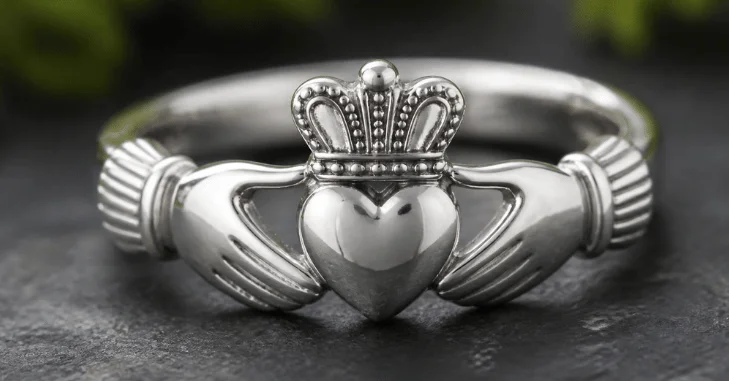
The meaning depends on the relationship.
A partner might give one as a symbol of romantic commitment. A parent or grandparent may give one to represent family love and heritage. Friends can exchange the design as a sign of loyalty and lasting friendship.
You also do not need to be engaged or married to wear one.
For couples who want to mark commitment without proposing marriage, StyleVanta’s promise-ring guide explains how symbolic rings can communicate devotion without creating the expectations attached to an engagement ring.
The best approach is to explain what the gift means to you. A short conversation prevents the recipient from assuming a romantic message you did not intend.
Can You Buy a Claddagh Ring for Yourself?
Yes. There is no rule that says you must receive one as a gift.
You may hear claims that buying your own ring brings bad luck. That idea appears in popular jewelry folklore, but it is not a requirement for wearing the design.
Buying one for yourself can mark Irish heritage, a personal value, a life milestone, or simply an appreciation for the design.
If you are shopping for jewelry in Canada, think first about how often you plan to wear it. Metal, band thickness, comfort, sizing, and care will matter more over time than following a superstition.
For broader styling inspiration, StyleVanta’s 2026 jewellery trends in Canada look at current ways Canadians are wearing meaningful and statement pieces.
Can It Be an Engagement or Wedding Ring?
Yes. The design has long been connected with love and partnership, so it can work as an engagement or wedding ring when both people like the symbolism.
The traditional wearing convention even includes separate engaged and married positions.
If you plan to wear it every day, look beyond symbolism. Check the strength of the band, the height of the design, the metal, and whether it sits comfortably beside another ring.
Couples considering a more conventional diamond design can also compare those practical factors with StyleVanta’s Canadian diamond-ring buying guide.
There is no need to choose a large or expensive ring for the symbolism to count. The meaning comes from what the piece represents to the wearer.
Does the Ring Have to Be Worn the Traditional Way?
No.
The traditional four-position system is useful when you want the ring to communicate relationship status. It is not mandatory.
Some people wear an inherited piece on whichever finger fits. Others choose a hand based on comfort, work, other jewelry, or family tradition.
That flexibility is especially useful when the piece represents heritage or friendship rather than romance.
If you want the traditional message to be understood, use the conventional hand and heart direction. If your reason for wearing it is personal, you can decide what feels right.
Why the Design Still Matters
Few jewelry designs communicate three values as clearly in one small object.
The heart speaks to love. The hands add friendship. The crown brings loyalty. The wearer can then add another layer of meaning through the ring’s position.
For Canadians with Irish family connections, it can also serve as a visible link to heritage. For everyone else, the values are broad enough to carry personal meaning without requiring Irish ancestry.
Its strength is not complicated symbolism. It is the way three familiar images combine into one message about the relationships people choose to protect.
Frequently Asked Questions
What is the claddagh ring meaning?
It traditionally represents love, friendship, and loyalty. The heart symbolizes love, the two hands represent friendship, and the crown represents loyalty. Its position can also communicate whether the wearer is single, in a relationship, engaged, or married.
What does it mean if the heart points outward?
On the right hand, an outward-pointing heart traditionally means the wearer is single or open to love. On the left hand, it is commonly associated with engagement.
What does it mean if the heart points inward?
On the right hand, the inward position traditionally signals a relationship. On the left hand, it usually represents marriage.
Do you need to be Irish to wear one?
No. Anyone can wear the design. People may choose it for its symbolism, family connections, personal values, or appearance.
Is it bad luck to buy your own ring?
There is no established requirement that another person must give it to you. Stories about bad luck belong to modern folklore rather than a rule you need to follow.
Can you wear one if you are not in a relationship?
Yes. Traditionally, a single wearer can place it on the right hand with the heart pointing toward the fingertips. You can also wear it simply for friendship, heritage, family, or personal meaning.
Choose the Meaning That Fits Your Story
If you want to follow tradition, remember one simple pattern: right hand before engagement, left hand after; heart outward when open or engaged, inward when committed or married.
The symbolism itself is even easier to remember. Heart for love, hands for friendship, crown for loyalty.
Whether you inherit one, receive it from someone important, or choose it for yourself, the most meaningful way to wear it is with a clear understanding of what those symbols represent.