
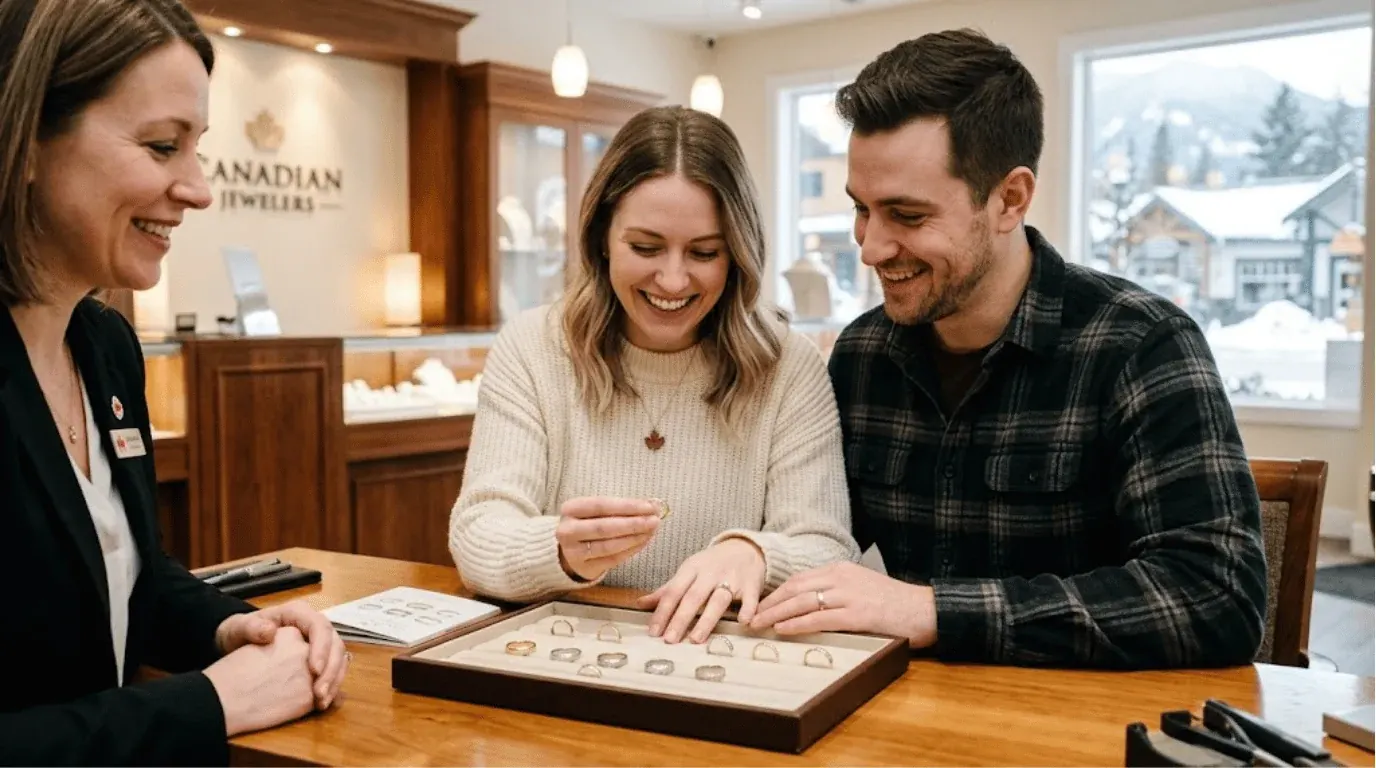
A wedding ring should suit more than your ceremony outfit. You may wear it almost every day, so comfort, metal, width, durability, fit, and how it works with other jewellery all deserve attention before you buy. More from us: Marquise Engagement Ring.
For Canadian couples, the smartest approach is to choose for your daily life first and appearance second. Start with the metal and fit, decide whether the band needs to sit beside an engagement ring, then compare design details within your budget.
| What to decide | Practical starting point |
|---|---|
| Metal | Gold or platinum for a traditional precious-metal band |
| Gold purity | Compare 10K, 14K, and 18K based on budget, colour, and wear |
| Width | Try several widths rather than choosing from photos alone |
| Style | Plain, textured, diamond-set, curved, eternity, or mixed finish |
| Fit | Get the exact finger measured before ordering |
| Engagement-ring pairing | Check whether the two bands sit comfortably together |
| Budget | Compare the complete ring cost, not the metal alone |
| Canadian buying check | Review metal claims, sizing, returns, resizing, and final charges |
The right band balances comfort, appearance, durability, and cost. For many buyers, a simple 14K gold band is a practical starting point. Platinum suits shoppers who want a naturally white precious metal. Diamond-set or contoured designs make sense when you want extra sparkle or an engagement-ring pairing.
How to Choose a Wedding Ring That Fits Your Life
Think about where your hands spend most of the day. A slim polished band can feel natural for office work and daily errands. If you frequently work with tools, lift equipment, garden, or handle machinery, you may prefer a simpler profile with fewer exposed stones.
Your existing jewellery offers another clue. If you regularly wear yellow-gold earrings, watches, or necklaces, a yellow-gold band may integrate easily. White metals can suit a cooler jewellery wardrobe, while mixed-metal styling gives you more flexibility.
Your band also doesn’t have to match your partner’s. Two rings can represent the same commitment without matching in width, finish, colour, or material.
Wedding Band Metals Compared
Metal choice affects colour, upkeep, feel, and price. Current Canadian retailers commonly offer yellow gold, white gold, rose gold, and platinum, while some sellers also carry alternatives such as tungsten or titanium.
| Metal | Appearance | Advantages | Trade-offs |
|---|---|---|---|
| 14K yellow gold | Warm classic gold | Familiar look, widely available, good balance for daily jewellery | Will collect surface wear over time |
| 18K yellow gold | Richer warm gold | Higher gold content and strong traditional appeal | Usually costs more than 14K |
| White gold | Bright white appearance | Works easily beside many diamond settings | Commonly uses rhodium plating that may need future maintenance |
| Rose gold | Warm pink tone | Distinctive colour and easy contrast with white metals | Colour doesn’t suit every jewellery wardrobe |
| Platinum | Naturally white | Dense precious metal with no need for rhodium colour plating | Usually sits at a higher price point |
| Tungsten | Grey to dark metallic | Often offered in substantial modern designs | Resizing options can be limited compared with gold |
Gold: a flexible starting choice
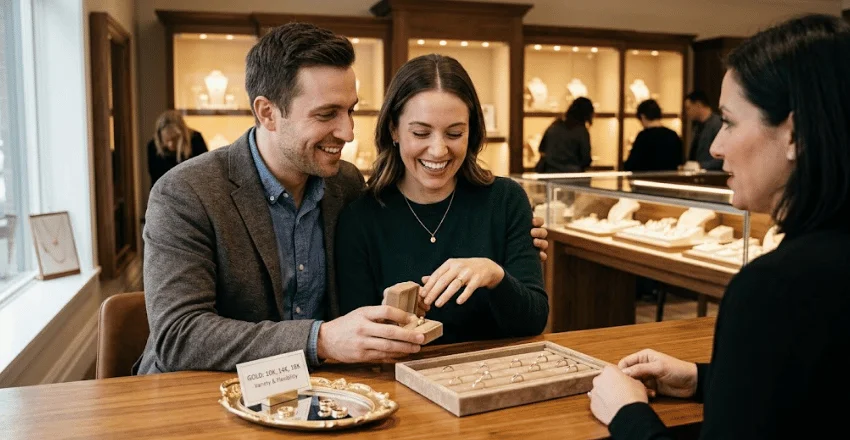
Gold remains easy to find in several colours and purity levels. Canadian precious-metal rules recognize quality descriptions such as 10K, 14K, and 18K when those claims meet the prescribed standards.
Canada’s Competition Bureau states that quality marking itself isn’t mandatory. If a seller uses a precious-metal quality claim, though, that claim must be truthful and follow the applicable rules.
Pros: broad style choice, several colours, familiar appearance, and many designs can be resized.
Cons: different alloys wear differently, and white-gold finishes can need maintenance.
Platinum: worth considering for a naturally white band
Platinum gives you a white precious-metal appearance without relying on a white surface coating for its colour. Canada’s quality-marking rules set specific composition requirements for jewellery represented with a platinum quality mark.
Pros: naturally white colour, substantial feel, and strong traditional fine-jewellery appeal.
Cons: higher initial cost in many current collections and a noticeably heavier feel than some alternatives.
Alternative metals: useful, but check the long-term details
Tungsten and titanium can appeal to buyers who like wider, contemporary bands. Current Canadian sellers offer many such designs, including brushed, polished, bevelled, and inlay styles.
Pros: distinctive finishes and often lower entry prices than fine precious-metal designs.
Cons: resizing or repair may be more restricted. Ask what happens if your finger size changes years later.
Our recommendation
If you don’t have a strong metal preference, start by trying 14K gold and platinum in person. Compare how each looks, weighs, and feels rather than choosing from specifications alone.
Choose the option that fits your budget and daily routine. A ring you’ll enjoy wearing is more useful than paying extra for a feature you don’t care about.
Choose a Style That Works With Your Engagement Ring
If you plan to wear both rings on the same finger, treat them as a pair. A straight band works well when the engagement setting leaves enough space beside it. Raised centre stones can often accommodate a straight design, although the exact setting matters.
Halo, cluster, or low-profile settings may leave less room. A curved, contoured, or notched band can follow the engagement ring’s outline and reduce the visible gap between the two pieces. Canadian jewellery collections currently include both straight and curved designs for this reason.
Take the engagement piece with you when shopping whenever possible. Check the pair from the top and side. Make sure the edges don’t press awkwardly against each other.
If you’re still researching centre stones, StyleVanta’s 5-carat diamond ring guide explains diamond size, settings, lab-grown options, grading, and Canadian buying costs.
Plain, Diamond, Eternity, or Textured?
A plain polished band is easy to understand and works across many personal styles. It also emphasizes shape, width, and metal.
Diamond-set bands add light and detail. Pavé, channel, shared-prong, half-eternity, and full-eternity designs create different amounts of sparkle and stone exposure. Current Canadian collections show all of these approaches.
A half-eternity design keeps stones across the visible upper section. A full-eternity design continues them around the finger.
Before choosing a full stone-set design, ask about resizing. Continuous stone placement can make later size changes harder than they are with a plain metal section.
Texture is another option. Brushed, satin, hammered, engraved, milgrain, and mixed polished-matte finishes can make a simple shape more personal without adding gemstones.
For broader inspiration, StyleVanta’s 2026 jewellery trends guide can help you place current finishes and jewellery styling in context.
Get the Ring Size Right in Canada
Canadian jewellery sellers generally work with the North American numeric sizing system. StyleVanta’s existing promise-ring guide also notes that Canadian retail uses sizes such as 6, 7, and 8. Professional sizing is the safest option when you’re buying a piece meant for long-term wear.
Measure the exact finger and hand. Your fingers aren’t guaranteed to be identical from left to right. Temperature matters too. Hands can feel tighter or looser as conditions change, which is especially relevant across Canadian seasons. Avoid taking one measurement when your hands are unusually cold or swollen.
Width can affect comfort as well. A wider band covers more of the finger, so don’t assume the same size will feel identical across every design. Try the final width or a close sample before ordering.
Decide on Width by Trying It, Not Guessing
Photos can make a narrow band look wider, and a substantial band looks smaller. Try several widths on your own hand. Pay attention to how the ring looks from a normal viewing distance, not only in a close-up mirror.
Narrower bands tend to look lighter and can stack easily. Wider bands create more visual presence and give finishes such as brushing or engraving more surface area.
Finger length also changes the effect. No single width fits men, women, or any other group. Choose based on proportion and comfort, not a gender label.
Set Your Budget Around the Finished Ring
Ring prices can vary widely because you’re paying for more than a category name. Metal type, purity, weight, width, diamonds or gemstones, setting work, brand, craftsmanship, engraving, and custom design can all affect the total. Current Canadian listings range from a few hundred dollars for some alternative-metal or stone-set options to well over CA$1,000 for many gold, platinum, and fine-jewellery designs.
Rather than chasing a national average, compare like with like. Ask what the quoted amount includes. Confirm resizing terms, engraving charges, warranty coverage, shipping, returns, and taxes before ordering.
For cross-border purchases, check the final landed amount rather than comparing only the displayed product price.
Check Metal Claims Before Buying in Canada
A small stamp can be useful, but don’t treat it as proof of value on its own.
The Competition Bureau explains that precious-metal quality marks aren’t mandatory in Canada. When businesses choose to make those quality claims, the representations must be accurate and comply with the Precious Metals Marking Act and Regulations.
Ask the retailer to state the metal clearly on your receipt or product documentation. For a large purchase, keep records related to the material, stones, grading documents, warranties, and service terms.
Make the Two Rings Personal Without Forcing a Match
Matching bands can be meaningful, but they’re optional. One partner might prefer polished yellow gold while the other wants brushed platinum. Instead, you can create a connection through engraving, similar profiles, matching dates, or a shared design detail.
Engraving works particularly well when you want the meaning to stay private. Initials, a wedding date, coordinates, or a short phrase can add sentiment without changing how the design looks from the outside.
If your relationship has included another symbolic ring before marriage, StyleVanta’s promise ring meaning guide explains how commitment jewellery differs from engagement and marriage symbolism.
Buy for the Next Decade, Not One Photo
Wedding-day styling matters, but ordinary Tuesdays matter more. Picture the band beside your everyday clothes, work routine, watches, bracelets, and other jewellery. Consider whether you’ll be comfortable cleaning it, maintaining its finish, and wearing its width every day.
Then check the practical details one last time:
- Confirm the correct finger size.
- Try the chosen width.
- Compare the metal in natural light.
- Test it beside the engagement ring, if applicable.
- Ask whether the design can be resized.
- Confirm the complete Canadian cost.
- Read the return and warranty terms.
A good final choice doesn’t need to be the most expensive or ornate. It needs to feel comfortable, look right to you, and make sense for the life you’ll wear it in.
Frequently Asked Questions
What is the difference between a wedding ring and a wedding band?
The terms are commonly used interchangeably. “Band” often describes a simpler continuous design, while “ring” is the broader term and can include stone-set or shaped styles.
How much should you spend on a wedding ring in Canada?
There is no required amount. Set the budget around the metal, design, craftsmanship, stones, and services you value. Compare full Canadian prices rather than relying on a fixed spending rule.
Does a wedding band have to match the engagement ring?
No. The two pieces should sit comfortably together if they’re worn on the same finger, but their metals, stones, and designs don’t have to match.
Is 14K or 18K gold better for everyday wear?
Neither is automatically better. 14K contains less pure gold and is commonly chosen for practical daily jewellery. 18K has higher gold content and a richer gold appearance. Your budget, colour preference, and lifestyle should guide your choice.
Can couples choose different wedding bands?
Yes. Matching designs are a personal choice, not a rule. Different metals, widths, finishes, and stones can suit each person’s style while representing the same marriage.
When should you buy your bands?
Leave enough time for sizing, ordering, engraving, custom work, or adjustments. Custom and special-order timelines vary by jeweller, so confirm the delivery date before paying.
Choose the Ring You’ll Want to Keep Wearing
Start with comfort. Then choose the metal, width, style, and details that make the piece feel like yours. You don’t need to follow a rule about matching rings, diamond count, or spending. You need a well-fitting piece that works with your lifestyle and still feels right after the wedding photographs are finished.
For more Canadian jewellery research and styling ideas, continue through StyleVanta’s jewellery guides before making your final choice.