

Choosing necklace lengths gets easier once you decide where you want the chain to land. For many adults, 18 inches is a flexible everyday starting point, while longer chains create more room for pendants, layering, and higher necklines. Your neck size, frame, clothing, and pendant can all change where the same chain sits.
For most adults, 18 inches (about 46 cm) is a flexible starting point because it usually sits near the collarbone. Shorter 14- to 16-inch chains sit higher, while 20- to 24-inch styles fall farther onto the chest. Your neck size, pendant drop, chain thickness, and neckline can shift the ideal fit.
Necklace Lengths at a Glance: Inches and Centimetres
Standard chain sizes commonly run from 14 to 36 inches. Where each one lands is only an estimate because body proportions vary. Current sizing guides use 14, 16, 18, 20, 22, 24, 30, and 36 inches as common reference points.
| Chain size | Approx. centimetres | Typical placement | Useful for |
|---|---|---|---|
| 14 in | 35.6 cm | Close around the neck | Choker looks, open necklines |
| 16 in | 40.6 cm | Base of neck or near collarbone | Short pendants, layering |
| 18 in | 45.7 cm | Around or below collarbone | Everyday chains, many pendants |
| 20 in | 50.8 cm | Upper chest | More relaxed fit, layering |
| 22 in | 55.9 cm | Below collarbone | Pendants, open collars |
| 24 in | 61.0 cm | Upper to mid chest | Larger pendants, high necklines |
| 30 in | 76.2 cm | Lower chest | Long statement pieces |
| 36 in | 91.4 cm | Around or below bust level | Long styling and dramatic layers |
How to Measure Necklace Length at Home
The simplest method starts with a piece you already like. Lay it flat and measure from one end to the other, including the clasp. Chain dimensions are generally listed as the full end-to-end measurement rather than the vertical drop on your chest.
If you don’t have a reference piece, use a soft measuring tape or a piece of string. Place it around your neck and adjust it until the front reaches your preferred position. Mark that point, remove the string, and measure the full loop.
Test the measurement while wearing the type of top you expect to pair with the jewellery. A size that works with a scoop neck may compete with the edge of a crewneck sweater.
Extenders are useful when your wardrobe changes through the year. A few extra centimetres can move a pendant away from a collar or give layered chains more separation.
Match the Chain to the Necklines You Wear
A good fit works with your clothes rather than following one universal chart. The easiest visual rule is to place the chain clearly above or below the edge of your neckline. A piece that lands directly on the fabric edge can disappear or compete with the clothing.
For common outfits, these starting points work well:
- Scoop and square necks: Try 16 to 20 inches so the chain remains inside the open area.
- V-necks: A pendant around 18 to 22 inches can echo the shape without sitting on the fabric edge.
- Button-up shirts: Shorter pieces can sit inside an open collar, while longer pendants can work over a closed shirt.
- Crewnecks: Choose a shorter chain that stays visible above the collar or a longer one that falls below it.
- Turtlenecks and mock necks: Longer chains can create a clear vertical line over the fabric.
This matters in Canada, where the same jewellery may need to work with summer tops, office layers, thick knits, scarves, and coats. StyleVanta’s cashmere sweater guide for Canadian wardrobes shows how much neckline and layering choices can change between seasons.
Pendants and Layering Change Where a Chain Appears to Sit
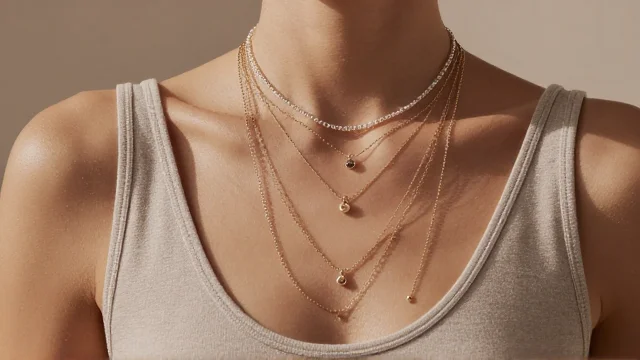
A pendant can make a chain look longer than the listed measurement suggests. Its weight pulls the front into more of a V shape, and the pendant itself adds extra visual drop.
That means an 18-inch plain chain and an 18-inch pendant piece may not appear to finish at the same point. When shopping online, check both the chain measurement and the height of the pendant.
For layering, give each piece enough room to be seen. Current styling guides often use gaps of about two inches as a practical starting point. Combinations such as 16, 18, and 22 inches or 16, 20, and 24 inches create clear levels.
Spacing does not prevent every tangle. Chain texture, thickness, pendants, movement, and clasps also matter.
Layered chains are part of current Canadian jewellery styling, alongside mixed metals, charms, beads, and stronger chain weights. See StyleVanta’s 2026 Canadian jewellery trends guide for more ways to build those combinations.
Use a Canadian Wardrobe Test Before You Buy
A chain should work with the clothes you wear, not only with the model photo on a product page. Before ordering, test your planned size with three outfits:
- a warm-weather top with an open neckline;
- an everyday shirt, blouse, or work layer;
- a fall or winter knit with your usual coat or scarf.
This simple test catches a common problem. A chain may look perfect with bare skin but disappear under a sweater collar for half the year.
Also consider chain thickness. A thicker piece has more visual weight and may feel closer around the neck than a fine chain at the same listed size.
If you are comparing jewellery metals as well as fit, StyleVanta’s guide to hypoallergenic earrings offers a useful introduction to material labels, plating, and nickel sensitivity.
Choosing a Size for a Gift
When you cannot measure the recipient, look at the jewellery they already wear. Note whether their usual pieces sit at the throat, collarbone, or farther down the chest.
For many women, 18 inches is a practical starting point. Current women’s sizing guides repeatedly place it around the collarbone and describe it as a common everyday choice. For many men, Canadian sizing guidance favours roughly 20 to 22 inches for everyday wear.
An adjustable chain or extender reduces the risk of choosing a fixed size that feels slightly wrong. Adjustable designs are especially useful when the wearer likes different necklines.
If the gift carries personal meaning, StyleVanta’s promise ring guide also covers how existing jewellery, metal colour, scale, and everyday habits can guide a thoughtful choice.
Choose Where You Want the Chain to Land First
Start with placement, not the number printed on the product page. Decide whether you want the piece at the base of your neck, around your collarbone, or farther down your chest.
Then measure that position and test it against the clothes you wear most. For Canadians, that means checking both warm-weather outfits and colder-season layers.
Once you know your preferred position, choosing chains, pendants, and layered combinations becomes much easier. For more accessory ideas, browse StyleVanta’s Jewelry section.
Frequently Asked Questions
What necklace length is most common for everyday wear?
An 18-inch chain is a common starting point for women and usually sits around the collarbone. For men, 20 to 22 inches is commonly recommended for an everyday fit.
Is 16 inches or 18 inches better?
Choose 16 inches when you want the piece closer to the base of your neck. Choose 18 inches for more room around the collarbone. Your neck circumference can shift both positions.
How do I measure a chain I already own?
Lay it flat and measure from one end to the other, including the clasp. That gives you a useful reference when comparing product measurements online.
What chain size works well with a pendant?
Many small pendants work comfortably around 18 to 22 inches, but the right choice depends on the desired drop. Remember that the pendant adds length below the chain itself.
How should necklace lengths be spaced for layering?
A gap of about two inches is a useful starting point. Wider spacing can help larger pendants or thicker chains remain visually separate. Try your full stack together because movement and chain texture also affect tangling.