
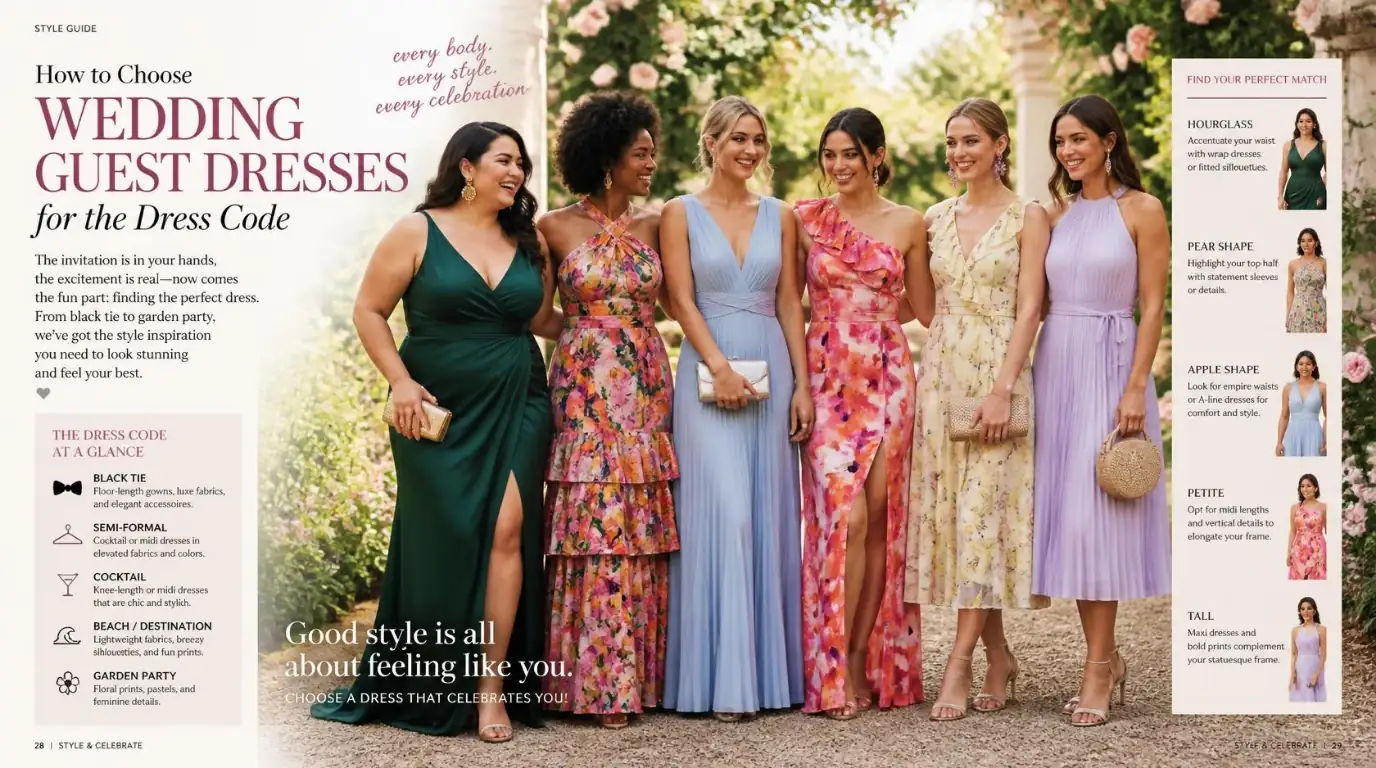
Shopping for wedding guest dresses comes down to three things: the dress code, the setting, and how comfortably you can wear the outfit for several hours. In Canada, the season matters too. A breezy garden party look needs a different plan from a January reception in Montréal or Toronto.
The safest starting point is a polished midi or maxi in a non-bridal color, paired with shoes and layers that suit the venue. Formal weddings usually call for richer fabrics and longer hems. Cocktail events allow more flexibility, while outdoor celebrations favor practical footwear and lighter materials.
| Wedding detail | Good starting point | What to check |
| Black tie | Formal maxi or gown | Fabric, length, evening accessories |
| Formal | Maxi or polished midi | Refined finish and structured styling |
| Cocktail | Midi or dressy knee-length style | Balance between festive and polished |
| Garden wedding | Floral or softly colored midi | Breathable fabric and practical shoes |
| Beach wedding | Light midi or maxi | Movement, heat, wind, and sand |
| Fall or winter | Midi or maxi with richer texture | Coat, tights, boots, and indoor comfort |
| Most versatile choice | Midi dress | Re-wearability across occasions |
How to Choose Wedding Guest Dresses for the Dress Code
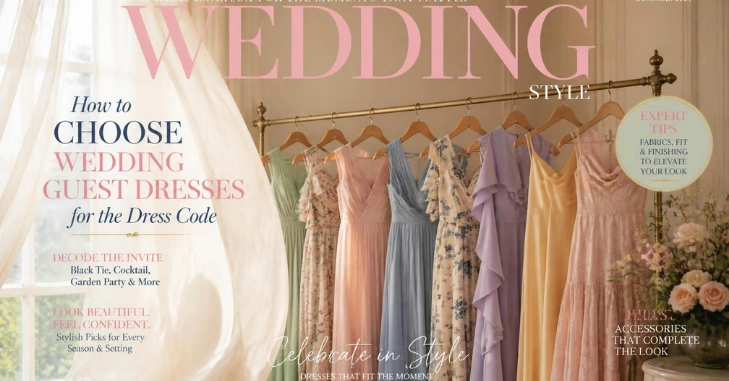
The invitation should guide your first decision. Canadian fashion coverage for 2026 stresses that guests should respect the couple’s stated dress code rather than treating it as a loose suggestion. Some couples now use mood boards, colour stories, or venue references to make their preferred level of formality clearer.
Wedding guest dresses: If the wording feels vague, look at the venue and time of day. An evening ballroom reception normally calls for a more formal outfit than an afternoon ceremony at a vineyard.
Black Tie
Choose a floor-length gown or an especially polished long dress. Satin, chiffon, crepe, velvet, and refined pleating can all work.
Pros: Easy to match to a formal setting and photographs well at evening events.
Cons: A floor-length hem can be harder to re-wear and less practical outdoors.
Formal
A maxi is a safe choice, but an elegant midi can also work when the fabric and accessories look intentional.
Pros: More flexibility than black tie while still feeling occasion-ready.
Cons: A simple daytime midi may look too casual without polished shoes, jewellery, or an evening bag.
Cocktail
Cocktail weddings give you room to wear a midi, dressy knee-length style, or sleek jumpsuit. Satin, crepe, lace, and structured fabrics fit well here.
Pros: Easy to re-wear for dinners, parties, and other events.
Cons: It is easy to drift into a too-casual approach if the fabric, shoes, and accessories look like everyday wear.
Garden or outdoor
Florals, soft colour, flowing skirts, and romantic details suit many garden settings. StyleVanta’s boho dress guide explains how lace, embroidery, tiers, and soft florals can be balanced with cleaner accessories.
Pros: Comfortable, photogenic, and well suited to daytime celebrations.
Cons: Long hems and narrow heels can become inconvenient on grass, gravel, or uneven ground.
Midi vs. Maxi vs. Mini: Which Length Works Best?
For most Canadian guests, a midi is the most adaptable choice. It can work with sandals in summer, pumps for a formal event, or tights and boots in colder weather.
StyleVanta’s flowy dress shopping guide also identifies midi lengths as an especially versatile option because they pair well with several shoe types and layers. A maxi creates more drama and coverage, while a mini suits relaxed or cocktail settings when the dress code allows it.
| Length | Strong points | Trade-offs | Best suited to |
| Midi | Versatile and easy to style | Some hems need careful shoe proportions | Cocktail, formal, garden, year-round |
| Maxi | Elegant movement and coverage | Hem can be impractical outdoors | Black tie, formal, evening |
| Mini | Light and playful | May be too casual for formal events | Cocktail and relaxed celebrations |
Recommendation: If you want one dress that can survive several wedding invitations, start with a midi in a refined fabric and a colour you already enjoy wearing.
Choose Fabrics Around the Season
Canadian wedding season can mean humidity in July, cool evenings in September, or snow outside a winter reception. For warm-weather weddings, look for lighter materials and breathable construction. Chiffon, lightweight crepe, linen blends, and softer viscose can feel easier during outdoor ceremonies.
For fall weddings, satin, crepe, jacquard, and richer textures make the outfit feel more seasonal. Velvet can suit colder formal events. Winter outfits need another test: Does the dress work with your real outerwear? A beautiful gown becomes inconvenient if its sleeves bunch under your coat or its hem drags through slush.
For cold-weather events, think about the full journey from your front door to the venue. Tights, boots, a warm coat, and a change of shoes may make more sense than building the outfit around indoor photographs alone.
What Colours Can You Wear to a Wedding?
Avoid colours that could reasonably be mistaken for bridal wear unless the couple specifically asks guests to wear them. That usually means being cautious with white, ivory, cream, and very pale shades that appear white in photos.
Black is now common at many modern weddings, especially evening events. The key is styling it so the outfit reads as celebratory rather than businesslike. Florals, jewel tones, soft pastels, earthy shades, navy, green, burgundy, and saturated blues all offer useful alternatives.
The couple’s cultural traditions matter as well. Some weddings have colour expectations that differ from mainstream Western etiquette. When you are unsure, asking the couple or someone close to the wedding party is better than guessing.
Shop for Repeat Wear, Not One Photograph
One of the strongest themes in current wedding-fashion coverage is re-wearability. Recent Canadian shopping coverage recommends choosing occasion pieces that can move beyond a single wedding into dinners, vacations, and other celebrations.
Before buying, ask yourself:
- Can I wear this with at least two pairs of shoes I already own?
- Does it work with my usual coat or jacket?
- Could I restyle it for dinner or another event?
- Is the fabric comfortable enough for sitting, eating, and dancing?
- Can I care for it without an expensive routine?
A dramatic detail can still make sense. The goal is to avoid buying an outfit whose only possible use is one six-hour event. That approach also makes it easier to spend more thoughtfully. Instead of putting the whole budget into a trend-driven dress, you can invest in the part of the outfit you are most likely to use again.
Make the Shoes Match the Venue
Shoes can turn a sensible outfit into an uncomfortable one within an hour. For lawns and gardens, block heels, wedges, polished flats, or dressy sandals are easier than narrow stilettos. For indoor formal receptions, pumps or heeled sandals can add a sharper finish.
Beach weddings need footwear that can handle sand and uneven surfaces. Winter weddings may require weather-ready boots for travel and a second pair of shoes inside. The right pair should let you stand through the ceremony and move comfortably at the reception. That matters more than adding a few extra centimeters of height.
Finish the Look Without Over-Styling
Let one or two features carry the outfit. If your dress has a bold floral print, strong ruffles, sequins, or a dramatic neckline, quieter accessories often work better. A simpler slip or crepe dress leaves more room for statement earrings, a decorative bag, or stronger shoes.
Hair can follow the same principle. Soft waves, a low bun, or a polished half-up style work across many wedding dress codes. StyleVanta’s half-up, half-down hairstyle guide includes cleaner pinned versions for formal events and softer variations for relaxed celebrations. You do not need every part of the outfit to compete for attention. A clear focal point usually looks more considered.
Our Verdict: Start With the Invitation, Then Buy for Your Life
The best approach to shopping for wedding guest dresses is not choosing the trendiest option first. Start with the required formality, then check the venue, season, comfort, and re-wear potential.
For the widest range of Canadian weddings, our pick is a polished midi with a clean silhouette. Choose a fabric that suits the season and a colour that does not read as bridal. From there, change the shoes, jewellery, bag, and outer layer to match each event.
If the wedding is black-tie, opt for a formal maxi or gown. For outdoor celebrations, prioritize movement and practical footwear. If your calendar includes several weddings, choose versatility before novelty.
Build an Outfit You Will Be Happy to Wear Again
A wedding invitation does not require a completely new wardrobe. Start with an outfit that respects the couple’s dress code and works with the season. Then make it feel personal through color, accessories, footwear, and styling. If you can move comfortably, feel appropriately dressed, and imagine wearing the piece again, you have probably made the right choice.
Conclusion
Choosing the right wedding guest dresses does not have to mean chasing every new fashion trend. The smartest approach is to start with the wedding invitation, understand the dress code, and then consider the venue, season, weather, comfort, and your own personal style. A dress that looks beautiful but leaves you uncomfortable after an hour is rarely a successful choice.
For most Canadian weddings, a polished midi is one of the most versatile options. It can be dressed up for a formal reception or styled more casually for a garden celebration. A maxi or elegant gown is better suited to black-tie and formal evening events, while a shorter dress can work well for cocktail or relaxed celebrations when the invitation allows it.
Frequently Asked Questions
What are the best wedding guest dresses for a Canadian wedding?
A polished midi is one of the safest all-purpose choices because it works across many venues, seasons, and dress codes. For black-tie weddings, choose a formal maxi or gown. For garden and beach events, lighter fabrics and practical footwear make more sense.
Can you wear black to a wedding?
Yes, Black works at many modern weddings, especially formal and evening receptions. Use festive accessories, interesting textures, or elegant jewelry so the outfit feels suited to a celebration.
Can you wear a short dress to a formal wedding?
You can in some cases, but a midi or maxi is usually easier to style at the expected level of formality. If you choose a shorter hem, pair it with refined fabric, polished shoes, and evening-appropriate accessories.
What should you wear to an outdoor wedding in Canada?
Dress for both the invitation and the weather. Choose a suitable midi or maxi, then add footwear that can handle grass or uneven ground. Bring a layer for cooler evenings, even if the ceremony is in summer.
How early should you buy your outfit?
Buy early enough to allow time for shipping, exchanges, alterations, and a full outfit test. Try the dress with your actual shoes, undergarments, bag, and outer layer, rather than checking it by itself.