

The right curly hair brush can make detangling easier, help styling products spread evenly, and shape more consistent curl clumps. The best choice depends on whether your main goal is removing knots, defining curls, adding volume, or smoothing your texture.
For most curly and coily routines, start with a flexible detangling brush or wide-tooth tool used on damp, conditioned hair. Choose a firmer defining brush when you want more tension and shape during styling. Dermatologists also recommend avoiding aggressive brushing on dry curls because it can increase frizz and breakage.
| What to know | Quick answer |
|---|---|
| Best starting choice | Flexible detangling brush |
| Best for curl definition | Styling or curl-defining brush |
| Best time to detangle | Damp or wet hair with conditioner for many curly textures |
| Main feature to look for | Flexible, smooth bristles with controlled tension |
| Good for dense curls | Wide or flexible brush with manageable sections |
| Typical Canadian examples checked | About CA$17.99 to CA$24.50 |
| Main mistake to avoid | Forcing a brush through dry, resistant tangles |
How to Choose a Curly Hair Brush for Your Routine
Start by deciding what you expect the tool to do. A brush that removes wash-day tangles may not create the polished ringlets you want from brush styling.
If tangles are your main problem, look for flexible bristles that move with the hair rather than gripping every strand firmly. The American Academy of Dermatology recommends wetting curly hair, adding leave-in conditioner, and working in sections when detangling.
For more difficult knots, StyleVanta’s guide to safely detangling matted hair explains why working upward from the ends is preferable to pulling through resistance.
A defining brush has a different purpose. Its bristles create controlled tension as you move through a product-coated section. That tension can encourage strands to group into more deliberate curl clumps.
If you wear a shorter cut, brush size matters too. A large head can feel awkward around the roots and face. StyleVanta’s short curly hair guide has more advice on matching styling methods to shorter curl shapes.
Curly Brush Types Compared
| Brush type | Best for | Main advantage | Main trade-off |
|---|---|---|---|
| Flexible detangling brush | Knots and wash day | Bristles bend under tension | Less control for precise curl shaping |
| Curl-defining brush | Forming clumps and ringlets | Gives controlled styling tension | Can pull if used on tangled hair |
| Wide-tooth comb | Gentle basic detangling | Simple and low tension | Limited styling ability |
| Paddle-style detangler | Thick or long sections | Covers more hair at once | Can be bulky around short curls |
| Round brush | Stretching curls during blow-drying | Adds tension and shape | Uses more heat and technique |
A dermatology review of hairbrush types notes that wide-tooth combs work well for curly and textured hair when used gently with moisture or conditioner. Round brushes have a different purpose and can be paired with a dryer when the goal is stretching or smoothing curls.
If you want to straighten rather than preserve your curl pattern, read StyleVanta’s hair straightener brush buying guide before choosing a heated tool.
Four Current Brush Options Canadian Shoppers Can Compare
These examples were checked for Canadian availability in August 2026. StyleVanta has not personally tested them, so the comparison is based on current manufacturer and retailer information rather than first-hand product testing.
LUS Detangle & Style Brush: A Versatile Starting Point
LUS Brands Canada lists its Detangle & Style Brush at CA$20. The company says it has more than 400 rounded bristles and can distribute styling product as it moves through the hair.
Pros
- Combines detangling and styling functions.
- Designed for curls and other textures.
- Can help distribute product through sections.
Cons
- LUS recommends using it on wet, conditioned hair for detangling.
- A multipurpose design may offer less specialized shaping than a dedicated defining brush.
Conair Curl Define Pro: An Affordable Definition Option
Conair Canada currently lists the Curl Define Pro Brush at CA$17.99. It combines flexible and firmer bristles, a vented design, and a tapered sectioning handle.
Pros
- Low current Canadian price.
- Handle can help divide the hair into styling sections.
- Designed for wet or damp curl styling.
Cons
- It is more styling-focused than a basic wide-tooth detangler.
- Dense tangles should be loosened before using strong styling tension.
CurlShoppe Curl Defining Brush: Best Suited to Styling
Toronto-based CurlShoppe lists its Curl Defining Brush at CA$17.99. The company positions it mainly for creating ringlets and curl clumps rather than shower detangling.
Pros
- Built specifically for curl formation.
- Can distribute styling products.
- Current price is accessible compared with many premium brushes.
Cons
- CurlShoppe does not recommend it as its main shower brush.
- People focused only on knots may prefer a flexible detangler.
PATTERN Shower Detangling Brush: Another Detangling Choice
Sephora Canada currently lists the PATTERN Shower Detangling Brush at CA$24.50. It appears alongside several other brushes marketed to curly-haired Canadian shoppers.
Pros
- Intended for shower detangling.
- Useful when detangling is the main priority.
- Available through a major Canadian beauty retailer.
Cons
- Costs more than the three examples above.
- A shower detangler is not automatically the best tool for forming defined ringlets.
Prices and stock can change, so check the Canadian seller before ordering.
Should You Brush Curly Hair Wet or Dry?
For detangling, damp or wet hair with enough conditioning slip is a practical choice for many curly and coily textures. The American Academy of Dermatology advises people with curly hair to wet it thoroughly, apply leave-in conditioner, and work in sections. It also recommends avoiding dry brushing when possible because it can contribute to frizz and breakage.
The Canadian Dermatology Association advises using conditioner when combing wet hair and starting from the ends of tangled strands. It also warns against harsh brushing and pulling.
That does not mean soaking-wet hair can tolerate unlimited tension. Wet strands can still break. Use slip, smaller sections, and slow strokes rather than forcing the tool through a knot.
A Simple Detangling and Brush-Styling Routine
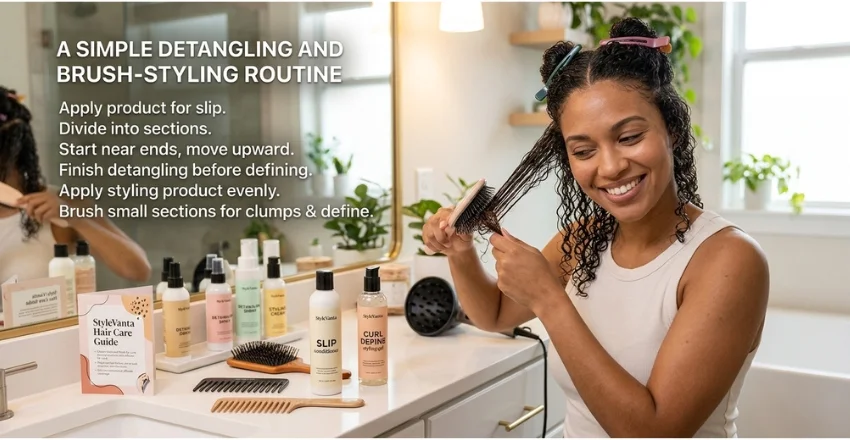
- Apply conditioner or a detangling product. Make sure each working section has enough slip.
- Divide the hair into sections. Four sections may be enough for lighter density. Denser hair may need more.
- Start near the ends. Hold the hair above the tangled area to reduce pulling at the scalp.
- Move gradually upward. Brush higher only when the lower part moves freely.
- Finish detangling before defining. A styling brush should shape curls rather than fight knots.
- Apply your styling product evenly. Cream, mousse, or gel choice depends on the finish and hold you prefer.
- Brush small sections for definition. Let the section form a clump, then scrunch if your routine calls for it.
If gel is part of your styling routine, StyleVanta’s hair-care section includes guidance on choosing hold and finish for curls. For people who dry their curls with airflow rather than stretching them straight, the site’s diffuser coverage can also help build a more complete routine.
What Features Matter Most?
Flexible bristles are useful when detangling is your priority. They can give under resistance rather than keeping constant pressure on a snag.
Bristle spacing also matters. Dense curls often benefit from enough space for sections to move through the tool without excessive pulling.
Look at the handle next. A comfortable grip gives you more control when your hands are wet or coated with conditioner. A pointed or tapered end can also help with sectioning.
Finally, match the size to your length and density. A broad brush may cover long hair faster, while a smaller tool can give more control around short cuts and face-framing pieces.
The Verdict: Which Brush Should You Buy?
If you are buying only one tool, a flexible detangling brush is the most practical starting point for many curly-hair routines. Removing knots gently is the first job. You can still use many detangling brushes to spread styling products.
Choose a dedicated defining brush when your hair already detangles easily and you mainly want uniform curl clumps, ringlets, or more controlled styling.
For Canadian shoppers comparing current examples, the Conair and CurlShoppe options both sit around CA$17.99, while LUS currently costs CA$20. The better purchase depends on the job you need the brush to perform, not a small difference in price.
Your Next Step
Choose your brush based on its job. Start with a flexible detangler if knots make wash day difficult. Add a defining brush when you want more controlled curl clumps.
Whichever design you pick, pair it with good slip, manageable sections, and gentle tension. Those habits matter more than buying the most expensive brush.
Frequently Asked Questions
What is the best curly hair brush for detangling?
A flexible detangling brush is a sensible starting point because its bristles can move under tension. Use it on manageable sections with conditioner or another product that provides slip. A wide-tooth comb is also a useful low-tension option.
Is a Denman-style brush good for curly hair?
This type of firmer styling brush can work well for defining curl clumps and distributing product. It is usually better to remove major tangles first. Styling tension should shape the section rather than force knots apart.
Does brushing curly hair ruin curls?
Brushing technique matters more than the act of brushing itself. Aggressive dry brushing can separate clumps, create frizz, and increase pulling. Controlled wet or damp detangling with enough slip is usually more suitable for curly textures.
Can I use the same brush for detangling and styling?
Yes, some brushes are designed for both. LUS, for example, markets its current Detangle & Style Brush for knot removal, product distribution, and styling. A specialized defining brush may still give you more control when curl formation is your priority.
How often should I brush curly hair?
There is no need to brush curls repeatedly throughout the day. Use the tool when you need to detangle or deliberately style your texture. Excessive tugging and overbrushing can contribute to breakage.