

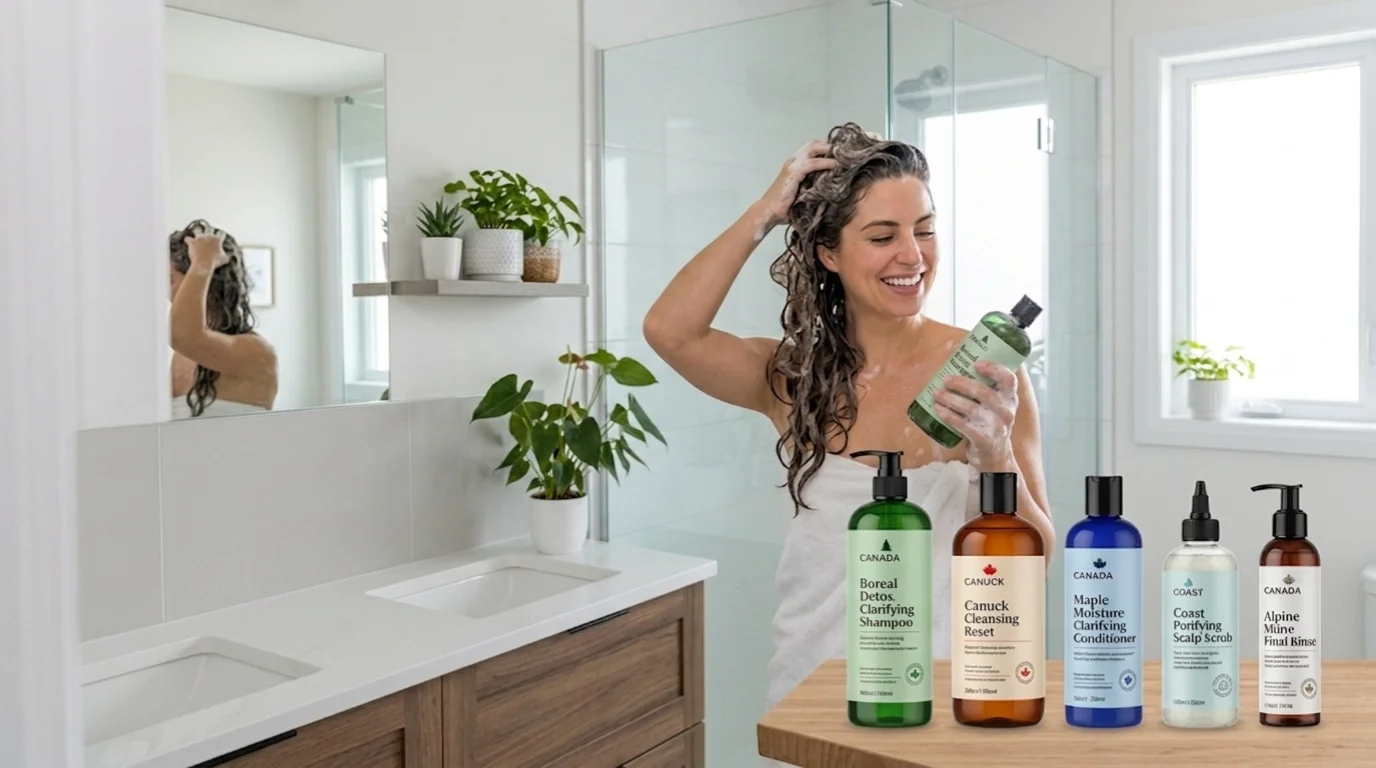
Hair that still feels coated, flat, greasy, or dull after washing may need more than your everyday cleanser. Product residue, excess oil, dry shampoo, swimming, and water deposits can all affect how your hair feels.
A clarifying shampoo is a deeper-cleansing wash used occasionally to remove stubborn product residue, excess oil, dry shampoo, silicones, and environmental buildup. It is not automatically a hard-water treatment. Mineral deposits may require a chelating formula. Follow the product’s directions and condition afterward to help prevent unnecessary dryness.
| At a glance | What to know |
| Main purpose | Remove stubborn oil and product residue |
| Useful for | Styling buildup, dry shampoo residue, oily roots, and swimming residue |
| Hard-water deposits | Look for a formula that also chelates minerals |
| Typical frequency | Often weekly, every two weeks, or as needed, depending on the formula |
| Colour-treated hair | Choose a colour-safe option and avoid unnecessary overuse |
| Curly or dry hair | Use less often if deep cleansing leaves the lengths feeling rough |
| Aftercare | Rinse well and follow with conditioner or a mask |
What Clarifying Shampoo Removes and What It Doesn’t
A deep-cleansing wash mainly targets residue sitting on the scalp and hair strands. This can include sebum, hairspray, styling creams, waxes, dry shampoo, and some silicones. It may be useful when your hair becomes limp despite regular washing. Another sign is when styling products suddenly stop behaving as expected. Curls may lose their bounce, or roots may become flat soon after drying.
Hard water requires a little more consideration. A standard clarifier is designed to remove oil and product residue. A chelating wash uses ingredients that bind to minerals and metals. Stylevanta’s guide to chelating cleansers explains that distinction in more detail. Some products combine both functions. If hard-water exposure is your main concern, look for wording related to minerals, metals, hard water, or chelation.
6 Signs Your Hair May Need a Deeper Clean
You do not need a strong cleanser every time your hair has a bad day. Look for a consistent pattern instead.
Common signs include:
- Your roots feel coated soon after washing. Oil may be mixing with styling residue.
- Your hair looks flat or unusually heavy. Product layers can reduce movement and volume.
- Dry shampoo no longer seems to brush or wash out cleanly. Repeated use can leave residue behind.
- Curls or waves lose definition despite your usual routine. Heavy styling layers may be weighing them down.
- Your hair feels different after frequent swimming. Pool exposure can leave residue that requires targeted cleansing.
- Your usual shampoo no longer seems strong enough. An occasional deeper wash may remove what regular cleansing leaves behind.
Greasy roots alone do not always mean you need a detox wash. If excess oil is the main issue, Stylevanta’s shampoo for oily hair guide covers routines designed specifically for excess sebum.
Clarifying vs. Chelating: Pick the Cleaner for the Buildup
The easiest way to choose is to identify what you are trying to remove.
| Your main problem | Better first choice | Why |
| Styling cream, wax, or hairspray | Deep-cleansing formula | Targets product residue |
| Excess oil | Purifying or oil-focused cleanser | Removes sebum without assuming minerals are the issue |
| Heavy dry shampoo use | Deep cleanser | Helps clear powder and styling residue |
| Hard-water minerals | Chelating formula | Mineral-binding ingredients target deposits |
| Frequent swimming | Chelating or swimmer-focused wash | Better suited to mineral and pool-related residue |
| Mixed product and mineral buildup | Dual-purpose formula | Addresses more than one source |
A Canadian retailer currently distinguishes the two in a similar way, noting that not every deep cleanser has the mineral-binding ability of a chelating product.
How Often Should You Use It?
There is no universal schedule. The right frequency depends on the formula, your hair type, and how quickly buildup returns. Several current products recommend periodic rather than daily use. Moroccan oil says its deep cleanser may be used twice monthly, with more frequent use for people who use a lot of styling products, swim often, or have hard-water exposure. OLAPLEX recommends using its No. 4C every one to two weeks or as needed.
A practical starting approach is:
- Fine or oily hair with frequent styling: Consider weekly use if the product directions allow it.
- Normal hair with moderate buildup: Try using it every one to two weeks.
- Dry, curly, bleached, or highly processed hair: Start less often and monitor how the lengths respond.
- Heavy mineral exposure: Choose a product designed for that problem instead of washing more often with a standard cleanser.
If your hair becomes rough, tangled, unusually dry, or harder to style, increase the time between treatments.
Can Coloured, Curly, or Dry Hair Be Clarified?
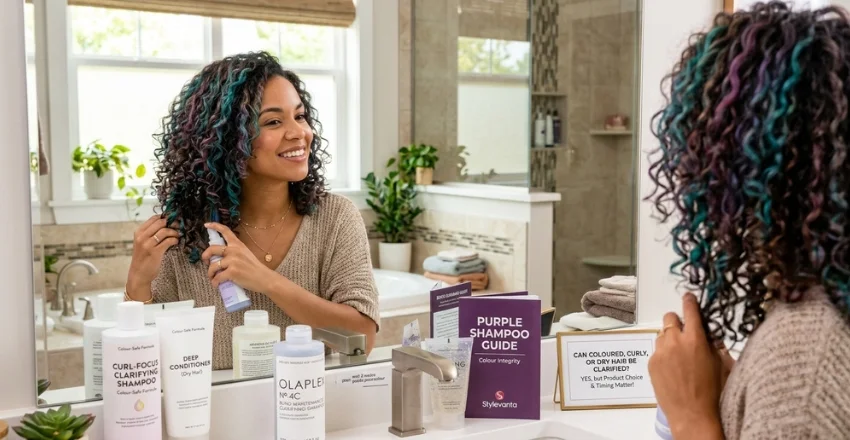
Yes, but product choice and timing matter.
Colour-treated hair can lose pigment faster when it is repeatedly exposed to strong cleansing. Look for a formula labelled colour-safe and follow its directions. OLAPLEX advises waiting at least two weeks after a colour service before using its No. 4C product.
This matters even more with deposited colour. If you use toners or temporary pigments, read Stylevanta’s purple shampoo guide before combining several strong or colour-altering products in one routine. Curly hair can also collect styling residue because creams, gels, mousses, and leave-in products are often part of a curl routine. The goal is to remove buildup without repeatedly stripping away moisture. Curl-focused products can make that balance easier to manage. Dry or bleached hair requires similar caution. If a wash leaves the ends feeling rough, use it less often and follow with suitable conditioning care.
How to Use a Deep-Cleansing Wash Without Overdoing It
The product label should come first because formulas vary. A simple routine usually works like this:
- Wet your hair thoroughly. Full saturation helps the cleanser spread more evenly.
- Apply the amount directed on the bottle. Concentrate on the scalp unless the product directs you to work it through the lengths.
- Massage gently. You do not need aggressive scratching to remove residue.
- Follow the stated contact time. Leaving a product on longer does not guarantee better results.
- Rinse thoroughly. Keep rinsing until the cleanser is fully removed.
- Condition the lengths. Use your normal conditioner or a richer mask if your hair needs more moisture.
Avoid combining several aggressive treatments during the same wash. More cleansing can create dryness without solving the underlying problem.
5 Options Canadian Shoppers Can Compare
Prices below were checked from Canadian listings on August 28, 2026. They can change, so confirm the current price and stock before buying. Stylevanta has not personally tested these formulas.
| Product | Best match | Size | Canadian price checked |
| AG Care Renew Clarifying Sulfate-Free Shampoo | Lower-cost, colour-conscious option | 296 mL | CA$28 |
| Living Proof Clarifying Detox Shampoo | Regular styling and product buildup | 8 oz | CA$54 |
| Curlsmith Curl Reset Detox Shampoo | Curly and textured hair routines | 237 mL | CA$38 |
| K18 PEPTIDE PREP Clarifying Detox Shampoo | Premium detox option | 250 mL | CA$56 |
| Moroccanoil Clarifying Shampoo with Argan Oil | Broad hair-type use | 250 mL | CA$40.50 |
Current Canadian Sephora listings support those sizes and prices.
AG Care Renew: Practical Value Pick
At CA$28 for 296 mL when checked, AG was the lowest-priced option in this group. Sephora Canada also lists it among products suitable for colour-treated hair.
Pros: Lower price, sulfate-free positioning, and a useful full-size bottle.
Cons: Its gentler positioning may not suit someone looking for an intensive mineral-removal treatment.
Living Proof Clarifying Detox: For Frequent Product Users
Living Proof was listed at CA$54 for the 8 oz size. It is positioned around detox cleansing and buildup removal.
Pros: Clear buildup-focused positioning and a mini size is also available.
Cons: It costs considerably more than AG.
Curlsmith Curl Reset Detox: For Curl Routines
Curlsmith’s 237 mL formula was CA$38 when checked. Its Canadian listing highlights curls, scalp freshness, and detox cleansing.
Pros: A straightforward option for routines that use several curl-styling products.
Cons: Dry curls still require careful frequency and good conditioning after a deeper wash.
K18 PEPTIDE PREP Clarifying Detox: Premium Choice
K18’s 250 mL detox cleanser was listed at CA$56 on Sephora Canada. That places it near the higher end of this comparison.
Pros: Clear detox positioning and a widely available, salon-oriented brand.
Cons: Higher price than AG, Curlsmith, and Moroccanoil.
Moroccanoil: Balanced Mid-Range Option
The 250 mL bottle was CA$40.50 at Sephora Canada when checked. Its Canadian product listing describes it as colour-safe and suitable for fine, medium, and thick hair.
Pros: Mid-range price, colour-safe positioning, and broad hair-type suitability.
Cons: Its fragrance and formula may not suit every shopper’s preferences.
The Verdict
For price-conscious Canadian shoppers, AG Care Renew is the easiest starting point in this comparison. Curlsmith may make more sense when curl-product residue is the main concern. Choose a dedicated mineral-targeting formula when hard water is the problem. If your roots are simply oily, an everyday oil-control routine may be more useful than stronger weekly cleansing.
What a Detox Wash Cannot Fix
A stronger cleanser cannot repair split ends, reverse bleach damage, or treat every scalp condition. Flaking and itching also require the correct diagnosis. The American Academy of Dermatology recommends dandruff shampoos with specific active ingredients when dandruff is the problem. Wash frequency should also match your hair and scalp type. If your scalp remains red, sore, intensely itchy, or inflamed, stop treating the issue as ordinary buildup. Seek advice from a dermatologist or another qualified health professional.
Choose the Cleanser That Matches the Problem
Start by asking what is building up on your hair. Styling residue, excess oil, mineral deposits, and dandruff are different concerns and do not require the same product. Use the gentlest option that solves the problem, follow the bottle’s recommended schedule, and pay attention to how your hair responds. For more routines matched to scalp and strand type, explore Stylevanta’s straight hair care guide and related hair-care resources.
Frequently Asked Questions
Can I use clarifying shampoo every day?
Usually, an intensive detox cleanser is intended for periodic use rather than every wash. Product instructions vary. OLAPLEX recommends every one to two weeks, while Moroccan oil provides different schedules based on buildup and exposure.
Is a clarifier the same as a chelating wash?
No. A clarifier mainly removes oil and styling residue. A chelating formula contains ingredients designed to bind to minerals or metals. Some products perform both functions.
Does deep cleansing remove hair colour?
Frequent strong cleansing can contribute to faster colour fading. Look for a colour-safe formula and follow its timing guidance. Recently coloured hair may require extra caution.
Should curly hair use a detox cleanser?
It can, especially when gels, creams, oils, or leave-in products accumulate. Use it based on buildup rather than following a rigid schedule, then condition well.
Should I clarify before or after swimming?
Your routine depends on the product and how often you swim. Frequent swimmers may benefit from a cleanser designed for chlorine or mineral exposure rather than a basic product-residue wash.