

This guide is general information, not medical advice. See a doctor or dermatologist if scalp itching, flaking or irritation persists or gets worse.
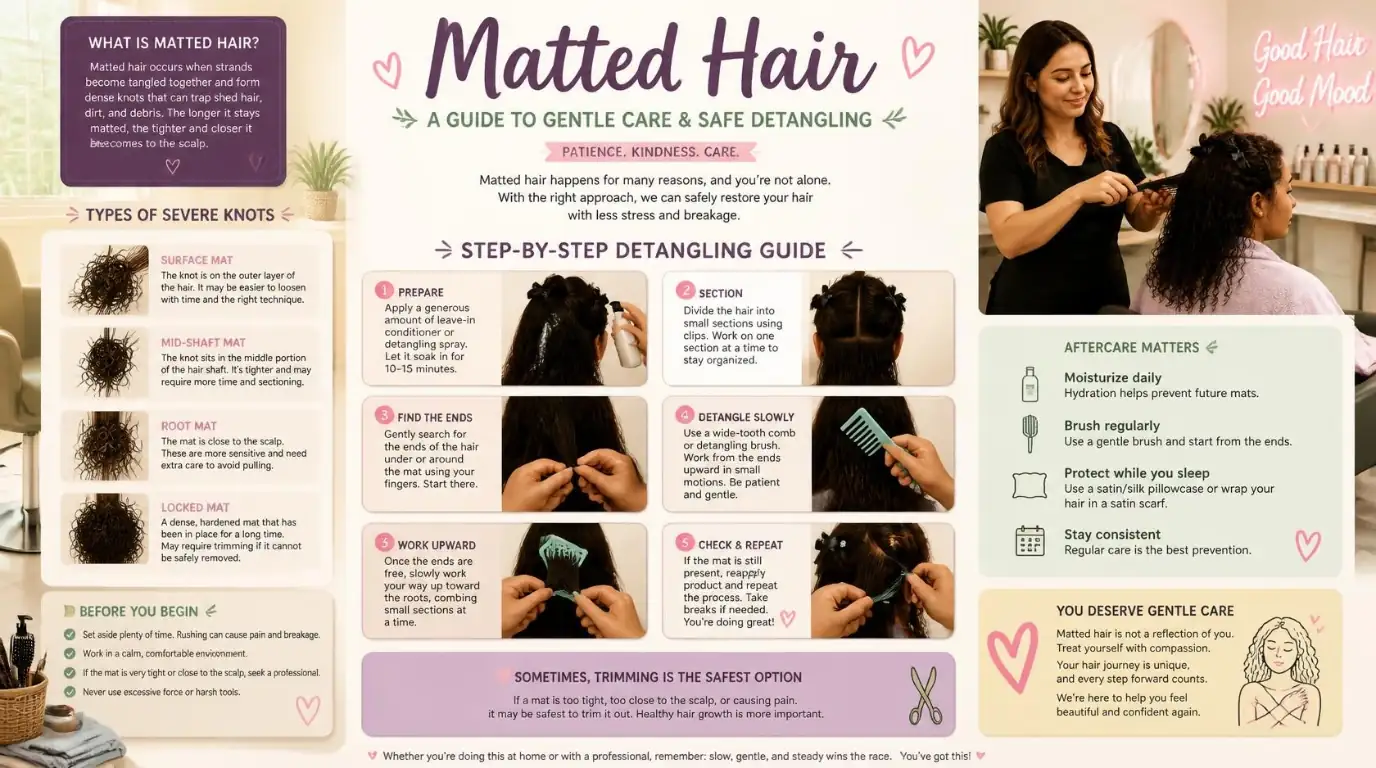
Matted hair can often be detangled without cutting if you slow down, add plenty of slip, and work in small sections from the ends upward. Use your fingers first, then a wide-tooth comb. Stop if the scalp is painful, bleeding, crusted, or inaccessible, as severe cases require professional help.
The Canadian Dermatology Association recommends using conditioner to make combing easier. It also advises starting at the ends of tangled strands and working upward with a wide-tooth comb.
| Situation | Safer first approach | What to avoid |
| Small, loose knot | Add conditioner or detangler and separate with fingers. | Pulling a brush straight through |
| Dense compact mat | Divide the surrounding area and loosen its outer edges. | Starting at the roots |
| Curly or coily texture | Work in sections with plenty of conditioning slip. | Brushing dry curls aggressively |
| Painful or crusted scalp | Stop and seek professional advice. | Cutting close to the skin |
What Causes Severe Matting?
A normal tangle involves a few crossed strands. A mat forms when shed strands twist around attached ones and become compressed into a dense knot.
Several things can make that happen. Missed detangling, dryness, product residue, damaged ends, friction, and long periods between wash or grooming sessions can all contribute. Long, fine, textured, chemically treated, or dry strands may knot more easily. Also worth reading: How to Wash Wool Sweater Safely.
Texture also changes how you should respond. Curly and coily strands tend to be drier and can break if brushed aggressively. The American Academy of Dermatology recommends working with conditioner, fingers, or a wide-tooth comb and dividing curls into manageable sections.
Matted hair: If your strands are straighter, StyleVanta’s Type 1 care routine can help you build a lighter maintenance routine. For tighter textures, the Type 4 care guide covers moisture and handling in more detail.
Canadian winters can create another problem at the nape. Scarves, coat collars, hats, and dry indoor air may increase friction around the back of the neck. Check that area regularly instead of waiting until a compact knot develops.
Buildup can make strands feel rough or coated too. If mineral residue or styling products are part of the problem, review StyleVanta’s guide to chelating cleansers. A strong cleanser isn’t a substitute for careful detangling, though.
What You’ll Need
Gather your tools before you start so you don’t have to stop halfway through:
- A slippery conditioner or detangling product
- A wide-tooth comb
- Sectioning clips
- Your fingers
- A detangling brush, if your texture tolerates one
- A towel or soft cotton T-shirt
- A mirror and enough time to work slowly
The most useful tool is patience. Repeated pulling creates more tension than several short, controlled sessions.
How to Detangle Matted Hair Safely in 7 Steps

- Isolate one section. Clip the surrounding strands away. Hold the section above the knot when possible so pulling doesn’t transfer directly to the scalp.
- Add controlled slip. Coat the problem area with conditioner or a suitable detangler. Some textures respond well to damp detangling, while curly textures often benefit from conditioner during washing. Wet strands can also be fragile, so avoid soaking and yanking indiscriminately.
- Open the outside with your fingers. Find loose strands around the edge and tease them away a few at a time. Don’t attack the dense center first.
- Comb from the ends upward. Once the outer strands begin moving, use a wide-tooth comb below the knot. Take short strokes. Move higher only after the lower section passes through easily.
- Make the working area smaller. If resistance increases, stop. Add more slips and divide the section again. Alternate between fingers and the comb instead of forcing one tool through.
- Cleanse and condition after the knot opens. Gently wash the scalp, then let the shampoo rinse through the lengths. Follow with conditioner. Pat or squeeze away excess water rather than rubbing with a rough towel.
- Inspect the ends and scalp. Split or badly damaged ends may need trimming. A dense knot fixed close to the skin is safer in professional hands than near household scissors.
This method follows one useful rule: slip first, force last. Advice about working wet or dry varies because texture, damage, products, and mat severity vary. What stays consistent is gentle handling, small sections, and working upward from the ends.
How to Stop Severe Knots From Coming Back
Once the strands are free, prevention takes less work than another long detangling session.
- Detangle often enough that shed strands don’t collect inside attached ones.
- Use conditioner after cleansing, especially if the lengths feel dry.
- Pay extra attention to the nape, ends, and other high-friction areas.
- Sleep with long or textured strands in a loose braid, twist, or other low-tension style.
- A satin or silk surface can reduce friction during sleep.
- Avoid tight styles that pull continuously at the scalp.
- Check beneath winter collars, scarves, and hats after repeated wear.
- Remove product residue when needed instead of layering more styling products over it.
The American Academy of Dermatology recommends sleeping with curly hair in a loose ponytail on top of the head or a loose braid to reduce friction against the pillowcase. It also advises avoiding hairstyles that create repeated pulling and breakage. It also advises avoiding hairstyles that create repeated pulling and breakage.
Swimming can add another source of dryness and residue. If you’re regularly in a pool, StyleVanta’s chlorine-protection routine explains what to do before and after swimming.
When to Get Professional Help
A difficult knot doesn’t always require a medical visit. A stylist experienced with dematting can often handle a compact section when the scalp underneath looks healthy.
Stop working at home if you find marked pain, swelling, bleeding, open skin, crusting, pus, a strong odor, or signs of lice. Rarely, severe matting can form a firm, felted mass and may occur alongside scalp disease or infection.
A dermatologist is the better choice when the skin itself looks abnormal. A stylist is more appropriate when the main problem is mechanical knotting on an otherwise healthy scalp.
Don’t keep tugging simply because part of the knot has started to loosen. Protecting the scalp and maintaining healthy strands matter more than finishing in a single session.
Your Next Step
Matted hair: Start with one small section and give yourself time. Add slip, loosen the outside with your fingers, then move from the ends upward with a wide-tooth comb. If the section won’t move without force, stop. A skilled stylist can often preserve more length than repeated pulling or hurried cutting at home.
Frequently Asked Questions
Can severely matted hair be saved without cutting?
Often, yes. Conditioner or detangler, finger separation, small sections, and a wide-tooth comb can loosen many mats. Cutting becomes more likely when the knot is extremely compact, damaged, or fixed close to the scalp.
Should you detangle dry or wet?
There isn’t one rule for every texture. Curly and coily strands often benefit from detangling with conditioner, while wet strands in general can be fragile. Use the method that provides slip without requiring force.
Why do knots keep forming at the nape?
The nape rubs against pillows, collars, scarves, jackets, and other fabrics. Shed strands can collect there and twist around attached ones. Regular checks and low-friction nighttime care can help.
Does oil make a severe mat easier to remove?
Oil can add lubrication for some people, but it isn’t required. Conditioner or a dedicated detangler may provide enough slip. The key is to reduce friction as you separate the knot into small pieces.