
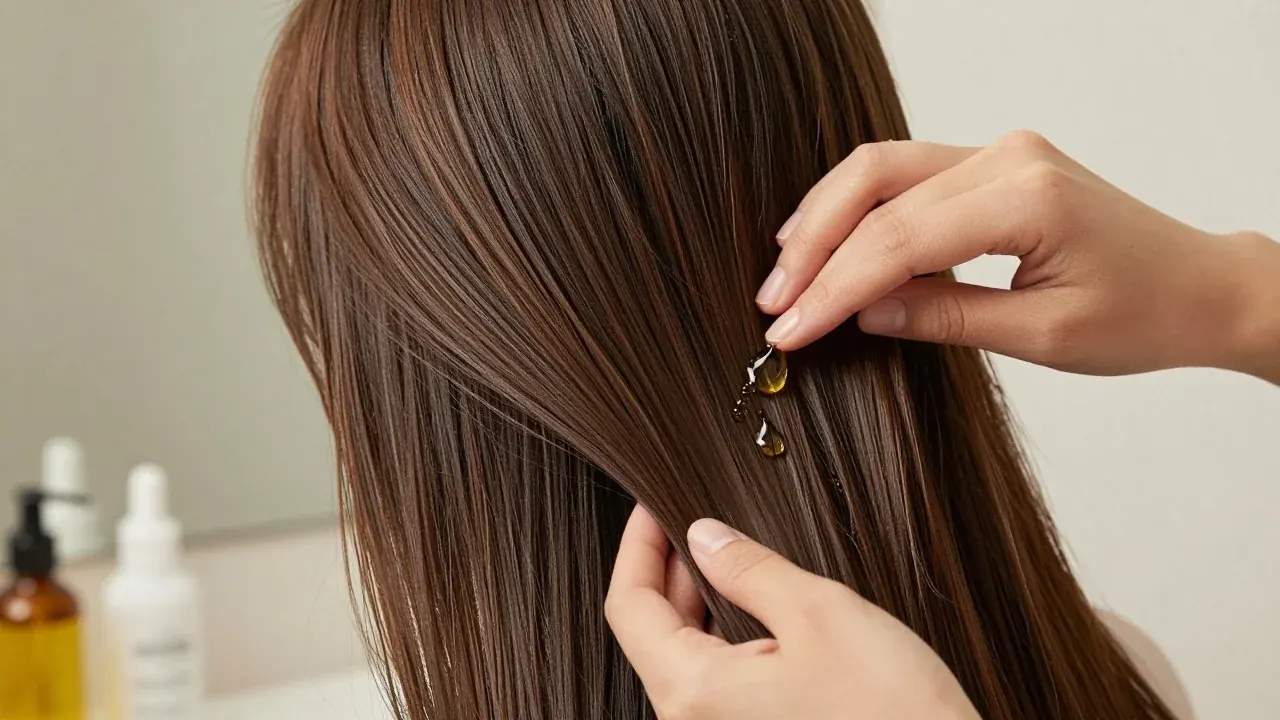
The right hair oil can soften rough ends, increase shine, reduce friction, and make frizz easier to control. The wrong formula can leave fine strands flat or make roots look greasy. The key is matching the oil type and application method to your hair’s needs. We cover this in more depth in How to Choose the Right Warm Brunette Blend for Your Hair.
Choose a lightweight finishing oil, such as jojoba or argan, if your goal is shine with minimal weight. Choose coconut oil as a pre-wash treatment for dry or damaged lengths. Thick castor oil blends suit coarse ends better than fine strands. For scalp-focused formulas, use a properly formulated product and follow the label directions.
| Oil type | Good fit for | Typical use | Main advantage | Watch out for |
| Coconut | Dry, porous, damaged hair | Pre-wash on lengths | Strong evidence for reducing protein loss | Can weigh down fine strands |
| Argan | Dull, frizzy, medium-to-thick hair | Damp or dry ends | Smooth finish and shine | Too much can look oily |
| Jojoba | Fine to normal hair | Small finishing amount | Lighter feel than richer oils | Not proven to repair damage |
| Castor | Coarse or very dry ends | Usually in a blend | Thick coating and added luster | Heavy and harder to wash out |
| Rosemary scalp blend | People interested in scalp-focused care | Use as directed | Limited human evidence for androgenetic hair loss | May irritate sensitive scalps |
| Silicone-oil blend | Frizz, shine, styling | Damp or dry lengths | Fast slip and polished finish | Buildup can occur over time |
Verdict: Coconut oil is the strongest starting point when damaged lengths are the main concern because it has direct hair-fibre research behind it. For everyday shine and frizz control, a lighter argan, jojoba, or formulated finishing product is easier to manage. Rosemary oil calls for more caution because the evidence supporting hair growth is still limited.
What Oils Actually Do to Your Hair
Oils mainly work on the hair fibre by improving lubrication, reducing friction, and limiting some forms of moisture-related swelling. A review of hair cosmetics notes that certain oils can enter the fibre and help reduce damage caused by repeated swelling and drying.
Coconut oil has unusually strong evidence in this area. A published study comparing coconut, sunflower, and mineral oils found that coconut oil reduced protein loss in both damaged and undamaged strands. Researchers linked that effect to its lauric-acid-rich structure and its ability to penetrate the hair shaft.
That does not mean every bottle marketed as an oil works the same way. Cosmetic chemists note that many commercial products contain silicones and hydrocarbons alongside, or instead of, large amounts of plant oils. These formulas are often designed to improve slip, shine, and frizz control.
How to Choose Hair Oil by Hair Type and Goal
Fine or straight strands usually need the lightest approach. Start with a single drop of jojoba, argan, or a light finishing blend. Concentrate it below ear level rather than coating the roots.
This also matters when styling fine front sections. Stylevanta’s widow’s peak styling guide notes that lighter styling products can work better on fine hair because heavy formulas may separate the strands.
Thick, coarse, curly, or very dry hair can usually tolerate richer formulas. Coconut oil works well as a pre-wash option, while argan oil can be used sparingly after styling. Castor oil is much thicker, so it often makes more sense as part of a blend.
Chemically treated or repeatedly heat-styled lengths need protection from further friction. A pre-wash coconut oil treatment is a practical choice because its ability to reduce protein loss has been studied directly. Oil can improve softness and appearance, but it cannot permanently repair a split hair fibre.
If your scalp becomes oily easily, keep ordinary finishing formulas away from the roots. Cleveland Clinic also advises caution with scalp oiling for people who are prone to dandruff.
How to Use Oil Without Making Your Hair Greasy
Most greasy results come from using more product than the strands can absorb comfortably. Current professional guidance consistently recommends starting with a small amount and adding more only when needed.
- Start with one to three drops. Fine or short hair may need only one.
- Spread it across both palms. This prevents one section from receiving the entire dose.
- Apply from mid-lengths to ends. Keep ordinary finishing formulas away from the scalp.
- Choose the timing based on your goal. Use richer natural oils before shampooing or a small amount after washing for shine.
- Add more only if needed. Waiting a minute makes it easier to judge whether your ends need another drop.
L’Oréal Professionnel recommends starting with two or three drops and generally applying the product from the mid-lengths downward. Its current guide distinguishes between pre-shampoo treatments and leave-in finishing applications.
Before Washing, on Damp Hair, or on Dry Hair?
A pre-wash treatment makes sense for dry or damaged lengths. Apply the product before shampooing and give it time to coat the hair fibre. Cleveland Clinic suggests using a small amount on the ends for roughly 20 minutes to an hour before washing.
Applying oil to damp hair is useful when you want added softness as your hair dries. Use a small amount after washing, then distribute it through the lower lengths.
Applying oil to dry hair is mainly a finishing step. One or two drops can tame flyaways and restore shine after blow-drying or between washes. Current salon guidance supports both damp and dry application, depending on the desired result.
Can Oils Make Hair Grow Faster?
This is where beauty marketing often gets ahead of the evidence.
Rosemary oil has some human data behind it. A randomized 2015 trial assigned 100 people with androgenetic alopecia to either rosemary oil or 2% minoxidil. Neither group showed a significant increase in hair count after three months. Both groups showed improvement from baseline after six months.
That single study is interesting, but it is not enough to treat rosemary oil as a proven replacement for established hair-loss treatments. Newer reviews still call for more research on natural treatments.
Castor oil has even weaker clinical evidence for regrowth. A 2026 dermatology review found evidence for improved luster and identified possible biological mechanisms, but it also stressed that clinical application remains uncertain.
If shedding becomes sudden, patchy, painful, or accompanied by scalp irritation, a styling product should not be your only response. Seek medical assessment when rapid changes or obvious thinning appear.
Natural Oil vs. Hair Serum: Read the Ingredient List
The front of the bottle does not always tell you what is inside.
A pure coconut or argan oil product consists mainly of plant-derived lipids. A cosmetic finishing serum may combine smaller amounts of oils with silicones or other smoothing ingredients. Many products sold under an “oil” name fall into the second category.
Neither format is automatically better. Choose according to the job you want the product to do. Natural oils make sense for pre-wash conditioning, while lightweight blends can be easier to use for daily frizz control and shine.
If you regularly use styling products, clarifying or thorough shampooing can help prevent buildup. Allure’s cosmetic-chemist guidance also notes that repeated silicone use can weigh strands down if residue is allowed to accumulate.
For more hair-care and styling coverage, readers can browse Sophie Palmer’s hair guides. StyleVanta’s editorial focus includes hair care, hairstyles, styling ideas, and beauty trends.
Build a Routine That Fits Your Hair
Start with one problem, not a crowded shelf. Choose dryness, frizz, dullness, breakage, or scalp care as your main goal. Then select the lightest formula that does the job and adjust from there.
Your texture, density, styling habits, and scalp condition matter more than a viral ingredient. Choose the lightest formula that meets your main need, then adjust gradually.
Frequently Asked Questions
Can hair oil help with hair growth?
Most oils have stronger support for conditioning, improving shine, and reducing breakage than for stimulating new growth. Rosemary oil has limited human trial evidence, but one small study is not enough to guarantee regrowth. Persistent or unexplained hair loss deserves medical assessment.
Should I apply oil before or after washing?
Use a richer natural formula before shampooing when you want a conditioning treatment. Use a small amount on damp or dry ends after washing when your goal is softness, shine, or frizz control.
How often should I oil my hair?
There is no universal schedule. Lightweight finishing products may suit frequent use in tiny amounts. Heavier pre-wash treatments are commonly limited to once or twice a week. Adjust the frequency if your strands become flat or coated.
Which oil works well for dry or damaged hair?
Coconut oil has the clearest direct evidence for reducing hair-fibre protein loss. It is especially useful as a pre-wash treatment for dry or damaged lengths. Argan oil can provide a lighter finishing option when shine and frizz control are the main concerns.
Is oil suitable for fine hair?
Yes, but the amount matters more. Start with one drop of a light formula and keep it on the lower lengths. Fine strands are more likely to look flat when coated with concentrated natural oils.