


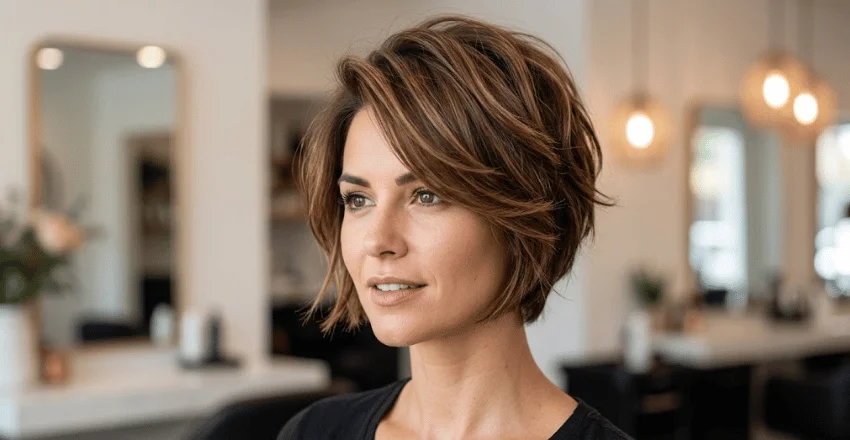
A pixie bob haircut gives you the short, light feel of a pixie without losing all the softness and styling freedom of a bob. Also called a bixie, it works especially well when the length, fringe, layers, and nape are adapted to your hair.
A bixie blends the cropped shape of a pixie with the softer length and layering of a bob. It usually sits between the ears and upper neck, with extra length through the top or front. The right version depends on your hair density, texture, face shape, and styling routine.
| Quick fact | What to know |
| Other name | Bixie |
| Typical length | Around the ears to the upper neck |
| Key features | Shorter back, longer top or front, layered shape |
| Hair textures | Straight, wavy, curly, fine, or thick when customized |
| Daily styling | Often light product, air-drying, diffusing, or a short blow-dry |
| Trim schedule | Roughly every 4- 8 weeks, depending on how precise the cut is |
| Grow-out | Usually transitions naturally toward a short bob |
What Makes a Bixie Different From a Pixie or Bob?
A classic pixie typically sits close to the head, exposing more of the ears and neckline. A bob keeps more weight around the jaw or chin.
The bixie occupies the space between them. It maintains sufficient length for movement while eliminating the weight of a traditional bob.
That middle ground is one reason the style has returned to fashion. Vogue highlighted the bixie as a major short-hair trend in summer 2026 and noted its late-1990s influence. The publication also described current versions as adaptable and intentionally relaxed rather than heavily styled.
The cut can also be changed without losing its identity. A stylist might keep a fuller front, taper the nape, add airy layers, create a fringe, or leave more length around the ears.
9 Bixie Styles Worth Considering in 2026
1. Soft Layered Bixie
Soft layers create movement without making the shape look choppy. This option suits anyone who wants a gentle transition from longer hair.
Keep more weight around the perimeter if your strands are fine. Too much thinning can make the ends appear sparse.
2. Side-Swept Bixie
A deep or soft side part brings attention to the eyes and cheekbones. A longer fringe also gives you more styling options.
This shape can work well if you want to soften a prominent forehead or change the visual width of your face.
3. Long Bixie
Nervous about going short? Keep the front near the jaw and leave extra length around the ears.
You can tuck the sides back, switch your part, or add a loose bend. The extra length also gives you an easier route back to a bob.
4. Shaggy Bixie
A shaggy version uses loose, broken-up layers for a relaxed finish. Natural waves make this shape especially easy to wear.
Ask your stylist to preserve enough weight at the ends. The goal is movement, not thin or wispy-looking hair.
5. Stacked Bixie
Graduation at the back builds a rounder silhouette and adds crown volume. It can help straight or slightly wavy hair hold a defined shape.
A sharply stacked cut requires more salon upkeep because growth can quickly change the outline.
6. Curly Bixie
Curls give this short shape natural volume and movement. Longer front sections can frame the face, while a shaped nape keeps the cut controlled.
Your stylist should account for how much your curls shrink as they dry. Styling may be as simple as applying curl product and using a diffuser.
7. Asymmetrical Bixie
An asymmetrical shape keeps one side or the fringe longer. The diagonal line makes the haircut feel sharper without requiring an undercut.
It is also useful if you prefer a strong side part rather than a symmetrical shape.
8. Tapered Bixie
A closely shaped nape gives the haircut a clean outline while leaving softness through the crown and front.
This version can feel polished with minimal daily styling, but the neckline will show signs of growth sooner than a longer shape.
9. Bixie With Wispy Bangs
Light bangs soften the transition between the forehead and short layers. They work especially well with fine, straight, or softly wavy hair.
If your hairline has a strong natural growth pattern, discuss it with your stylist before cutting a fringe. StyleVanta’s guide to working with a widow’s peak and front hairline explains why the direction of growth matters when choosing bangs and parts.
How to Choose a Pixie Bob Haircut for Your Face and Hair
There isn’t one correct shape for each face. Instead, think about where you want length, volume, and movement.
| Feature | A useful starting point |
| Round face | Crown lift, side part, or slightly longer front pieces |
| Square face | Softer layers, movement, or side-swept fringe |
| Heart-shaped face | Wispy fringe or balanced volume near the jaw |
| Oval face | Most variations can be adjusted easily |
| Fine hair | Keep perimeter weight and use controlled crown layering |
| Thick hair | Remove internal bulk while preserving the outer shape |
| Wavy hair | Use layers that support the natural bend |
| Curly hair | Plan length around shrinkage and curl pattern |
Expert hairstyle sources make the same broader point: this cut works because its front length, layering, and volume can be adjusted rather than copied exactly from one photograph.
A useful StyleVanta rule is to choose three controls before your appointment: front length, crown volume, and nape length. Those choices often matter more than the name of the haircut.
What to Tell Your Hairstylist
Don’t stop at saying, “I want a bixie.” Two people can use that term and picture different cuts.
Bring photographs that show hair with a texture and density similar to yours. Then explain what you like about each image.
Tell your stylist:
- how short you’re comfortable going at the nape;
- where you want the longest front pieces to fall;
- whether you want your ears exposed or partly covered;
- how much crown volume you prefer;
- whether you want bangs or a longer side fringe; and
- how many minutes you want to spend styling your hair each morning.
Hair.com also recommends bringing reference photos and letting the stylist adapt them to your texture and facial proportions.
How to Style It at Home
Start with damp hair and use the lightest product that gives your texture enough control.
For fine hair, try a lightweight mousse or root-support product. Blow-dry the crown upward with your fingers or a small brush. Avoid coating the ends with heavy oils.
For waves or curls, apply a suitable styling cream and air-dry or diffuse your hair. Touch your hair as little as possible while it sets if you want stronger definition.
For a sleek finish, direct the front pieces into place as they dry. Add a small amount of styling cream after your hair is dry.
Current 2026 trend coverage also points toward softer, less overworked short hair. Vogue notes that some current bixie wearers air-dry the cut and rely on the haircut itself to create much of the shape.
Is It Really Low Maintenance?
Daily styling can be simple. Salon upkeep is the part people often underestimate.
A soft, longer version may remain wearable for six to eight weeks. A precise taper, fringe, or sculpted neckline can need attention sooner. Hairstyle guides suggest schedules ranging from about 3 to 8 weeks, depending on the cut’s structure.
Ask your stylist which part will lose its shape first. A small fringe or neckline tidy-up may help you extend the time between full appointments.
The grow-out is generally easier than that of an ultra-short crop because there is already some length around the top and front. As the nape grows, the silhouette gradually moves toward a short bob.
Before You Make the Chop
Save two or three reference images rather than relying on one perfect photograph. Choose images that show the front, side, and back.
Then compare them with your natural texture and normal routine. A haircut that looks good after a salon blowout may not suit someone who wants to air-dry their hair every morning.
You can also browse Sophie Palmer’s StyleVanta hair coverage for related styling guidance, or return to the StyleVanta fashion and personal-style hub for new guides.
The strongest bixie is not the one copied most precisely from a trend photo. It is the version shaped around your hair and the amount of upkeep you are willing to give it.
Frequently Asked Questions
Is a pixie bob haircut low maintenance?
It can require little daily styling when the shape suits your natural texture. Salon maintenance is less hands-off. Expect reshaping roughly every four to eight weeks, with precise napes or fringes often needing attention sooner.
Is a bixie the same as a pixie bob?
Yes. “Bixie” is a common name for a haircut that combines elements of a pixie and a bob. Exact length and layering vary by stylist and wearer.
Does a bixie work for fine hair?
Yes. Fine hair can benefit from a shorter length and carefully placed crown layers. Avoid excessive thinning, since removing too much perimeter weight can make the ends look sparse.
Can you wear the cut with curly hair?
Yes. The shape can work with curls when the stylist accounts for shrinkage, density, and the natural curl placement. A diffuser or air-drying routine can help preserve the texture.
Does a bixie suit a round face?
It can. Crown height, a side part, and longer front pieces can alter the haircut’s proportions. The goal is to customize the outline rather than avoid the style because of your face shape.
How often should you trim a bixie?
A practical range is about four to eight weeks. Softer, longer cuts usually tolerate growth better than sharply tapered or highly structured versions.