

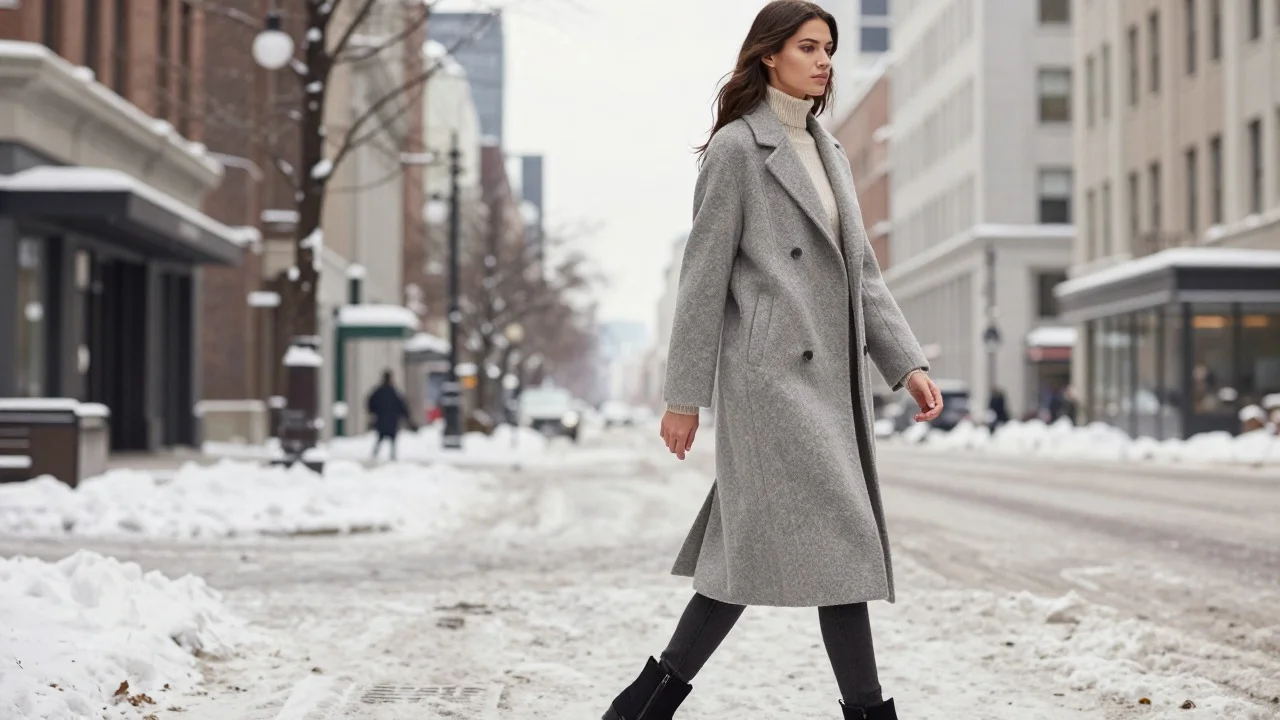
A wool coat can be one of the hardest-working pieces in a Canadian cold-weather wardrobe, but the fibre name alone does not tell you whether a coat will be warm, durable, or comfortable. Start with the composition label, then judge fabric density, lining, closures, length, fit, and room for layers. The right choice should suit the weather you face and the clothes you already wear.
For most Canadian shoppers, choose a lined, knee-length or mid-thigh coat with enough room for a sweater, a clearly stated fibre composition, and dense fabric that holds its shape. Prioritize fit and coverage before colour. For prolonged deep cold, wind, or wet weather, compare an insulated puffer instead.
| What to check | Practical starting point | Why it matters |
|---|---|---|
| Fibre content | Read the percentages, not only the product name | Wool and blends can perform differently |
| Fabric | Dense, stable, substantial enough for your climate | Construction affects warmth and shape |
| Length | Mid-thigh to knee for broad everyday use | More coverage can help in cold wind |
| Fit | Room for your normal winter layers | Prevents pulling and restricted movement |
| Lining | Smooth, secure, suitable for the intended season | Helps layering and comfort |
| Closure | Buttons, belt, zipper, or storm details that close well | Open fronts lose more protection |
| Colour | A neutral that works with your existing wardrobe | Makes repeat wear easier |
| Care | Read the care label before buying | Maintenance varies by construction |
This guide is based on current Canadian retail options, Canadian textile-labelling requirements, specialist fibre guidance, and the outerwear questions appearing repeatedly in current search results. The goal is to help you judge a garment before paying for it, rather than rank brands by price or reputation alone. That approach is especially useful online, where photographs can hide differences in fabric weight, lining, and construction.
Why Wool Works So Well for Cold-Weather Dressing

Wool fibres have a natural crimp that creates small air spaces, helping fabric insulate while managing moisture vapour. Woolmark also describes wool as naturally breathable, temperature regulating, elastic, and resistant to odour. Those properties help explain why wool remains common in tailored winter outerwear even as synthetic insulation has become widely available.
Still, fibre performance does not make every wool garment equally warm. A lightly constructed unlined style can feel much cooler than a dense, lined overcoat with a secure closure and greater body coverage. Canadian shoppers should judge the finished garment rather than assume the material name guarantees protection in every winter condition.
Canada also requires useful fibre information on consumer textiles. The Competition Bureau states that fibres representing at least five per cent of total fibre mass generally need their generic name and percentage shown on the label. That makes the composition tag one of the most useful factual checks you can make before comparing two similar-looking coats.
How to Choose a Wool Coat for Canadian Weather
Choosing well becomes easier when you evaluate the garment in a fixed order. Start with function before colour or trend details, because appearance cannot compensate for a coat that is too light, too tight, or inconvenient to maintain. Use these seven checks in a store or while comparing product pages online.
- Read the fibre label. Note the exact percentages of wool, polyester, nylon, cashmere, alpaca, or other fibres rather than relying on a broad marketing description.
- Check fabric density and structure. Look for fabric that feels stable and substantial enough for the season you expect to wear it.
- Inspect the lining and construction. Check seams, buttons, pockets, vents, hems, and the way the garment hangs when fastened.
- Choose enough coverage. Mid-thigh and knee-length designs are versatile, while longer cuts protect more of the legs in cold wind.
- Test your real layers. Wear or bring a typical sweater so you can judge the shoulders, chest, sleeves, and armholes realistically.
- Match closures to your routine. A coat that buttons or belts securely usually offers more protection than an open-front style.
- Read the care instructions. Make sure the cleaning and storage requirements fit the amount of maintenance you are willing to do.
These checks matter even more when you shop online because you cannot feel weight or density through a screen. Look for garment measurements, fibre percentages, lining information, close-up fabric images, model measurements, care instructions, and a clear return policy. Missing specifications should be treated as uncertainty rather than automatically interpreted as premium quality.
Pure Wool vs. Wool Blends: Which Should You Buy?
A higher wool percentage can be useful, but there is no universal percentage that makes every garment good. Two coats with the same fibre content can differ in fabric density, weave, finishing, lining, pattern cutting, and seam construction. A well-made blend may suit hard daily use better than a delicate pure-fibre design.
| Material approach | Main advantage | Trade-off | Good fit for |
|---|---|---|---|
| 100% wool | Natural insulation and classic structure | Can cost more and require careful maintenance | Shoppers prioritizing natural fibre |
| Wool-rich blend | Balances wool with durability or lower cost | Performance depends on the blend and construction | Frequent everyday wear |
| Wool-cashmere blend | Softer hand and refined feel | Often more expensive | Workwear and polished wardrobes |
| Wool-alpaca blend | Warm feel with distinctive texture | Texture and care vary by garment | Shoppers wanting softness and warmth |
| Synthetic-heavy blend | Often lower priced and easier to find | May provide less of wool’s characteristic feel | Budget-led or occasional wear |
Verdict: start with the finished garment, then use composition to understand what you are buying. A clear fibre label, dense fabric, strong construction, useful lining, good fit, and appropriate length matter more than chasing one percentage. This also keeps you from paying more for a fibre claim that does not improve the coat for your routine.
Compare the Main Coat Styles Before Buying
Silhouette changes warmth, movement, layering space, and how easily outerwear crosses between work and casual clothing. Current Canadian and international collections include tailored overcoats, longline styles, pea coats, wrap coats, and relaxed double-breasted designs. Choose the shape according to how you expect to use it most often.
| Style | Strengths | Trade-offs | Best suited to |
|---|---|---|---|
| Tailored overcoat | Clean, polished, easy over workwear | Close cuts need careful layering fit | Office, dinners, daily commuting |
| Longline coat | More leg coverage and strong visual line | Can feel bulky in cars or on petite frames | Walking, dresses, colder days |
| Pea coat | Compact, structured, easy to move in | Less lower-body coverage | Driving, casual wear, milder cold |
| Belted or wrap coat | Adjustable shape and softer silhouette | Open necklines can admit more cold air | Flexible styling and dressier outfits |
| Relaxed double-breasted coat | Good layering room and secure front | Extra volume may overwhelm some frames | Sweaters, workwear, mixed wardrobes |
A tailored mid-thigh or knee-length option is the most flexible starting point for many Canadian wardrobes. A longer design makes sense if you walk or use transit frequently and value added leg coverage. A shorter pea coat works better when movement, driving, and easy everyday styling matter more than maximum protection.
Get the Fit Right With Your Winter Layers
Outerwear should be assessed over the clothing you intend to wear, not over a thin fitting-room top. Fasten the coat over a sweater, reach forward, raise your arms, sit down, and check whether the shoulders or chest pull. You need movement without so much extra space that the garment loses its intended shape.
Sleeve length should cover the wrist comfortably, while the shoulder line should follow the intended cut of the design. Oversized styles may deliberately drop below the natural shoulder, so do not apply tailored-coat rules to every silhouette. For online purchases, compare your measurements with the retailer’s chart and use actual garment measurements whenever they are provided.
Layering can improve warmth without forcing you into an excessively bulky coat. A fine insulating knit is especially useful under structured outerwear because it adds warmth while preserving movement. StyleVanta’s cashmere sweater buying guide explains how fibre content, knit density, fit, and care affect a winter layer.
When a Puffer or Trench Makes More Sense
Wool outerwear is not the automatic answer for every Canadian weather condition. Wool itself is not waterproof, and severe wind, prolonged sub-zero exposure, freezing rain, or heavy wet snow may call for a coat designed specifically around insulation and weather protection. Woolmark describes the fibre as naturally water resistant rather than waterproof, which is an important distinction when choosing an outer layer.
If deep-winter protection matters more than tailoring, compare StyleVanta’s guide to insulated puffers before buying. For mild rain, spring, and transitional fall weather, a lighter outer layer may be more practical, and StyleVanta’s trench coat guide for Canadian weather covers those conditions in more detail.
What Should You Expect to Pay in Canada?
Current Canadian-market listings show a broad price range rather than one standard cost. COS Canada currently lists wool and wool-blend outerwear from roughly the high-CA$100s into the CA$400s, while designer listings on NET-A-PORTER Canada extend into several thousand dollars. Canadian Living’s 2026 winter edit also shows examples around CA$228, CA$398, and CA$560, illustrating how quickly prices can spread across brands and materials.
Price alone cannot tell you which garment offers better value. Compare composition, density, lining, seams, hardware, fit, care, return terms, and how often you expect to wear it. A moderately priced coat that works for your commute five days a week can offer better practical value than an expensive piece that rarely leaves your closet.
Style Wool Outerwear Without Rebuilding Your Wardrobe
Start with the clothes and footwear you already repeat through fall and winter. Camel, charcoal, black, navy, chocolate, and grey work easily with many Canadian wardrobes, while a statement shade makes more sense when the rest of your clothing is already neutral. Before buying, picture the coat with at least three outfits you wear regularly.
For a simple cold-weather formula, combine a fine knit, straight or wide-leg trousers, and weather-appropriate boots. StyleVanta’s guide to Chelsea boots for Canadian wardrobes can help you compare proportions, materials, and practical footwear considerations. You can also use the site’s broader fall clothing guide for Canada to build layers that carry into the first colder weeks of the season.
Accessories can change the mood without forcing the outer layer to do all the styling work. A scarf can add colour, while a structured bag makes a relaxed coat feel sharper. If your outerwear already has a dramatic collar, belt, print, or oversized shape, simpler accessories usually keep the outfit easier to repeat.
Care for Wool So It Keeps Its Shape
Always start with the garment’s own care label because construction and finishing affect what cleaning method is safe. Woolmark recommends brushing woven garments lengthwise with a soft garment brush, airing them between wears, and hanging woven pieces on shaped or padded hangers. If the garment becomes wet, dry it at room temperature away from direct heat or strong sunlight.
Empty pockets before storage so weight does not distort the fabric, and fasten closures to help the garment keep its intended shape. Give the coat space in the closet rather than crushing it between heavier pieces. Follow the care label for washing or professional cleaning instead of assuming every wool garment requires the same treatment.
The Verdict: Choose the Coat That Matches Your Real Winter
If you are buying one wool coat, start with a versatile mid-thigh or knee-length design that closes securely and fits over a normal sweater. Look for a clear fibre label, stable fabric, sound construction, and a colour that already works with your boots, trousers, knitwear, and bags. That combination gives you a stronger basis for repeat wear than choosing by brand or fibre percentage alone.
Think about the weather you face most often before paying. City commuting, driving, office wear, mild coastal conditions, and prolonged outdoor exposure create different priorities. The strongest purchase is the one that fits your climate, routine, wardrobe, maintenance habits, and budget at the same time.
Build a Winter Wardrobe You Will Use
Choose outerwear as part of a system rather than as an isolated purchase. Start with the weather, add the layers and footwear you already depend on, then select a coat that works with those pieces comfortably. Browse StyleVanta’s cold-weather fashion guides next if you want to compare knitwear, puffers, transitional coats, boots, and seasonal outfit ideas before you buy.
Frequently Asked Questions
Is a wool coat warm enough for a Canadian winter?
It can be warm enough for many fall and winter situations, especially when the fabric is dense, the garment is lined, and the length provides useful coverage. Your layers, wind exposure, local temperature, and time outdoors also affect comfort. For prolonged deep cold or severe wet weather, an insulated and weather-protective winter coat may be the safer choice.
Is 100% wool always better than a blend?
No, because fibre percentage does not measure every part of garment quality. A blend can add durability, alter the feel, reduce cost, or change how the fabric holds its shape. Compare composition together with density, lining, construction, fit, care requirements, and intended use.
What percentage of wool should I look for?
There is no single percentage that guarantees warmth or quality. A higher proportion gives you more of the natural fibre’s characteristics, but a well-made blend can still be practical for regular wear. Read the entire composition and judge the finished garment rather than rejecting or buying it based on one number.
Should I size up for sweaters?
Do not size up automatically, because many coats already include the ease needed for layers. Try your usual size over the thickest knit you normally expect to wear, then check movement through the shoulders, chest, sleeves, and armholes. Move up only when the intended fit becomes restrictive.
Can wool handle snow and rain?
Wool can manage some moisture and is naturally water resistant, but it is not waterproof. Light snow or brief damp conditions are different from prolonged rain, freezing rain, or wet snowfall. Check the finished garment’s fabric treatment and manufacturer guidance when weather protection is a major buying priority.

