

This guide is general information, not medical advice. Follow the product’s allergy-test directions, and stop and seek medical advice if you develop burning, swelling or a rash.
If you’re choosing blue hair dye in Canada, start with your current hair colour, the shade of blue you want, and how much maintenance you can handle. Deep navy can create a subtle tint on darker bases, while cobalt, turquoise, and pastel shades usually need lighter hair for a clear, vivid result.
The formula matters too. Semi-permanent colour offers more flexibility, while permanent colour requires a greater commitment. Your starting base often has more influence on the final result than the shade shown on the box.
| Quick fact | What to know |
|---|---|
| Easiest blue for darker hair | Navy, midnight blue, blue-black |
| Brightest result | Usually achieved on pre-lightened hair |
| Lower-commitment option | Semi-permanent direct colour |
| Highest-maintenance shades | Pastel blue and pale aqua |
| Common fade direction | Blue may become softer, teal, greenish, or smoky depending on the base |
| Canadian safety step | Follow the label and complete the recommended patch test |
How to Choose Blue Hair Dye for Your Starting Colour
The first question isn’t which brand to buy. It’s how light your hair is before the colour goes on.
Bright blue pigment shows most clearly when the underlying hair is light enough to provide a clean background. A pale blonde base can display cobalt, aqua, turquoise, and pastel tones with much more clarity.
Dark brunette or black hair behaves differently. A deep navy formula may create a cool blue undertone, especially in strong light, but it usually won’t resemble a bright blue product swatch.
StyleVanta’s guide to choosing hair colour for different undertones and starting bases explains the same principle with other colour families: your natural depth, undertone, condition, and desired contrast all affect the result.
Dark brown or black hair
Choose navy, midnight, indigo, or blue-black if you don’t want major lightening. These shades can add a cool cast rather than an electric finish.
If you want royal blue, turquoise, or another bright tone, your hair may need to be lightened first. Previously coloured hair can be harder to lift evenly, so a professional assessment can be useful before a dramatic change.
Medium brown or dark blonde hair
You have more flexibility, especially with deeper saturated blues. The colour may still look muted compared with a light-blonde base.
A hidden panel is one way to try a vivid shade without colouring your full head. StyleVanta’s peekaboo hair guide includes electric blue under black hair and teal under dark hair as placement ideas.
Light blonde or pre-lightened hair
A light base gives you the widest range of options. Cobalt, royal blue, aqua, turquoise, denim, and pastel shades can all appear more clearly.
Your undertone still matters. Yellow warmth in the hair can change how a cool blue pigment looks as it fades. A strand test gives you a better preview before you commit to the full application.
Compare Blue Shades Before You Buy
“Blue” covers a large range of tones. Choosing the right family first can save you from buying a shade that doesn’t match your goal.
| Shade family | Typical effect | Starting base | Upkeep |
|---|---|---|---|
| Midnight or navy | Deep, subtle blue | Dark blonde to brunette | Moderate |
| Royal or cobalt | Strong, saturated blue | Light to medium blonde | Moderate to high |
| Denim blue | Softer, muted finish | Blonde or lightened | Moderate |
| Turquoise or aqua | Bright blue-green | Light blonde | High |
| Pastel blue | Pale, soft finish | Very light blonde | High |
| Blue-black | Mostly dark with blue reflection | Brunette to black | Lower |
If you want bold contrast without colouring every strand, consider colour blocking. StyleVanta’s skunk hair guide covers blue panels as well as classic black-and-platinum combinations.
A gradient is another option. The site’s ombré hair guide explains how a darker base can transition into lighter or bolder ends instead of using one shade from root to tip.
Semi-Permanent vs Permanent Blue Colour
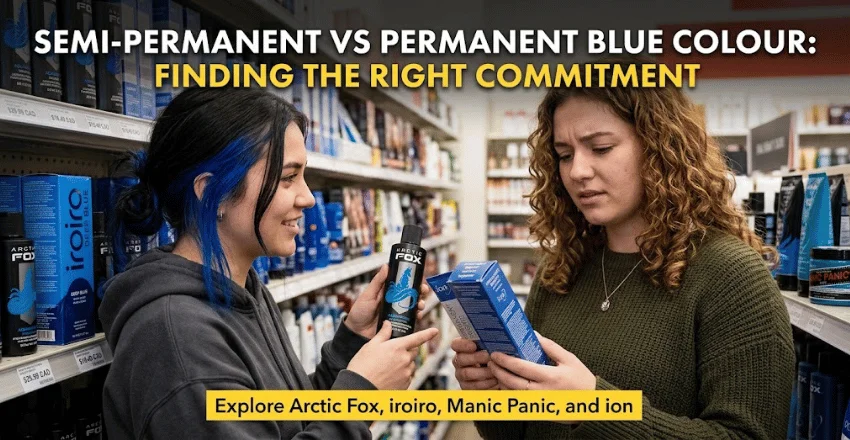
For most people experimenting with vivid colour, semi-permanent formulas offer a simpler starting point. They deposit pigment without creating the same commitment as permanent oxidative colour.
Current listings from Sally Beauty Canada show several semi-permanent blue options. Arctic Fox Aquamarine and Poseidon are listed at $29.99 CAD, while iroiro Deep Blue is listed at $19.49 CAD. Manic Panic Atomic Turquoise is also listed at $19.99 CAD. Prices and stock can change.
Permanent vivid colour is also available. Sally Beauty Canada currently lists ion Permanent Brights Sapphire at $15.19 CAD. Permanent colour should be approached differently, as the formula and any future colour correction may require more commitment.
Quick verdict
Choose semi-permanent colour if you’re experimenting with vivid shades, changing colours often, or want more flexibility.
Consider permanent colour when you’re comfortable with a longer-term result and understand how it may affect your next colour change.
Your hair history matters more than the label category alone. Bleached, porous, or previously coloured sections can absorb and release pigment differently.
Will You Need to Bleach Your Hair First?
Not always.
Deep blue can add a visible cool tone to some brunette hair without lifting it to blonde. The result is usually darker and subtler than the photos that show vivid colour on light hair.
Pastel, turquoise, bright cobalt, and electric shades normally need a significantly lighter base to appear clean and bright. The exact amount of lightening depends on your starting level and the target shade.
Don’t keep lightening fragile hair simply to reach a colour swatch. If your hair feels weak, stretches when wet, or has undergone repeated chemical processing, ask a qualified colourist to assess it first.
How to Help Blue Colour Last Longer
Vivid pigment fades with washing, heat, sun exposure, and normal wear. You can’t stop fading, but you can make your routine less aggressive.
Wash your hair only as often as your scalp and lifestyle require. Cooler or lukewarm water is usually kinder to vivid colour than repeated hot washing.
Choose cleansing products designed for colour-treated hair. Strong or frequent clarifying washes can remove deposited pigment more quickly.
Keep high-temperature styling to a sensible minimum. If you use hot tools, follow the instructions for your heat-protectant product.
You should also expect some transfer from strong pigments, especially soon after colouring. Protect pale towels, pillowcases, clothing, bathroom grout, and other porous surfaces during the first washes.
Think About Placement, Not Only Colour
You don’t have to colour your entire head to wear a bold shade.
A narrow panel behind the ear can give you a small flash of colour. A nape section stays hidden until you tie your hair up. A larger underlayer creates stronger contrast while keeping the crown closer to your natural shade.
For a bolder result, use face-framing pieces or distinct colour blocks. These placements put the vivid tone where it will be noticed without requiring full-head maintenance.
Placement can also reduce the amount of hair that needs to be lightened. That can be useful if you like bright colour but don’t want to process every section.
At-Home Hair Colour Safety in Canada
Health Canada says permanent and semi-permanent hair-colour labels must carry specific warnings where applicable and include directions for preliminary skin-irritation testing. It advises repeating the recommended patch test before each use because sensitivity can develop over time.
Follow the directions supplied with your specific product rather than mixing formulas or changing processing times yourself.
Don’t use standard hair-colour products on eyelashes or eyebrows. Health Canada specifically warns against this use.
If you experience redness, burning, itching, blistering, or any other significant reaction during the recommended sensitivity test or when using the product, stop using the product and seek appropriate medical advice.
What Should You Choose?
Start with the result you want to see under normal, everyday light.
For dark hair with minimal lightening, midnight blue or blue-black is the practical choice. For a classic vivid result, look at royal or cobalt tones on a lighter base. Choose turquoise for a brighter blue-green finish.
Pastel blue makes more sense when your hair is already pale, and you’re comfortable with frequent upkeep.
If you’re unsure about committing to a full head, start with a hidden panel, ends, or another smaller placement. You’ll learn how the colour looks on your base and how quickly it fades, so you can decide whether to take on more maintenance.
Your Next Step
Choose your shade family, starting-base strategy, and placement before choosing a product. That order makes it easier to predict what you’ll get and how much upkeep the look will require.
For a lower-commitment change, try a hidden blue section or darker navy tone. If your goal is a bright cobalt, aqua, or pastel finish, first assess whether your hair is light and healthy enough. When major lifting is needed, a professional colour consultation can help you plan the change with fewer surprises.
Frequently Asked Questions
Does blue hair dye work on dark hair?
Yes, but the result depends on the shade and your starting colour. Navy, indigo, and blue-black may create a visible tint on brunette hair. Bright cobalt, turquoise, and pastel shades usually need a lighter base for a vivid finish.
How long does blue colour last?
There isn’t one fixed timeline. Formula, porosity, washing frequency, water temperature, heat styling, and the starting base all affect fading. Semi-permanent colour is designed to fade gradually rather than remain permanently unchanged.
Does blue always fade to green?
No. The fade depends on both the pigment blend and the colour underneath it. Yellow warmth in lightened hair can make some blue shades appear greener as the pigment becomes less intense.
What blue shade is easiest to maintain?
Deeper shades such as navy and denim tend to look intentional through a wider range of fading stages. Pale blue and aqua can require more frequent refreshing because small colour changes are easier to notice.
Can I put blue over orange or yellow hair?
You can apply it, but the underlying warmth may alter the finished tone. Strong yellow can push some blues toward green, while orange can make a clean cool result harder to achieve. A strand test can show what your specific combination will do.
Should I use a salon or colour my hair at home?
At-home colour can suit a straightforward pigment refresh on healthy hair when you follow the product directions. A salon is worth considering when major lightening, colour correction, banding, previous box dye, or significant damage is involved.