
This guide is general information, not medical advice. Follow the product’s allergy-test directions, and stop and seek medical advice if you develop burning, swelling or a rash.
Going lighter can give you a dramatic colour change, but the wrong product or timing can leave hair dry and fragile. Your starting colour, previous treatments, hair condition, and desired result should guide the choice.
Hair bleach lightens hair by oxidizing melanin inside the hair shaft. Most systems combine an alkaline lightener with a hydrogen peroxide developer. The right choice depends on your starting colour, hair condition, and the product’s directions. If your hair is fragile, heavily processed, or unevenly coloured, professional help is the safer option.
| What to consider | Quick answer |
| What lightener does | Removes or reduces pigment so hair appears lighter |
| Common formats | Boxed kits, powder lighteners, and cream formulas |
| What developer does | Supplies hydrogen peroxide that activates the lightening process |
| Does strength equal lift? | No. Strength affects processing speed, while the formula and hair condition also matter |
| Do you need toner? | Often, if unwanted yellow, orange, or warm tones remain |
| Main risks | Dryness, brittleness, breakage, and scalp irritation |
| Better DIY candidate | Healthy hair with a simple, modest lightening goal |
| Better salon candidate | Damaged hair, complicated colour history, or a major transformation |
How Hair Bleach Works
Lightening products change hair colour through oxidation. An alkaline ingredient helps swell the hair fibre so oxidizing agents can reach pigment inside the strand. Hydrogen peroxide then breaks down melanin, which makes the treated hair look lighter. Powder formulas may also contain persulfate salts.
This process also changes the structure of the strand. Bleached hair can become less elastic and more prone to breakage. The amount of stress depends on the formula, processing time, starting hair condition, and previous chemical services.
Which Lightening Option Should You Choose?
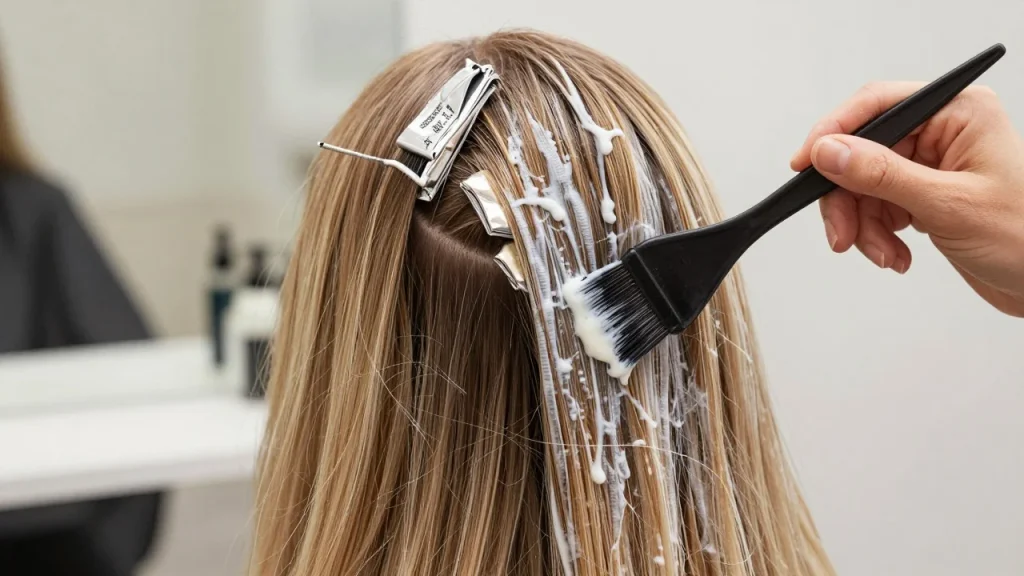
The strongest product is not automatically the right product. Match the format to your experience, colour history, and goal.
| Option | Best fit | Pros | Cons |
| Complete boxed kit | First-time DIY users making a straightforward change | Components are designed to work together; directions are specific | Less control over the formula; one box may not suit every hair length or history |
| Powder lightener plus developer | Experienced DIY users or professional use | Greater control over product choice and placement | Measuring and application errors can lead to uneven lift or damage |
| Cream lightener | Controlled applications where the label permits the intended technique | Creamy texture can make placement easier | Lift and scalp suitability vary by formula |
| Professional colour service | Major changes, corrective colour, fragile hair, or complex histories | Formula and placement can be adjusted by section | Costs more than a home application |
Recommendation: A complete kit with clear manufacturer’s directions is the more practical DIY choice for a modest change on healthy hair. Choose a professional colourist for dark-to-platinum changes, heavily coloured lengths, chemical treatments, or hair that already breaks easily.
Canadian retail listings checked in August 2026 show common boxed lightening products around C11toC21. Professional lightener-and-developer sets can cost considerably more. Prices and stock change by retailer.
Developer Strength Matters, but Higher Is Not Automatically Better
Developer contains hydrogen peroxide. Higher-volume developers generally make the lightening reaction work faster.
A hairstyling textbook from BCcampus makes an important distinction: developer volume does not determine a fixed number of levels of lift. It affects the speed of lift. Product alkalinity, texture, porosity, colour history, and placement also change the result.
That makes buying based on developer strength alone a poor strategy. The American Academy of Dermatology also notes that greater lightening usually requires more peroxide and causes more hair damage. Follow the developer and mixing instructions for the exact product you buy.
Check Your Hair Before You Bleach
Hair condition matters as much as your target shade. Pause before a home application if your hair is already snapping, unusually stretchy when wet, heavily highlighted, relaxed, or repeatedly coloured.
Previous colour also changes what is possible. Natural pigment and artificial dye do not always lift the same way. A strand that has been coloured several times may respond differently from new growth.
Before full application:
- Read every warning and direction supplied with the product.
- Use the product only for the application areas permitted on its label.
- Complete any allergy or patch test required by the manufacturer.
- Test a small hidden strand before committing to the whole head.
- Stop if you experience intense scalp burning or significant irritation.
Health Canada advises consumers to read cosmetic product directions carefully because misuse can cause irritation, burns, or eye injuries. It also recommends following patch-test directions when a product requires them.
If your new colour makes your front hairline more noticeable, Stylevanta’s widow’s peak styling guide also explains how parts, fringe, and texture can change the look of the hairline.
Why Roots, Lengths, and Ends May Lift Differently
One formula does not always behave the same way from scalp to ends.
The area closest to the scalp processes faster because body heat speeds the reaction. Mid-lengths lack that extra heat. Older, porous ends may also lighten faster because previous wear or chemical treatments have changed the fibre.
This difference explains many uneven results. Applying the same mixture everywhere at the same moment can produce lighter roots, darker bands, or fragile ends.
Processing time is also product-specific. Do not extend the stated maximum processing time because the colour has not reached your target. WebMD and FDA guidance both stress following package timing rather than leaving chemical colour products on longer than directed.
Toner and Aftercare Are Part of the Result
Lightening removes pigment, but it does not guarantee the finished tone. Darker bases often reveal warm underlying shades as they lighten. A toner can adjust yellow, gold, or orange tones after enough lift has been reached.
Aftercare cannot undo structural changes, but gentler handling can reduce additional breakage.
- Use conditioner consistently and detangle with care.
- Reduce frequent high-heat styling.
- Avoid stacking more chemical services onto fragile strands.
- Protect coloured or lightened hair from strong sun exposure.
- Trim damaged ends when they begin splitting or breaking.
The American Academy of Dermatology notes that bleaching can leave hair dry and brittle. It also recommends sun protection for chemically treated hair.
For more hair, beauty, and personal-style coverage, browse Stylevanta’s latest guides. You can also read how Stylevanta researches and reviews its content.
The Bottom Line
Choose a lightener based on hair condition, colour history, desired change, and product instructions, not on the strongest developer on the shelf.
A complete kit makes the most sense for a simple DIY change on healthy hair. Powder-and-developer systems offer more control but leave more room for formulation and application errors. If your goal involves major lift or corrective work, book a professional colour service instead.
Frequently Asked Questions
Does hair bleach permanently change your hair?
Yes, the treated section has undergone a chemical colour change. Your natural colour does not return to the treated lengths. Instead, new growth comes in with your natural pigment unless it is treated too.
Is developer the same as lightener?
No. Developer is the hydrogen-peroxide component that activates oxidative lightening. Powder or cream lightener contains the other ingredients needed for the intended formula. Always use products in the combination and ratio specified by their manufacturer.
How long should lightener stay on your hair?
There is no universal time. It depends on the formula, developer, starting colour, texture, and product instructions. Never exceed the manufacturer’s maximum processing time because more time can increase damage without giving a better result.
Can you use household bleach on hair?
No. Household cleaning products are not formulated for cosmetic hair lightening. Hair-lightening products use different ingredients and concentrations and are formulated for cosmetic use.
Can previously coloured hair be lightened at home?
It can respond unpredictably, especially after repeated permanent colour, highlights, relaxers, or other chemical treatments. A professional assessment is a better choice when the hair history is complicated or the strands already feel weak.