
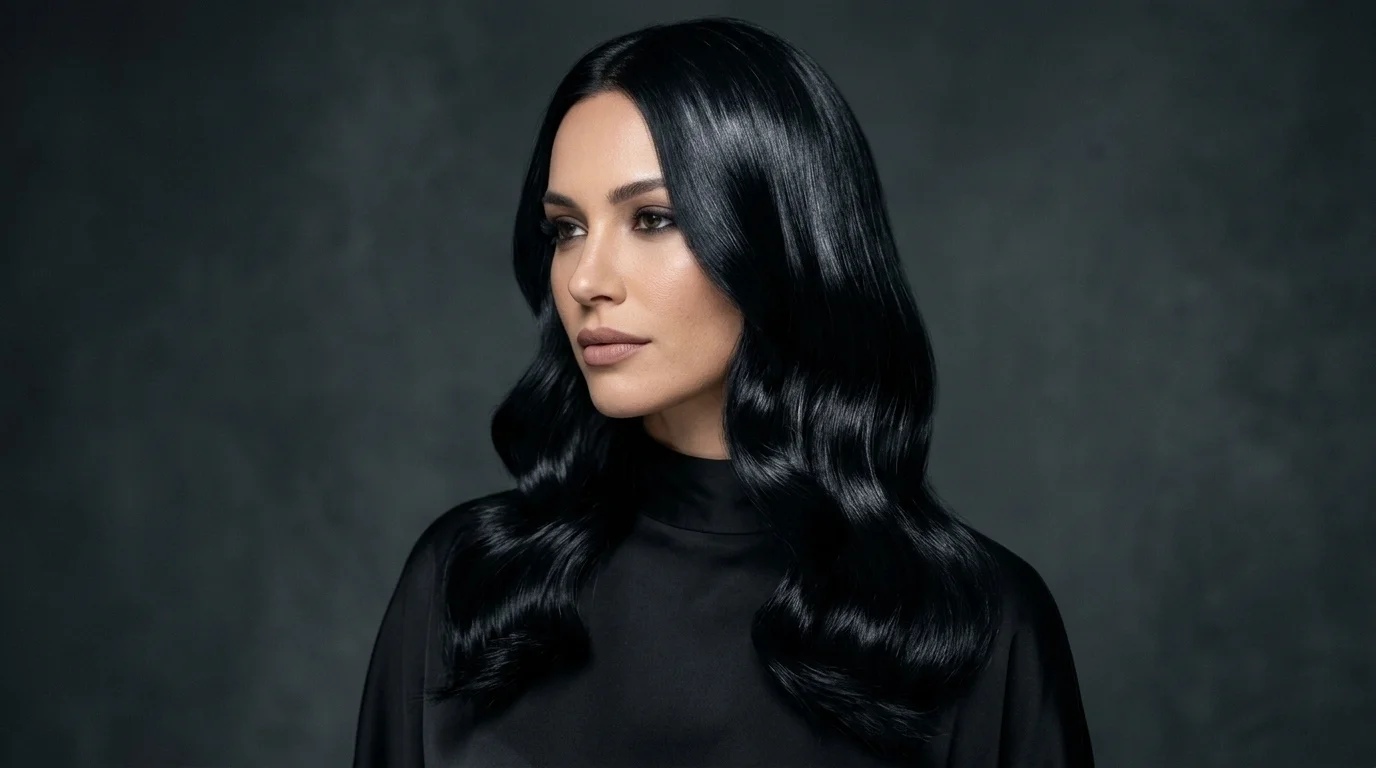
Jet black hair makes a sharper statement than softer black or dark brown shades. The colour sits at the deepest end of the hair-colour scale and usually has a neutral-to-cool, inky finish. It can look polished and reflective, but permanent black colour is a serious commitment if you may want lighter hair later.
Jet black is the deepest, most saturated black hair shade and usually reads as neutral-cool rather than brown. It creates strong contrast and a reflective finish, but it is a high-commitment choice if you may want lighter hair later. The right version depends on your starting colour, undertone, and maintenance plans.
| Aspect | What to know |
| Colour depth | Usually placed at the deepest end of the colour scale, often around level 1 |
| Undertone | Neutral-cool to cool rather than visibly brown |
| Compared with blue-black | Blue-black has a more noticeable blue reflection |
| Commitment | High when permanent colour is used |
| Going lighter later | Often more difficult after permanent dark dye |
| Lower-commitment option | Temporary or deposit-only colour can help you test the look first |
| Maintenance focus | Conditioning, shine, gentle cleansing, and sensible heat use |
| At-home safety in Canada | Follow all label directions and complete the required patch test |
What Is This Deep Black Shade?
Cosmetic colour charts usually place the darkest black at or near level 1. Unlike soft black, which can reveal brown warmth under strong light, the deepest black aims for a denser, more ink-like result. L’Oréal describes the shade as neutral-cool to cool and distinguishes it from blue-black, which has a more obvious blue reflection.
That distinction matters when you shop for colour. Terms such as “natural black,” “soft black,” “blackest black,” and “blue-black” are not interchangeable across every brand. Always check the manufacturer’s swatch and undertone description rather than choosing a colour based on the shade name alone.
The finish also depends on your starting point. Naturally dark, healthy-looking strands may produce a different result from bleached, highlighted, or porous lengths. Previous colour services can also affect how evenly a dark formula deposits.
How Jet Black Hair Differs From Natural Black and Blue-Black
These shades may appear almost identical on a box, but they can look quite different in daylight.
| Shade | Typical appearance | Undertone | Contrast level | Good choice when |
| Jet black | Deep, dense, and inky | Neutral-cool to cool | High | You want a dramatic, saturated black |
| Natural or soft black | Dark but less severe | Neutral or slightly warm | Medium-high | You want a softer result |
| Blue-black | Black with a visible cool reflection | Blue/cool | High | You like a fashion-forward, cool finish |
| Dark brown | Clearly softer beside black | Warm, neutral, or cool | Medium | You want depth without maximum contrast |
Blue-black is the easiest shade to distinguish visually. In bright light, it can show an almost navy or midnight-blue reflection. A pure black shade is designed to read as more neutral and ink-like instead.
Soft black deserves consideration if you like dark colour but worry that pure black could feel too severe. Another option is a warmer brunette. StyleVanta’s honey-brown hair guide shows how warmth changes the overall effect.
Who Does a Deep Black Colour Suit?
There is no single skin tone that can or cannot wear a dark shade. What changes is the amount of contrast the colour creates around your face. People with deep or olive complexions may find that an inky shade blends naturally with their colouring. On lighter complexions, the same shade can create a sharper contrast between the hair, skin, and brows. Cool undertones can also complement the cool character of the shade. L’Oréal notes that the colour can work across complexions while creating different levels of contrast.
Your personal style matters too. Consider your brow colour, eye colour, everyday makeup, and wardrobe. A strong black shade may make pale brows appear lighter by comparison. It may also make cool reds, jewel tones, and crisp neutrals stand out more. If you’re uncertain, test the visual effect before using permanent colour. A wig, digital colour preview, or temporary product can show you whether you like the contrast without locking you into the result.
Before You Color, Decide How Much Commitment You Want
The biggest question is not whether you can go darker. It is whether you might want to reverse the decision soon.
Permanent black dye can be difficult to lift cleanly. L’Oréal describes the shade as a high-commitment option because going lighter later may require significant colour correction.
| Your situation | A sensible starting point |
| You only want to see how black looks | Try a wig, temporary colour, or another removable option |
| You want dark colour with less commitment | Consider a semi- or demi-permanent formula suited to your hair |
| You want long-lasting darkness or grey coverage | Permanent colour may suit your goal |
| Your hair is bleached or heavily highlighted | Ask a colorist to assess its porosity and recommend a formula first |
| You want blonde hair in the near future | Think carefully before applying permanent black colour |
A future colour change should be part of the decision you make now. Artificial dark pigment may need to be removed gradually, and the final lightening plan will depend on your hair’s condition and color history.
How to Get a Rich, Even Black Result

Going darker usually does not require the same lightening process used to become blonde. The challenge is achieving an even, flattering result while protecting the condition of your hair.
- Review your colour history. Note any permanent colour, bleach, highlights, henna, and other chemical services.
- Compare shade swatches. Decide whether you want neutral black, soft black, or a visible blue-black reflection.
- Read the full product directions. Processing times and safety requirements differ between formulas.
- Complete the required allergy test. Follow the manufacturer’s instructions before every application.
- Use the formula only as directed. Do not extend the processing time in an attempt to make the colour “take better.”
- Plan your maintenance before colouring. Choose gentle cleansing, conditioning, and heat protection from the start.
Previously lightened hair deserves extra care. Porous sections can absorb pigment differently from untouched roots, so a professional consultation may help prevent a flat, patchy, or overly dark result.
How to Keep a Deep Black Finish Glossy
Dark colour looks most striking when the surface of the hair reflects light. That does not mean the hair has to be straight. Waves, curls, and coils can all show rich dimension when the strands are well-conditioned and styled with controlled heat.
Start by avoiding unnecessary washing and harsh cleansing. Use products designed for colour-treated hair when they suit your scalp and hair texture. Apply conditioner mainly to the mid-lengths and ends, where dryness often becomes more noticeable.
Heat can make a dark finish look dull when styling becomes excessive. Use an appropriate heat protectant and choose the lowest temperature that gives you the result you need.
Mineral buildup can also leave hair feeling coated or looking less reflective. If buildup is a concern where you live, StyleVanta’s guide to chelating shampoo explains what these stronger cleansers do and why they should not automatically replace your everyday shampoo.
A colour-depositing conditioner or gloss may help refresh a dark tone between full colour applications. Check that the product is compatible with your existing colour and follow its directions carefully.
A Canadian Safety Note for At-Home Hair Colour
Canadian shoppers should treat the safety instructions on hair colour as part of the colouring process, not as optional fine print.
Health Canada states that permanent and semi-permanent hair dyes containing certain dye bases must include warnings about skin irritation, instructions for a preliminary patch test, and warnings against use on the eyebrows or eyelashes. The agency also identifies p-phenylenediamine (PPD) as a known sensitizer used in some oxidative hair-colour products.
Follow the product’s patch-test directions exactly and repeat the test before each use when instructed. Previous trouble-free colouring does not guarantee that you will never develop a sensitivity.
Stop using a product if you experience concerning irritation or another reaction. Seek medical advice if symptoms are severe, persistent, or worsening.
Never use ordinary scalp hair dye to colour your eyebrows or eyelashes. Health Canada’s guidance specifically warns against this misuse.
Styling Ideas That Keep a Dark Colour Interesting
A one-colour finish does not have to look flat. Shape, texture, and colour placement can change how the shade appears.
Face-framing layers can break up the visual weight around the face. A blunt bob creates a cleaner, more graphic effect, while long layers add movement to dense lengths. Curls and waves create their own patterns of light and shadow.
You can also use contrast instead of changing the entire base. Platinum, silver, or vivid panels against black create a much bolder result. StyleVanta’s skunk hair guide covers this high-contrast approach.
If you prefer something more subtle, keep the base dark and add gentle dimension around the face. A colorist can help you choose a tone that works with your existing pigment and future color plans.
Your Next Step
Before buying dye, compare three swatches in daylight: pure black, soft black, and blue-black. Then decide whether you are comfortable keeping a dark result for the foreseeable future.
If your hair is bleached, chemically processed, or uneven, book a colour consultation before making it darker. If you’re colouring your hair at home in Canada, read the safety directions and complete the required patch test first. A good colour decision considers both the shade you want now and the colour you may want next.
Frequently Asked Questions
Does jet black hair fade?
Yes. Artificial dark colour can gradually lose some of its intensity and shine. Washing frequency, heat styling, sun exposure, water quality, and the condition of your strands can all affect how the finish looks over time.
You may not need a full permanent colour application every time the lengths start to look less glossy. Ask your colourist whether a gloss or deposit-only refresh would make more sense.
Is it darker than natural black?
Usually, yes, in cosmetic colour terminology. A pure inky shade is designed to look extremely saturated, while shades labelled natural black or soft black may appear slightly less intense.
Brand naming varies, so the colour swatch is more useful than the shade name alone.
Is blue-black the same colour?
No. Blue-black contains a more obvious cool blue reflection. Pure black aims for an inky, neutral-to-cool appearance without the same visible blue cast.
Can I go blonde after dying my hair black?
It may be possible, but artificial black pigment can make the process much more difficult. Permanent dark colour often requires staged professional correction before a significantly lighter shade becomes realistic.
Tell your colorist your complete color history before any lightening service. Trying to force a dramatic change in one session can place unnecessary stress on previously processed strands.
Do I need bleach to color my hair black?
Usually not when the goal is simply to make your hair darker. Your starting shade, porosity, and previous chemical treatments can still affect which formula and preparation method are appropriate.
If your hair is heavily bleached or uneven, a salon assessment is a safer way to plan for an even, dark result.
Should I choose permanent or semi-permanent color?
Choose based on your goal and your future color plans. Permanent formulas may suit people who want longer-lasting color or specific coverage needs. A lower-commitment option makes more sense if you are experimenting or expect to change shades again soon.
Always compare the manufacturer’s exact claims because “semi,” “demi,” and other formula descriptions can have different wear characteristics.