

A layered bob haircut keeps the recognizable bob outline while adding shorter sections through the interior, ends, or face-framing areas. The layers can create movement, remove bulk, or give the shape more lift. The right version depends on your hair density, texture, dry length, face proportions, and styling routine.
A good result is less about copying a single trend photo and more about deciding what you want the layers to change. Fine hair may need weight preserved at the ends. Dense hair may benefit from weight being removed from the interior. Curly hair requires extra attention to its finished dry length.
| Feature | Practical starting point |
| Typical length | Jaw, chin, or above the shoulders |
| Main purpose of layers | Movement, shape, lift, face framing, or weight control |
| Fine or lower-density hair | Keep a stronger perimeter and use restrained layers |
| Thick or dense hair | Consider selective internal weight removal |
| Wavy hair | Soft layers can encourage natural movement |
| Curly or coily hair | Plan around shrinkage and the finished dry shape |
| Fringe options | Side-swept, wispy, curtain, curly, or no fringe |
| Maintenance | More precise shapes usually show growth sooner |
StyleVanta’s broader bob cut guide for women uses the same practical approach: choose the endpoint, perimeter, weight distribution, and fringe based on your own hair.
What Makes a Layered Bob Different From a Blunt or Stacked Bob?
These terms often get mixed up, but they describe different design choices.
| Cut | Main feature | What it changes |
| Layered | Shorter sections within the overall shape | Adds movement or controls weight |
| Blunt | Strong, mostly one-length perimeter | Keeps visual weight near the ends |
| Stacked or graduated | Shorter sections at the back built into a fuller shape | Creates more structure toward the back |
| Textured | Ends are softened or broken up | Makes the finish look less rigid |
| A-line | Front remains longer than the back | Creates a visible forward angle |
A bob can combine several of these ideas. For example, you could have a blunt-looking outer edge with subtle internal layers. That combination can keep the ends looking full while reducing heaviness inside the cut.
A more useful question for your stylist is not, “Can you add lots of layers?” Instead, ask what each layer is meant to accomplish.
9 Bob Styles Worth Considering in 2026
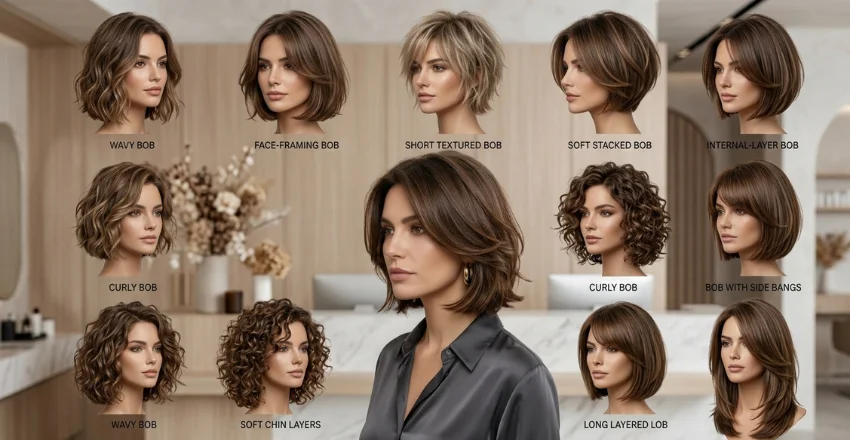
Current hairstyle trends show that there is no single fixed bob shape. Bobs can be adapted by texture, length, face framing, and styling effect. Choosing a style based on your hair’s needs is usually more useful than following one trend name.
| Style | Useful for | Main effect |
| Soft chin-length layers | Straight or lightly wavy hair | Gentle movement without a shaggy finish |
| Face-framing bob | Anyone wanting softness around the cheeks | Draws attention toward facial features |
| Short textured bob | Straight or wavy textures | Creates a relaxed, less precise finish |
| Soft stacked bob | Fine to medium-density hair | Adds shape toward the crown and back |
| Internal-layer bob | Thick or dense hair | Removes weight without obvious short pieces |
| Wavy bob | Naturally wavy hair | Allows bends and texture to form the shape |
| Curly bob | Curls and ringlets | Builds a rounded, controlled silhouette |
| Bob with side bangs | Anyone wanting a stronger face frame | Changes the front without shortening the entire cut |
| Long layered lob | Anyone wanting a lower-commitment short haircut | Keeps more styling and tie-back flexibility |
If losing too much length worries you, compare shorter options with StyleVanta’s practical lob haircut guide. A lob generally sits closer to the shoulders or collarbone and leaves more room for tying your hair back.
How to Choose a Layered Bob Haircut for Your Hair Type
Fine or Lower-Density Hair
Fine hair refers to strand diameter, while density describes how much hair you have. Both factors can affect how full the ends appear. Too much layering can leave a low-density perimeter looking sparse. A stronger outer line with a small amount of strategic layering often preserves more visible weight.
Ask for movement where you need it rather than layers everywhere. Face-framing pieces or subtle crown shaping may be enough.
Thick or Dense Hair
Dense hair can carry too much weight around the sides and ends of a short cut. As a result, the finished shape may feel wider or heavier than the reference photo. Selective internal weight removal can make the cut easier to control while keeping the outer line intentional. You do not necessarily need highly visible short layers.
Tell your stylist where your hair normally expands after washing. That information is more useful than simply describing your hair as “thick.”
Wavy Hair
A natural wave pattern can give a bob movement without requiring much heat styling. Soft layers may help the waves separate instead of forming one heavy block.
Keep your usual routine in mind. If you normally air-dry your hair, bring a reference photo that shows an air-dried finish. A salon blowout may hide how the cut behaves on an ordinary morning.
Curly or Coily Hair
Curly shapes need to be planned around the hair’s dry position, not just how long it appears when wet. Tighter curls can shrink considerably as they dry. Fine curls often benefit from fullness around the perimeter. Dense curls can support more carefully placed internal shaping.
StyleVanta’s short curly hair guide explains how curl pattern, density, and shrinkage can influence the choice of a short haircut.
Match the Length to Your Proportions, Not a Strict Face-Shape Rule
Face-shape advice works best as a starting point. Your hairline, texture, density, part, and preferred styling method also affect how the finished bob frames your face. For a rounder face, placing the endpoint below the widest part of the cheeks can create a longer visual line. An angled front can produce a similar effect.
A square jaw can work well with softer ends, bends, or curved face-framing sections. Heart-shaped faces may suit extra fullness near the chin. Longer faces can benefit from side volume or fringe. Oval faces tend to offer broad flexibility, but that does not mean every version requires the same amount of styling effort. Choose the length that fits your normal routine first.
Bangs Can Change the Entire Balance
You do not need fringe, but it can quickly shift the focus of a bob. Side-swept bangs add a diagonal line around the forehead and cheekbone. Wispy fringe creates a lighter effect. Curtain bangs create a more open frame, while blunt fringe makes the front look more graphic. Growth direction also matters. A cowlick, widow’s peak, or strong natural part can affect how much daily styling your fringe requires.
StyleVanta’s side bangs guide recommends choosing the sweep based on your texture, density, and the direction in which the front naturally falls. Defined side bangs commonly need attention every four to six weeks.
If your front hairline has a strong V-shaped growth pattern, the site’s widow’s peak styling guide can also help you decide between a side part, fringe, or an exposed hairline.
What to Ask Your Hairstylist
A trend name alone leaves too much room for interpretation. Before your appointment, decide on these five details:
- Dry endpoint: Where should the longest pieces fall when your hair is dry?
- Perimeter: Do you want a full, clean edge or a softer finish?
- Layer depth: Should the layers be subtle, visible, or mainly internal?
- Face frame: Where should the shortest front section fall?
- Routine: Will you air-dry, diffuse, straighten, or blow-dry your hair most days?
A useful salon brief could sound like this:
“Keep the dry length slightly below my jaw. I want the perimeter to stay fairly full, with enough internal layering to create movement. Please keep the front pieces long enough to tuck back, and shape the cut for how I normally air-dry my hair.”
Bring two or three reference images. Choose photos featuring hair with a similar density and natural texture to yours. One front view and one side view can make the intended silhouette much clearer.
Style It Without Turning Every Morning Into a Project
For a smooth finish, direct the hair downward while blow-drying and bend the ends only where you want them to sit. A round brush can add shape without creating excessive volume. For waves, apply a light styling product while your hair is damp. Scrunch it and let it air-dry, or use a diffuser. Avoid forcing every section into an identical curl.
Fine hair often responds better to lighter products that do not collapse the shape. Dense hair may need more smoothing or moisture control through the mid-lengths and ends. The strongest test is simple: Can you make the cut look good using your normal routine? If not, the reference style may require more daily work than you want.
Maintenance and Grow-Out
A precise chin-length outline changes more noticeably as it grows. Softer textured shapes and longer lobs usually transition more gradually. Fringe may need its own maintenance schedule. A defined side-swept fringe often needs reshaping every four to six weeks, while longer versions can grow out more gradually.
Your main cut can be adjusted according to how quickly the perimeter loses its shape. Your stylist may recommend a different interval based on your length, texture, and preferred level of precision. If you dislike frequent appointments, keep a little more length and avoid extremely short fringe. This gives the haircut more room to grow without looking unintentional.
Your Next Step
Save two or three reference photos before booking your salon appointment in Canada. Look for hair that resembles your natural density, texture, and curl pattern, not just the finished styling.
Then decide on your dry endpoint, perimeter strength, amount of layering, face frame, and realistic morning routine. Those five details give your stylist far more useful information than a trend name alone.
Frequently Asked Questions
Is a layered bob haircut good for fine hair?
It can be, but layer placement matters. Fine or lower-density hair often benefits from a stronger outer perimeter with restrained internal shaping. Heavy layering can remove too much visible weight from the ends.
Can this style make thick hair feel less bulky?
Yes. A stylist can remove weight from the interior while keeping the outer shape controlled. The goal is to reduce excess bulk without creating thin or disconnected ends.
Can curly hair wear a bob with layers?
Yes. The finished dry length and natural spring should guide the cut. Fine curls may need more fullness preserved, while dense curls can often support more internal shaping.
What is the difference between layered and stacked bobs?
Layering places shorter sections throughout different areas of the haircut. Stacking, or graduation, builds a more structured shape, commonly with shorter sections toward the back. A single bob can include elements of both.
Are side bangs a good match?
They can be. A longer side sweep blends easily with face-framing sections and gives you a softer grow-out. Your natural part and front growth pattern should guide the final direction.
Is a lob easier if I’m nervous about going short?
Often, yes. The extra length gives you more styling flexibility and usually provides more tie-back options. A lob can be a useful transition if a chin-length cut feels like too significant a change.