
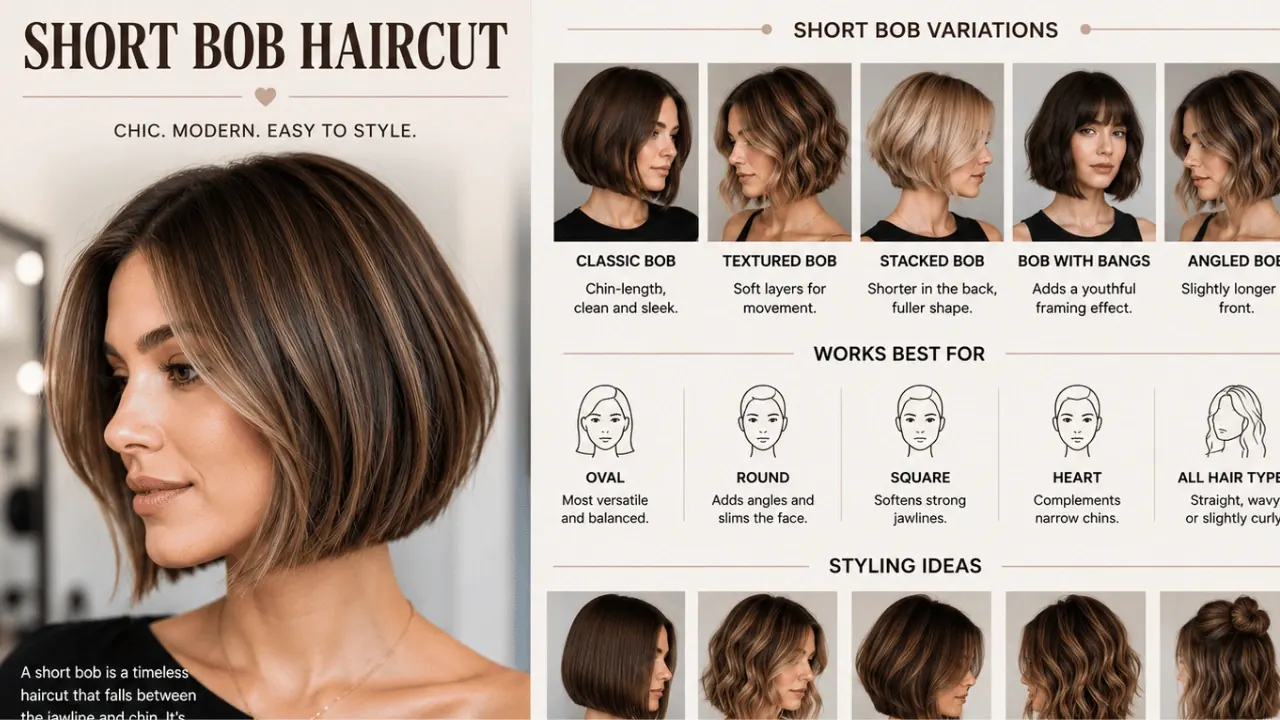
A short bob haircut usually ends between the ear and jaw, with options ranging from blunt and French shapes to layered, textured, stacked, and curly versions. The most flattering choice depends on where the ends sit, your natural texture and density, the features you want to highlight, and how much styling or salon upkeep you can manage.
A good bob shouldn’t work only in a salon photo. It should still make sense after you wash it, let it dry, and style it on an ordinary morning. Start with your hair rather than a trend name, then adjust the length, perimeter, layers, fringe, and parting.
| If you want… | A useful starting point | What to consider |
| Fuller-looking fine hair | Blunt or lightly graduated bob | Keep enough weight through the ends |
| Less bulk in thick hair | Layered or textured shape | Ask about internal weight removal |
| Natural movement | Wavy, curly, or textured bob | Plan around the finished dry shape |
| A sharper finish | Jaw-length or micro bob | Precise lines need more upkeep |
| Softer face framing | Curtain fringe or side movement | Growth pattern matters |
| More styling flexibility | Longer chin-length bob | Easier transition toward a lob |
9 Short Bob Styles Worth Considering
Current 2026 haircut coverage shows that “bob” describes a family of shapes rather than one fixed cut. Blunt, micro, French, textured, inverted, curly, and layered versions all appear prominently in current guides.
| Style | Main feature | Often works well when you want… | Upkeep |
| Blunt bob | Strong one-length perimeter | Fuller-looking ends and a polished shape | Medium-high |
| French bob | Compact length, often with fringe | A soft but defined cropped look | Medium-high |
| Micro bob | Ends near the ears or upper jaw | A bold, clearly short silhouette | High |
| Textured bob | Broken-up ends and movement | A relaxed finish that doesn’t need perfect smoothing | Medium |
| Layered bob | Visible or internal layers | Movement or less bulk | Medium |
| Stacked bob | Graduation through the back | Lift and a more sculpted profile | High |
| A-line bob | Shorter back, longer front | Stronger face framing without fringe | Medium-high |
| Curly bob | Shape designed around curl pattern | Natural volume and movement | Medium |
| Bob with bangs | Fringe added to the front | More focus around the eyes and cheekbones | Medium-high |
Fine hair doesn’t automatically need heavy layers. A stronger perimeter can make the ends look denser, while too much thinning may remove the weight you want to keep. Current stylist guidance for fine hair frequently favours controlled structure and careful internal shaping
.Dense hair needs a different plan. Strategic weight removal can stop a short shape from becoming bulky around the sides while preserving enough structure for the bob to read clearly.
How to Choose a Short Bob Haircut for Your Face Shape
Face shape is useful for thinking about proportion, but it shouldn’t become a set of restrictions. The endpoint, parting, fringe, texture, and volume placement can change the visual effect of the same basic cut.On a rounder face, you may prefer a line that finishes near or below the jaw rather than at the widest part of the cheeks. An angled front or a little height at the crown can also change the balance.
Short bob haircut: A square jaw can look striking with a sharp perimeter if you want to emphasize structure. If you prefer softness, introduce movement through waves, lighter ends, or a less rigid fringe. Heart-shaped faces often offer plenty of flexibility around chin length because extra visual weight near the lower face can create balance.
Oval faces can usually focus more heavily on texture, density, and lifestyle.StyleVanta’s 2026 hairstyle guide uses the same practical approach: treat facial proportions as one factor in the decision rather than the only rule.
Match The Cut to Your Hair Texture and Density
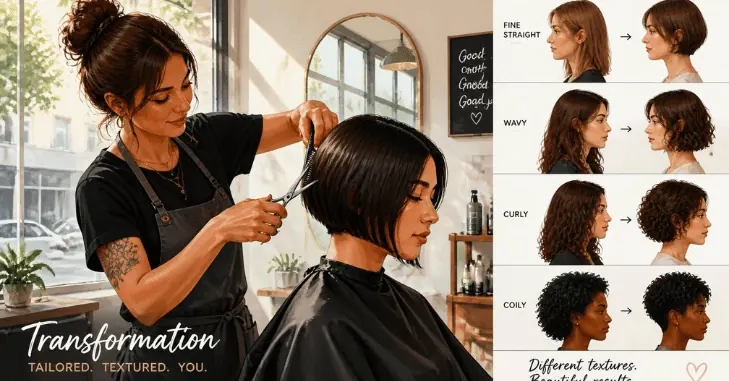
Straight hair shows the perimeter clearly, so blunt, micro, and A-line shapes can look especially graphic. That same precision means uneven growth becomes easier to see.Wavy hair can support softer ends and visible movement. A textured shape often allows the natural bends to become part of the finish rather than something you straighten out.
Curly and coily hair should be planned around how it sits when dry. Curl spring can change the apparent length, especially around the face and fringe. StyleVanta’s short-hair-with-bangs guide also recommends accounting for natural movement and shrinkage rather than planning only around stretched hair.
For lower-density hair, ask whether every proposed layer serves a purpose. For dense hair, ask where weight can be removed without creating thin or disconnected ends.
Should you Add Bangs?
Bangs can make a compact bob feel softer, sharper, or more dramatic without changing the back length. Curtain fringe and longer, side-swept fringe usually offer an easier grow-out, while short, blunt, or micro fringe makes changes in length more visible.
Your hairline matters as much as your face shape. A cowlick, strong side growth, or pronounced centre growth can change how fringe behaves every morning.If you’re undecided, compare curtain, wispy, side-swept, and blunt options in StyleVanta’s guide to different types of bangs before committing.
How Much Maintenance Does a Short Bob Need?
Short hair can dry quickly, but a precise cut isn’t automatically low maintenance. The shorter and sharper the perimeter, the sooner growth changes its intended line.Hair.com recommends planning around a four-to-six-week salon cycle for many short bobs, with blunt cuts or fringes sometimes needing attention sooner. Current 2026 guidance from The Right Hairstyles gives a similar range for precise shapes while allowing longer intervals for softer, textured versions.
That means a textured chin-length cut may be easier to stretch between appointments than a micro bob with a perfectly straight edge. Decide which type of upkeep you prefer before choosing the most dramatic reference photo.
Bob or Lob: which Length Makes More Sense?
If you need to tie your hair back often, feel uncertain about exposing your neck, or want a gentler grow-out, moving the endpoint lower can be practical.A lob keeps the defined outline of a bob but adds enough length for more styling and tie-back options.
StyleVanta’s lob haircut guide explains how the extra length changes movement, layering, and day-to-day flexibility.Choose the shorter version when the cropped silhouette itself is the feature you want. Choose the longer option when versatility matters more than creating a distinctly short shape.
What to Tell your Stylist Before The Cut
Bring reference images that resemble your natural texture rather than choosing them only by colour or face shape. Then make the consultation specific.
- Explain where you want the ends to fall when the hair is dry.
- Say whether you usually air-dry, blow-dry, straighten, or wear your natural texture.
- Point out cowlicks, strong growth patterns, or a part you don’t want to change.
- Ask how the chosen shape will look after six to eight weeks and how often it should be reshaped.
- Tell your stylist if you need enough length to tuck behind your ears or pull sections back.
A useful reference photo should start a conversation, not replace one. Two people can request the same-named style and still need different cutting decisions because their density, curl pattern, hairline, and daily routines differ.
Choose The Version That Fits your Real Routine
The strongest choice isn’t necessarily the shortest or newest style. It’s the version that works with your natural texture, preferred styling time, and willingness to maintain the shape.Before your appointment, save two or three realistic photos. Decide where you want the ends to sit and what you’re prepared to style each morning. Then ask your stylist to adapt the idea to your hair rather than copying a photo line-for-line
Conclusion
A short bob haircut can be stylish, versatile, and flattering, but the best version is the one that works with your natural hair rather than requiring constant correction. Consider your face shape, hair texture, density, growth pattern, preferred styling routine, and how often you are willing to visit the salon before choosing a specific bob style.
Whether you prefer a blunt bob, French bob, textured bob, layered bob, stacked bob, curly bob, or bob with bangs, the right length and shape can make a major difference. Instead of copying a trend exactly, use your favourite reference photos as inspiration and ask your stylist to adapt the cut to your individual features and everyday routine.
Frequently Asked Questions
What length counts as a short bob?
Most current guides place the category at roughly ear-to-jaw length, although salon terminology varies. The important detail is the final endpoint, not the label itself.
Is a short bob haircut low maintenance?
It can be quick to wash and style, but precise versions need regular reshaping. Expect sharper blunt, stacked, micro, or fringe-heavy cuts to show growth sooner than loose, textured shapes.
Does a short bob suit a round face?
Yes. Instead of avoiding the cut, adjust the endpoint and volume. A length near or below the jaw, an angled front, side movement, or controlled height can change the proportions.
Is a blunt bob good for fine hair?
It can be. Keeping a stronger edge helps preserve visual weight through the ends. Your stylist may still add subtle internal shaping if the hair needs movement.
Can curly hair wear a short bob?
Yes. The shape should account for curl spring, density, and the finished dry length. Reference photos showing a curl pattern similar to yours are more useful than photos of straightened hair.
How often should a bob be trimmed?
A four-to-six-week interval is common for crisp short shapes, while softer, textured cuts may grow comfortably for longer. Bangs can need separate maintenance sooner.
What length counts as a s