

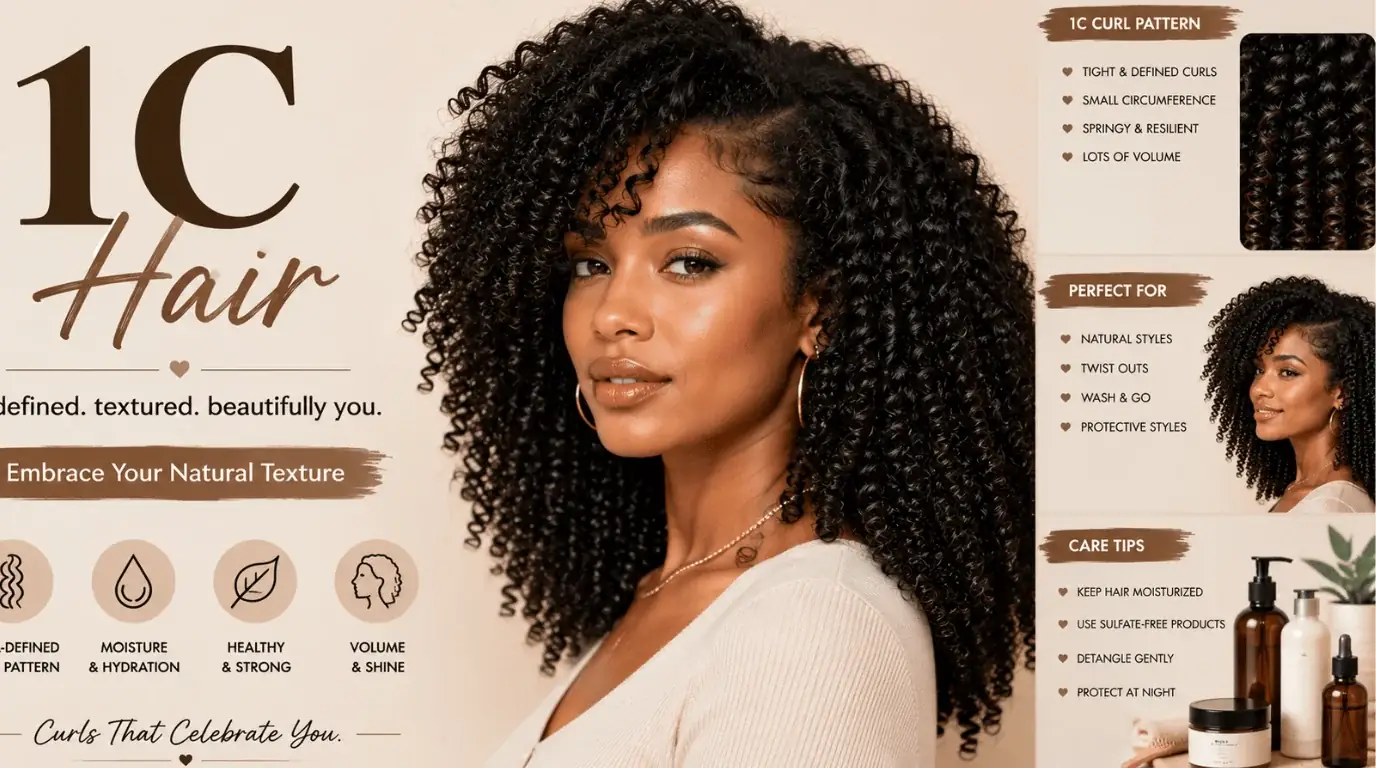
If your hair looks straight but develops bends, body, and frizz as it dries, you may have 1C hair. This texture sits at the fuller end of the straight-hair category. It often has more movement than Types 1A and 1B but lacks the consistent S-shaped wave associated with Type 2A.
The label can help you choose a routine, but it shouldn’t dictate every product you use. Scalp oil, strand thickness, damage, density, and styling habits matter too.
| 1C | What to know |
| Hair family | Type 1, or straight |
| Typical appearance | Mostly straight with subtle bends or arcs |
| Common strand feel | Often medium to coarse |
| Natural volume | More body than 1A or 1B |
| Common concerns | Frizz, flyaways, oily roots, dry ends |
| Styling strength | Can hold bends and styled movement well |
| Routine focus | Clean scalp, conditioned lengths, light styling |
Type 1C is generally straight hair with noticeable body, thicker-looking strands, and slight bends through the lengths or ends. A useful routine balances scalp cleansing with moisture on the mid-lengths and ends. Lightweight styling, gentle drying, and sensible heat use can help control frizz without flattening its natural movement.
How to Tell If You Have 1C Hair
Hair typing is easiest when you look at your natural pattern rather than the result created by a dryer, flat iron, braids, or styling cream.
Wash your hair and allow it to dry without manipulating it into a particular shape. Then look at the pattern from roots to ends.
Common signs include:
- roots that appear predominantly straight;
- visible body rather than a pin-straight, flat finish;
- loose bends or arcs through the lengths;
- ends that may curve or flip;
- noticeable frizz or flyaways;
- strands that often feel more substantial than fine Type 1 hair.
Hair.com describes this subtype as straight with a coarse, near-wavy texture. It also notes that the pattern can have body while remaining comparatively flat near the roots. That combination helps explain why someone can experience both flat roots and fuller, frizzier lengths.
Your whole head doesn’t need to behave identically. Natural pattern, strand diameter, density, damage, and porosity can vary from one area to another.
1C Hair vs. 1B and 2A: What Is the Difference?
The boundary between neighbouring hair types isn’t exact. Treat the categories as useful styling shorthand rather than a scientific diagnosis.
| Feature | Type 1B | Type 1C | Type 2A |
| Overall pattern | Straight | Mostly straight | Wavy |
| Movement | Mild body | Bends and arcs | Loose S-shaped waves |
| Root pattern | Straight | Usually straight | Often straighter near roots |
| Typical texture | Fine to medium | Often coarser | Often fine to medium |
| Frizz tendency | Low to moderate | Moderate | Moderate |
| Natural body | Moderate | Fuller | Soft, wavy volume |
The biggest clue between 1C and 2A is usually the pattern. Type 2A develops a clearer loose S-wave. The straight subtype tends to form softer, less consistent bends. StyleVanta’s straight-hair guide can help you compare Types 1A, 1B, and 1C in more detail. neighboring
A Simple 1C Hair Care Routine

You don’t need a shelf full of products. Start with a basic routine and adjust one element at a time.
1. Wash according to your scalp.
There is no universal wash schedule for this texture. The American Academy of Dermatology recommends washing according to how quickly your hair becomes dirty or oily. People with straight hair and oily scalps may need frequent shampooing.
Apply shampoo mainly to your scalp. This removes excess oil and product residue without unnecessarily scrubbing the drier lengths.
If greasy roots are your main concern, StyleVanta’s guide to shampoo for oily hair explains how to match cleansing strength to your scalp.
2. Condition the lengths
Apply conditioner after shampooing, focusing on the areas that feel dry or rough. If your roots flatten easily, avoid putting a rich conditioner directly on the scalp. Coarser lengths may tolerate more conditioning than finer straight strands. Start with a modest amount and adjust based on the result after drying. When the ends remain rough despite regular conditioner, a suitable hair mask for dry hair may provide extra conditioning.
3. Reduce friction while drying
Don’t aggressively rub wet hair with a bath towel. The American Academy of Dermatology recommends gentle handling and suggests wrapping or blotting hair rather than rough drying. Let straight hair dry partly before detangling.
Work carefully from the ends upward with an appropriate comb. Air-drying can also reveal your natural pattern. If your lengths develop soft bends without forming repeated S-waves, that result can help with hair-type identification.
4. Use leave-in products where you need them.
A leave-in conditioner can help when the ends feel dry, tangled, or frizzy. Dermatologists recommend using a small amount and concentrating it on the hair rather than the scalp. Start with less than you think you need. You can add a little more to rough ends, but removing excess product usually means washing again. For frizz control, try a lightweight leave-in spray or a small amount of serum. Heavy butters and thick creams can make straighter roots look coated.
5. Protect your hair from excess heat.
A naturally straight pattern doesn’t make hair immune to heat damage. Frequent high temperatures can contribute to brittleness, dullness, and frizz. Use a heat-protecting product when the label indicates protection from hot tools. Keep your dryer or iron at the lowest effective temperature. If you want smoothness and root lift, StyleVanta’s at-home blowout guide covers sectioning, brush control, directed airflow, and heat safety.
How to Control Frizz Without Making Your Hair Flat
Frizz control often fails when too much product is added at once. Rich creams may smooth the surface while taking away the body you wanted to keep.
Try dividing your routine by area:
- Scalp: cleanser and minimal styling residue
- Roots: lightweight volumizing products when needed
- Mid-lengths: light moisture or smoothing product
- Ends: conditioner, leave-in, or a small amount of serum
This approach is useful when your roots become oily before your ends feel conditioned.
Humidity can make existing bends and flyaways more visible. Rather than coating the whole head in oil, use a small amount of anti-frizz product where the texture needs it most.
Hairstyles and Cuts That Work With This Texture
The natural body of this hair type gives you several styling options. The goal doesn’t have to be making every strand perfectly straight.
Long layers can introduce movement when thick lengths feel heavy. A lob or bob can make natural bends more noticeable. Face-framing layers can also prevent fuller hair from looking like one solid shape.
For everyday styling, consider:
- a smooth blowout with softly curved ends;
- loose bends created with minimal heat;
- a textured lob;
- long layers that remove excess bulk;
- a sleek ponytail with controlled flyaways;
- an air-dried style that keeps the natural movement visible.
The right cut also depends on density, face shape, hairline, and how much daily styling you’re prepared to do.
Common Routine Mistakes
One common mistake is choosing products from the hair-type label alone. Two people in the same category can have different scalp oil levels, densities, color damage, and styling habits. Another is applying rich products everywhere because the ends feel dry. Treating dry ends shouldn’t require coating an oily scalp.
Watch for these problems:
- using more styling product every time frizz appears;
- applying heavy oils directly to roots that flatten easily;
- shampooing the lengths aggressively;
- rubbing wet strands with a rough towel;
- using high heat when a lower setting works;
- flat-ironing hair automatically when you like its natural bends.
A simple routine makes troubleshooting easier. If your roots become greasy, change the cleansing or root products first. If your ends feel rough, adjust conditioning before changing your whole routine.
Build a Routine Around Your Hair, Not the Label
A hair-type code is most useful when it helps you notice patterns. It shouldn’t become a rigid set of rules. Start with scalp-focused cleansing, targeted conditioner, gentle drying, and minimal styling product. Then watch what happens over several wash days. Adjust the part of the routine linked to the problem you see. For more guidance on neighboring Type 1 textures and product weight, read StyleVanta’s complete straight-hair care guide.
Frequently Asked Questions
Is 1C hair straight or wavy?
It falls within the straight Type 1 category in the commonly used typing system. It can still develop noticeable bends, body, flipped ends, and surface frizz. A consistent S-shaped pattern is more characteristic of Type 2 wavy hair.
How can I tell the difference between Type 1C and 2A?
Look at clean hair after it dries with minimal styling. Mostly straight strands with irregular arcs or bends point toward the Type 1 end. Repeated loose S-shaped waves suggest Type 2A.
How often should I wash it?
Wash according to scalp oil, sweat, buildup, and your routine rather than following a fixed calendar. An oily scalp may need frequent cleansing, while a less oily scalp may stay comfortable longer between washes.
Does this hair type need oil?
Not necessarily. If your ends feel dry, a small amount of a suitable oil or serum may help with smoothness. Avoid assuming that your scalp needs oil because the lengths feel rough.
Why are my roots oily but my ends dry?
Your scalp produces sebum while the older ends are exposed to washing, friction, weather, coloring, and heat. Instead of treating your entire head the same way, cleanse the scalp and direct more conditioning toward the lengths.
Can I enhance the natural bends?
Yes. Try air-drying with minimal manipulation or use a lightweight styling product on damp lengths. Avoid loading the roots with rich cream. If you use heated tools, apply heat protection and use the lowest effective setting.

