
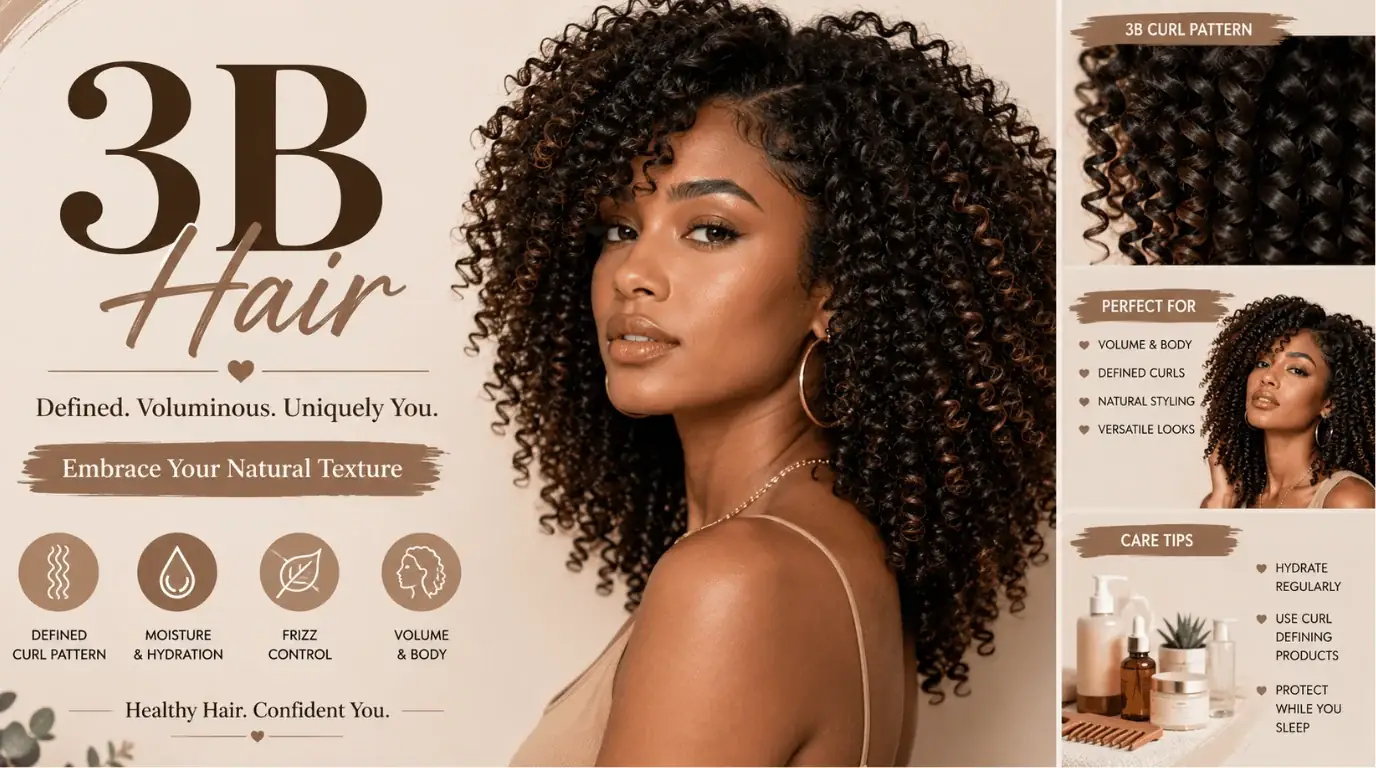
3B hair is a Type 3 curl pattern known for springy, clearly formed ringlets that usually sit between the looser spirals of 3A and the tighter corkscrews of 3C. The label can help describe curl shape, but your density, strand thickness, porosity, scalp needs, styling habits, and damage level should guide your routine too.
Type 3B curls often form medium-sized, elastic ringlets with noticeable volume and definition. A useful routine combines gentle scalp cleansing, regular conditioning, careful wet detangling, enough styling hold, and limited heat. In Canada, you may also need to adjust product weight and styling methods as indoor dryness and outdoor humidity change through the year.
| 3BHair | What to know |
| Curl family | Type 3, between 3A and 3C |
| Typical shape | Defined, springy spirals or ringlets |
| Curl size | Often compared with the width of a marker |
| Common concerns | Dryness, tangles, frizz, buildup, loss of definition |
| Routine priorities | Gentle cleansing, conditioning, wet detangling, controlled hold |
| Drying options | Air-drying or diffusing with controlled airflow |
| Canadian consideration | Adjust moisture and hold as seasonal conditions change. |
| Important limitation | Curl type alone does not tell you porosity, density, strand width, or damage. |
What Does the Type 3B Curl Pattern Mean?
Curl typing gives you a visual language for describing the shape your hair forms. Type 3 covers clearly curly textures, while the A, B, and C labels describe progressively tighter examples within that group.
Type 3B usually refers to springy ringlets that look tighter than broad 3A spirals but more open than many 3C corkscrews. Marker-width comparisons can help when you are learning the system, but they are only visual reference points.
You may also have several patterns on one head. Your crown, temples, nape, and front sections do not need to produce identical spirals. That variation is normal and is one reason a single curl label should not dictate every product you buy.
Porosity, density, strand diameter, chemical processing, and heat history can change how your curls respond to moisture or styling. Two people with similar-looking ringlets can therefore need quite different routines.
How to Know If You Have 3B Hair
Start by looking at clean hair with minimal styling interference. Let your natural pattern form, then examine several areas instead of judging one curl near your face. Look for defined spirals that spring into a medium-sized ringlet rather than a broad loop or a very tight corkscrew. The pattern usually remains clearly curly instead of relaxing into an S-shaped wave.
Current curl guides commonly use a permanent-marker-sized spiral as a rough visual comparison. Do not use shrinkage alone to identify your subtype. The amount of visible length you lose as curls dry can vary with water, styling, damage, and individual fiber geometry.
3A vs. 3B vs. 3C
| Feature | 3A | Type 3B | 3C |
| General curl shape | Larger, looser spirals | Springy medium ringlets | Tighter corkscrews |
| Visual diameter | Broad | Often marker-like | Smaller and tighter |
| Volume | Can range from soft to full | Often visibly springy and full | Often dense-looking and compact |
| Product approach | Often responds well to lighter layers | Balance moisture with enough hold. | May tolerate richer moisture, depending on strands |
| Key caution | Heavy creams can flatten some curls. | Too much weight can reduce bounce | Curl tightness still does not determine porosity or density. |
These categories overlap. Treat the comparison as a starting point rather than a test you must pass.
Build Your Routine Around More Than a Curl Number
The most useful question is not, “Which product is made for my curl code?” Ask what your hair is doing. If your scalp feels oily or coated, you may need more effective cleansing. If the lengths feel rough and knot easily, conditioning and gentler handling deserve more attention. Flat, limp curls may point to excess product weight or buildup rather than a lack of moisture.
Dermatologists recommend washing textured or curly hair according to how dirty or oily it becomes instead of following a rigid universal schedule. Shampoo should focus mainly on the scalp, while conditioner can be used through curly lengths to improve moisture and manageability. This approach also prevents a common mistake: assuming every curl problem needs another heavy cream or oil.
A Simple Wash-Day Routine for Springy Type 3 Curls

A routine should be repeatable enough that you can tell what works. Change one variable at a time instead of replacing your cleanser, conditioner, cream, gel, and drying method together.
- Cleanse the scalp based on need. Massage shampoo through the scalp and allow the rinse water to move through the lengths. If styling products accumulate, occasional deeper cleansing may help.
- Condition the lengths. Apply enough conditioner to give the hair slip without leaving it heavily coated. If dryness remains a concern, compare lighter and richer treatments rather than assuming the richest option is automatically better. StyleVanta’s hair-mask guide discusses how formula weight can change the result on different textures.
- Detangle while the hair is wet and slippery. Work gently from the ends upward with your fingers or a wide-tooth comb. The American Academy of Dermatology recommends wet detangling for thick or curly textures and warns against rough towel drying.
- Apply styling product while curls are stilldamp. A leave-in, curl cream, mousse, gel, or a combination can provide softness and hold. Start with less if your curls lose volume easily.
- Dry without constantly disturbing the curl clumps. Air-drying works for many routines. If you use a diffuser, begin with controlled airflow and moderate heat. StyleVanta’s Clarifying Shampoo guide explains bowl size, airflow, root lift, and lower-frizz drying techniques in more detail.
- Judge the result once completely dry. Curls that feel greasy or limp may need less product. Rough, tangled lengths may need more conditioning or gentler handling. A hard gel cast can often be softened after the hair is dry without destroying the definition underneath.
The goal is not maximum product. It is enough cleansing, moisture, and hold for the finish you want.
Adjust Your Curl Routine for Canadian Seasons
Canadian conditions can make a fixed year-round routine frustrating. StyleVanta’s current dry-hair guidance notes that cold weather and indoor heating can affect how rough or manageable hair feels. During colder months, pay attention to static, rough ends, tangling, and loss of softness. You might use a slightly richer conditioner, add a leave-in to the driest sections, or reduce unnecessary heat.
Warm, humid weather creates a different styling problem. Research has found that changes in humidity can influence the tactile perception and friction associated with frizz, with curly hair responding differently from straight hair.
In humid conditions, stronger styling hold may matter more than adding increasingly rich moisture layers. A gel or mousse that keeps curl groups together can sometimes give a cleaner result than several creams stacked on top of each other.
For 3B hair in Canada, think of your routine as adjustable settings rather than fixed rules. Keep the steps that work and change product weight or hold only when your results give you a reason.
Avoid the Problems That Often Get Blamed on Curl Type
Dryness is not always proof that you need more oil. Product residue, strong cleansing, coloring, heat, rough detangling, and mineral buildup can all change how strands feel. Buildup can make curls feel coated while reducing bounce. If your conditioner suddenly seems ineffective, consider whether the issue started after adding a new styler or using more product.
Heat is another variable worth watching. Dermatologists recommend limiting excessive heat, using low or medium settings when possible, and applying heat protection. A diffuser still produces heated air, so its gentler airflow does not make high temperatures harmless. StyleVanta also recommends starting conservatively with diffuser heat and speed.
If you occasionally prefer a stretched or smoother finish, use controlled technique rather than repeatedly passing high heat over the same section. StyleVanta’s blowout guide covers sectioning, heat protection, and lower-stress drying choices.
Haircuts and Styles That Work With Springy Curls
A good haircut accounts for more than the curl label. Density, shrinkage, face framing, and the amount of salon maintenance you want can all influence the finished shape. Layered bobs can remove weight and create movement. Shags can shift volume toward the crown and face. Pixies and tapered crops make the curl pattern a major part of the silhouette.
If you are considering a shorter cut, remember that removing length can make curls appear springier because there is less weight pulling downward. The underlying pattern has not necessarily changed. StyleVanta’s short-curly-hair guide compares bobs, pixies, shags, tapered shapes, density, shrinkage, and face-framing choices.
Build a Routine You Can Read and Adjust
A useful curl routine gives you predictable results without forcing you to follow every trend. Start with gentle cleansing, enough conditioner for easy detangling, one styling combination, and a drying method you can repeat.
Then watch what happens. If the curls flatten, reduce weight. If they feel rough, review moisture and handling. If the definition disappears in humid weather, adjust the hold before rebuilding the entire routine. Once you know how your own curls respond, a type label becomes what it should be: a helpful description rather than a rulebook.
Frequently Asked Questions
Can 3B hair be mixed with other curl patterns?
Yes. It is common for different areas of the same head to form looser or tighter curls. Use the pattern that best describes most of your hair, then adjust products and techniques for sections that behave differently.
Should curly hair be brushed when dry?
Dry brushing can separate established curl groups and may increase frizz or breakage. Dermatologists recommend detangling thick or curly textures while wet and conditioned, using a wide-tooth comb or another gentle method.
Should curly hair be brushed when dry?
Dry brushing can separate established curl groups and may increase frizz or breakage. Dermatologists recommend detangling thick or curly textures while wet and conditioned, using a wide-tooth comb or another gentle method.
How often should you wash Type 3 curls?
There is no single ideal schedule. Wash based on scalp oil, sweat, product buildup, and how your hair responds. The AAD advises people with dry, curly, textured, or thick hair to shampoo when needed rather than automatically washing every day.
Do you need a special product for every curl subtype?
No. A curl label describes visible shape, but it does not tell you everything about density, porosity, strand width, damage, or scalp condition. Choose products based on the problem you want to solve and how your hair responds.