

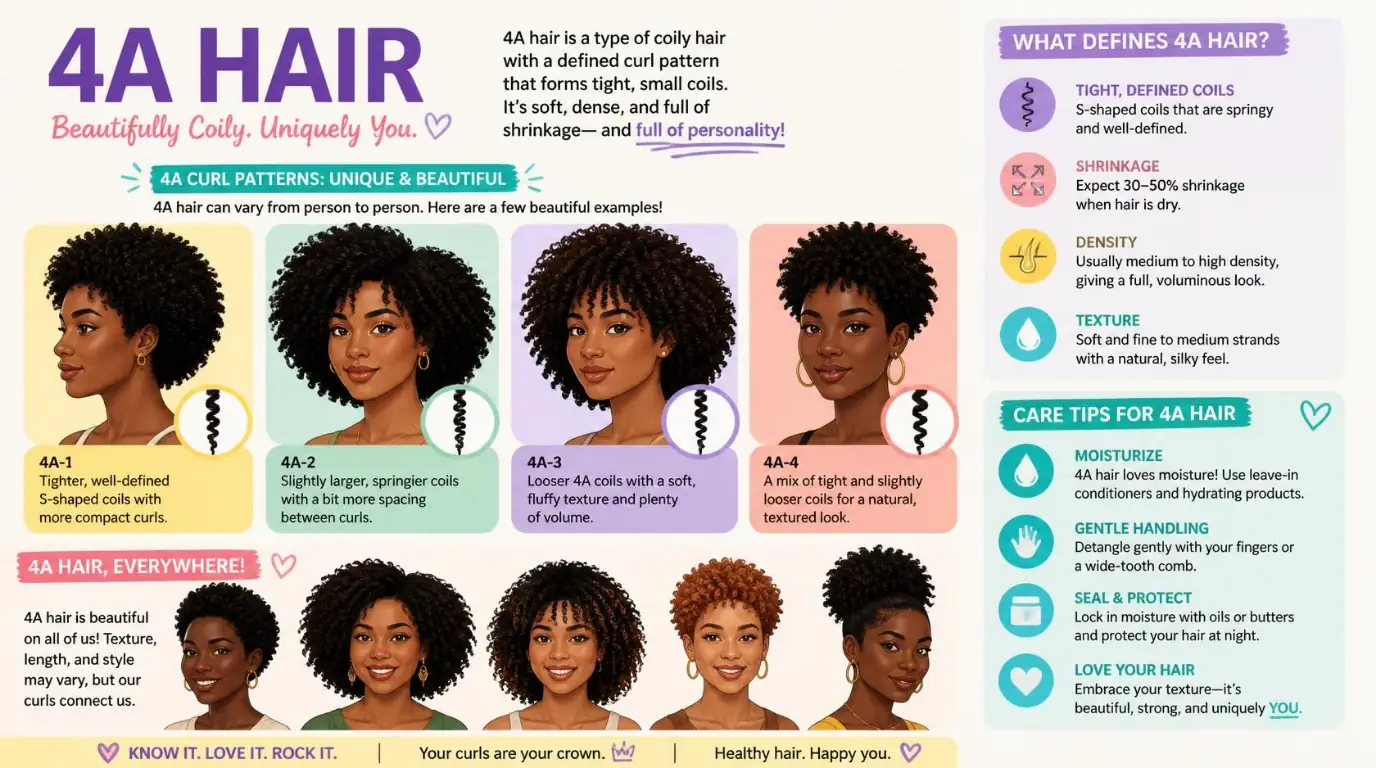
4A hair forms small, springy coils with a visible S-shaped pattern, usually about the width of a crochet needle or knitting needle. It holds definition well but loses moisture quickly, so the routine that works best is simple: gentle cleansing, thorough conditioning, careful detangling in sections, layered moisture on damp hair, and low-friction care at night. Porosity, strand thickness, density and Canada’s changing seasons matter as much as the curl type itself.
This guide shows you how to confirm whether your hair is 4A, how it differs from 3C and 4B, a step-by-step wash-day routine, how to moisturize without buildup, styling options, and how to adjust your routine between a dry, indoor-heated winter and a humid summer.
| What to know | Practical starting point |
|---|---|
| Curl pattern | Small, springy, usually S-shaped coils |
| Main care concern | Dryness and moisture retention |
| Detangling | Work gently in sections with plenty of slip |
| Conditioning | Condition after every cleanse; add deeper treatments as needed |
| Styling | Wash-and-gos, twists, braid-outs, puffs, buns and other low-tension styles |
| Drying | Air-dry or diffuse with low heat and gentle airflow |
| Night care | Reduce friction with satin or silk |
| Canadian seasons | Adjust product weight and moisture for indoor heat, humidity and cold |
What Is 4A Hair and How Can You Identify It?
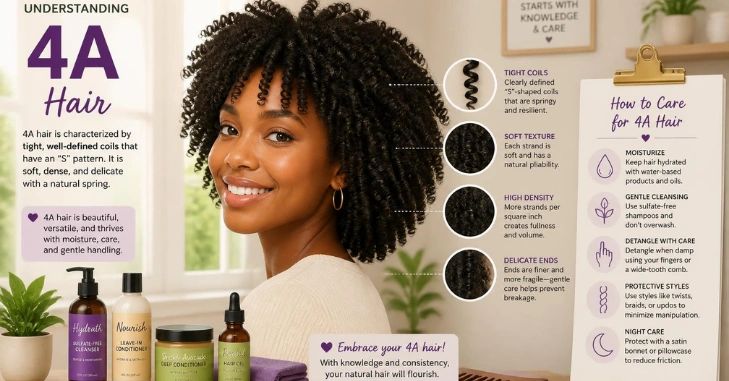
4A sits within the type 4, or coily, section of the widely used curl-typing system. Its most recognizable feature is a small, springy coil that often forms a clear S shape when you stretch a strand and let it go. Compared with other type 4 patterns, 4A coils tend to be the most defined and the easiest to see without much styling.
Treat that description as a starting point, not a diagnosis. Many people have more than one pattern on the same head, often tighter at the nape and crown and looser around the hairline. Curl typing also ignores porosity, strand width, chemical processing and heat damage, and those traits often shape your routine more than the letter assigned to your curls.
A quick self-check
- Wash and condition your hair, then let it air-dry with no styling product.
- Look at several sections: front, crown, sides and nape.
- Gently pull a single strand straight and release it. A 4A strand springs back into a small, defined coil with a recognizable S or spiral.
- Note how much the hair shrinks as it dries. Noticeable shrinkage is typical of type 4 hair.
- If most sections form defined coils but a few are looser or tighter, you have a mixed pattern, which is completely normal.
3C vs. 4A vs. 4B: What’s the Difference?
These categories overlap visually, which is why comparing yourself with one photo online can be frustrating.
| Hair type | Common visual pattern | Useful distinction |
|---|---|---|
| 3C | Tight corkscrew curls | Usually larger, more ringlet-like curls with less shrinkage |
| 4A | Small, visible S-shaped coils | Strong coil definition is often visible on wash day |
| 4B | Tighter, Z-shaped bends with less uniform definition | Pattern looks more angular or compressed; definition usually needs styling |
You don’t need every strand to match one category. Choose products and techniques based on how your hair behaves after washing, conditioning and drying. If you suspect your hair leans tighter, StyleVanta’s guide to 4B Hair in Canada covers that pattern in detail.
Know Your Porosity, Density and Strand Width
Two people with 4A coils can need very different products. These three traits explain why:
- Porosity: how easily your hair absorbs and holds water. Low-porosity hair takes a while to get wet and products tend to sit on top; high-porosity hair soaks up water fast but dries quickly, often because of heat or chemical damage.
- Density: how many strands you have. High-density hair needs more product and smaller sections; low-density hair can be weighed down easily.
- Strand width: fine strands flatten under heavy butters, while coarse strands usually tolerate richer formulas.
| If your hair is… | Lean towards | Go easy on |
|---|---|---|
| Low porosity | Lighter leave-ins, applying to very wet hair, gentle warmth during deep conditioning | Heavy butters that sit on the surface |
| High porosity | Richer conditioners, layering a leave-in with a cream or gel to slow moisture loss | Frequent high heat |
| Fine | Lightweight creams, mousse, gel for hold | Thick butters and oils |
| Coarse or dense | Richer creams, smaller sections, more product per section | Rushing through detangling |
Why Type 4 Coils Need Consistent Moisture
Natural scalp oils travel easily down straight strands but struggle to follow the many turns of a coil, so the mid-lengths and ends of 4A hair often feel dry first. Each bend in the strand is also a point where breakage is more likely if the hair is dry and handled roughly.
That doesn’t mean loading your hair with the heaviest butter you can find. Fine strands may become coated or flat under rich products, while dense, coarse or highly porous hair responds differently. Start with moisture, then judge the result once the hair is dry. Soft, flexible coils mean the amount is working; a waxy, stiff or heavy feel usually means too much product.
For extra conditioning, StyleVanta’s guide to choosing a hair mask for dry hair explains how product weight should change with strand thickness, dryness and damage, and how Canadian routines may need adjusting during cold weather and months of indoor heating.
A Simple Wash-Day Routine for Defined, Manageable Coils
A useful routine doesn’t need ten products. Consistency and technique matter more than a crowded shelf.
- Pre-detangle if needed. If your hair is heavily tangled, apply conditioner or an oil to dry sections and gently separate them before getting the hair wet.
- Cleanse your scalp. Focus shampoo where oil, sweat and buildup collect. Massage with your fingertips rather than your nails, and let the suds rinse through the lengths.
- Condition the lengths. Work conditioner through wet hair and give tangled sections enough slip before you start detangling.
- Detangle in sections. Divide the hair into four to eight sections. Start at the ends and work upward with your fingers or a wide-tooth detangling tool. Twist or clip each finished section.
- Rinse gently. Keep the sections in place if your hair tangles quickly.
- Apply a leave-in on damp hair. Use enough to coat each strand without leaving it heavy.
- Add a styler for hold. A cream, mousse or gel helps preserve coil clumps and control frizz.
- Dry with minimal disturbance. Air-dry or diffuse on low heat, and avoid touching the hair until it’s fully dry.
There’s no universal washing frequency for coily hair. Many people with 4A hair wash weekly or every other week, but your scalp, exercise habits, products and protective styles should guide the schedule. If your scalp is itchy, flaky or uncomfortable for more than a short time, check with a dermatologist rather than simply changing products again.
How to Moisturize 4A Hair Without Creating Buildup
More product doesn’t automatically mean more hydration. Water supplies moisture; conditioners, leave-ins and stylers soften the strand and slow moisture loss.
Apply products in thin layers. Start with a leave-in, then use a cream or gel only where you need definition or hold. Oils can reduce friction and help seal a finished style, but they don’t replace water-based conditioning.
Signs you have buildup
- Coils have lost their bounce and movement.
- Styling products flake or leave a white cast.
- Hair feels coated or waxy even straight after washing.
- Water seems to bead on the surface instead of soaking in.
If you notice these, adding another butter or oil will usually make things worse. A clarifying wash followed by a deep conditioner often resets the hair. A deeper treatment can also help when the lengths feel persistently rough; choose it based on thickness and the cause of dryness rather than automatically buying the richest formula.
Midweek refresh
Instead of reapplying everything, lightly mist dry or flattened sections with water or a diluted leave-in, smooth a small amount of styler over the surface, and let it dry. Refresh only the areas that need it.
Styling Options That Work With Tight, Defined Coils
- Wash-and-go: shows off your natural coil pattern. Apply stylers while the hair is soaking wet so coils clump, work in sections, and don’t touch the hair while it dries.
- Twist-out or braid-out: stretches the pattern into a fuller, looser shape. Make sure the hair is completely dry before unravelling, since opening damp twists creates frizz and reduces definition.
- Finger coils: very defined and long-lasting, though slower to install.
- Puffs, buns and updos: quick options for second- or third-day hair. Keep them loose at the hairline.
- Protective styles: braids or twists can reduce daily handling, but should never feel tight or painful.
If you prefer shorter shapes, StyleVanta’s guide to short curly hair covers pixies, bobs, tapered crops and rounded styles while accounting for density and shrinkage.
Should You Use a Diffuser?
A diffuser can speed up drying without blasting a narrow stream of air at your coils, which helps keep clumps intact. Start with lower airflow, hover the bowl or gently cup sections, and handle the hair as little as possible. Choose a bowl that suits your density and length. The full StyleVanta hair diffuser guide covers technique in more detail.
Keep heat conservative. A diffuser spreads airflow, but it doesn’t make high heat harmless. Let the style partly set before moving the dryer around.
How Canadian Weather Can Change Your Routine
One routine may not feel the same in February and July. Cold outdoor air combined with heated indoor air can leave hair rougher in winter, while summer humidity can cause swelling and frizz.
| Season or setting | What changes | What to adjust |
|---|---|---|
| Winter | Dry indoor heat, wool collars and toques | Richer conditioning, satin-lined hats, gentle cleansing |
| Humid summer | Frizz and loss of definition | Stronger-hold gel, lighter leave-in |
| Dry indoor spaces | Ends feel brittle midweek | Refresh only where needed instead of coating the whole head |
| Travel | Different water, humidity and temperature | Pack familiar products and expect results to vary |
Test one change at a time so you can tell what actually improves the result. This seasonal approach is more useful than labelling a product as universally good or bad for coily hair.
Shrinkage Is Normal, but Breakage Deserves Attention
Shrinkage happens when coils contract toward their natural shape as they dry, and on 4A hair it can make hair look far shorter than its stretched length. Strong shrinkage alone doesn’t mean your hair has stopped growing; it’s often a sign of healthy elasticity.
Length retention depends on limiting avoidable breakage. Detangle carefully, reduce excessive heat, keep dry ends conditioned, trim split ends when needed, and avoid styles that pull repeatedly on the same areas. Short broken pieces on your sink or a thinning hairline are worth investigating. If retaining length is one of your goals, StyleVanta’s guide on how to make hair grow faster without damaging it separates realistic practices from common shortcuts.
Nighttime Care Can Make Wash Day Last Longer
Your pillowcase and sleep position create hours of friction. A satin or silk scarf, bonnet or pillowcase reduces rubbing and helps maintain a finished style.
Longer hair can be gathered loosely on top of the head (often called pineappling), or kept in a few large twists. Avoid pulling it so tightly that the hairline stays under tension overnight. In the morning, shake out the roots and refresh only the sections that need attention.
Common Mistakes to Avoid
- Detangling dry, resistant sections without enough slip.
- Using high heat every time you dry or stretch your hair.
- Applying more cream when buildup is the real issue.
- Choosing products solely from a curl-type label.
- Wearing protective styles too tight around the hairline.
- Rubbing wet hair roughly with a terry towel instead of blotting with a microfibre towel or cotton T-shirt.
- Expecting every section of your head to form identical coils.
Frequently Asked Questions
Is 4A hair curly or coily?
It’s generally classified as coily. The terms overlap in everyday conversation, but type 4 patterns are tighter than the curls grouped under type 3. 4A is the loosest of the type 4 patterns, with springy, S-shaped coils.
Can one person have 4A and 4B hair?
Yes. Mixed patterns on one head are very common, often tighter at the crown and nape. Treat curl typing as a guide rather than a rigid rule, and care for each area based on how it behaves.
How often should you moisturize 4A hair?
There’s no single correct schedule. Refresh when the hair starts to feel dry or becomes harder to manage, often once or twice between wash days. If frequent layering causes buildup, use less and reassess your wash routine.
What products do you need for 4A hair?
A basic routine includes a gentle cleanser, a conditioner, a leave-in and a styling product such as a cream or gel. Add a deep conditioning mask or oil when your hair benefits from it, choosing formulas based on porosity, density and strand thickness.
Can 4A hair grow long?
Yes. Length depends largely on retaining the growth you already have. Gentle detangling, conditioned ends, sensible heat use and avoiding unnecessary tension all help reduce preventable breakage.
Is shrinkage bad for 4A hair?
No. Shrinkage is a normal feature of tightly coiled hair and reflects the strand returning to its natural shape. Pay attention to unusual breakage, roughness or loss of elasticity instead.
Final Thoughts on 4A Hair Care
Curl typing gives you a useful vocabulary, but your own hair should make the final decisions. Start with a simple routine of gentle cleansing, thorough conditioning, careful sectioned detangling, layered moisture and satin at night. Factor in porosity, density and the Canadian season, and change one thing at a time so you can see what really helps. If you’re dealing with persistent breakage, scalp discomfort or sudden thinning, book a visit with a dermatologist or a stylist experienced with coily hair.