
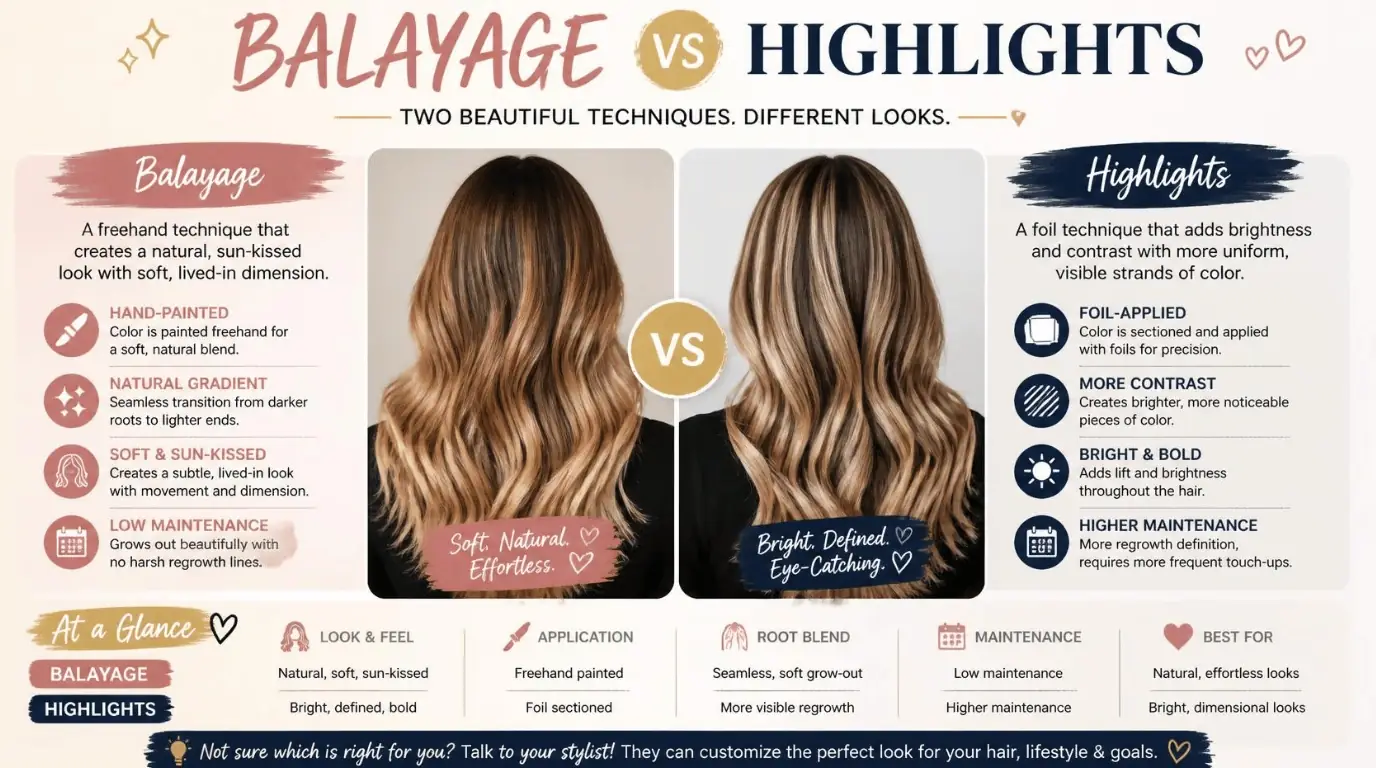
If you’re comparing balayage vs. highlights, the better choice depends on the finish you want and how often you want salon maintenance. Both techniques can brighten your hair, add dimension, and work across many base colors. The main differences are placement, contrast, grow-out, and upkeep. More from us: Partial Highlights.
Choose balayage if you want softer, lived-in color, less obvious regrowth, and fewer full-color appointments. Choose traditional highlights if you want brighter root-to-end lift, more uniform placement, or stronger contrast. Neither is automatically better. Your starting color, hair condition, budget, and tolerance for upkeep should determine your choice.
| Factor | Balayage | Traditional highlights |
| Application | Freehand-painted placement | Sections usually isolated in foils |
| Typical finish | Soft, blended, sun-kissed | Brighter, more structured |
| Root area | Usually softer or left deeper | Lightness often begins near the root. |
| Grow-out | Gradual and less obvious | Regrowth can become visible sooner. |
| Maintenance | Usually fewer full refreshes | Often more frequent root maintenance |
| Best fit | Lived-in, lower-upkeep color | Noticeable brightness and precision |
| Cost pattern | May cost more per visit | May cost less per visit, depending on service |
| Hair length | Especially flexible on medium or long hair | Works across short, medium, and long cuts |
Balayage vs. Highlights: 7 Differences That Matter Most
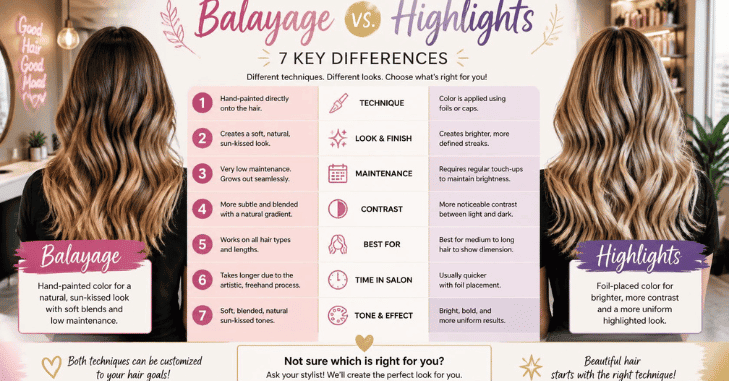
1. The Application Technique is Different
Traditional highlighting usually involves weaving small sections of hair and placing them in foils with lightener. This gives the colorist tight control over placement and lift. Balayage uses freehand painting to create softer transitions.
Balayage vs. Highlights: The lightest areas are often concentrated through the mid-lengths, ends, and face-framing sections. The root can stay closer to your natural shade. If you are also comparing this technique with a stronger dark-to-light gradient, Stylevana’s ombre hair guide explains how ombré differs.
2. Highlights usually create more brightness near the roots.
Foils can create clear, consistent brightness from close to the scalp through the ends. This makes them useful when you want an obvious color change or a polished blonde effect. Painted color tends to keep more depth near the top. The result often looks softer and less uniform, which is part of its appeal.
Neither method changes your natural pigment in the same way as an all-over permanent color service. If you are considering full coverage instead, read Stylevana’s guide to permanent hair dye.
3. TheGrow-out Can Look Quite Different
Regrowth is one of the biggest practical differences. Highlights placed close to the scalp can show a clearer line as your natural roots grow. A Canadian salon guide reports a common maintenance window of about 8 to 12 weeks for foil services. Painted color may last about 12 to 20 weeks before a full repaint, though toner appointments can happen sooner. That makes the softer option useful if frequent salon visits do not fit your schedule.
4. Upfront Price Does Not Tell You the Full Cost
There is no reliable rule that one service always costs more across Canada. Hair length, density, color history, stylist level, toner, and the amount of lightening all affect the bill. Current salon menus show how much prices can overlap. A Toronto salon lists full highlights from about C$220 and a painted service from about C$230, with extra products charged separately. Our related guide, Conditioner in Canada, goes further into this.
A Montreal salon lists full highlights from about C$160 to C$180 and painted color from about C$180 to C$200. A Vancouver salon lists both full highlights and hand-painted color from C$225. Ask for the total expected annual maintenance cost, not just the first appointment price.
5. The Better OptionDepends on How Light You Want to Go
If you want strong brightness from the roots, foils often give the colorist more control over lift and placement. A softer painted effect can work on dark hair too, but a major transformation may require more than one appointment. Your previous color history also matters. Box dye or earlier lightening can change what is safely achievable.
Bring reference photos that show a starting color and texture similar to yours. A good consultation should set expectations before any lightener is applied.
6. Neither Technique Is Automatically “Damage-Free”
Both services can involve lightener, so both can affect the hair fiber. The final condition depends on your starting hair, product strength, processing time, overlap, and how aggressively you lighten.
Canadian colorists also point out that technique alone does not determine the extent of damage. Careful application and avoiding repeated processing on already-lightened areas can matter more.
If your hair already feels dry or fragile, tell your colorist about previous chemical services. You can also review Stylevana’s keratin hair treatment guide before combining several salon treatments.
7. Your haircut and texture affect the final effect.
Longer hair gives a colorist more space to create gradual transitions. Waves and curls can also make dimensional color appear more noticeable because different sections catch the light. Short hair can still suit painted placement, but precision matters more when there is less length to blend.
Highlights can work well on short cuts because the colorist can control exactly where brightness begins. If length is part of your decision, Stylevana’s long hair guide covers care, styling, and maintenance for longer strands.
When Balayage Is the Better Choice
Pros
- You prefer soft, natural-looking dimension.
- You want less obvious root regrowth.
- You would rather space full-color appointments farther apart.
- You like a lived-in finish instead of uniform brightness.
- You want to preserve more depth around the roots.
Cons
- The first appointment can take longer.
- Custom placement may cost more at some salons.
- It may not create enough root brightness for your goal.
- Major lightening from a dark base can require several sessions.
When Traditional Highlights Are the Better Choice
Pros
- You want visible brightness from close to the roots.
- You prefer consistent, controlled placement.
- You want a bigger blonde transformation.
- They work well on shortcuts and precise styles.
- Partial foils can target specific areas without coloring the full head.
Cons
- Root regrowth may show sooner.
- Maintenance can require more frequent appointments.
- A high-contrast result may feel less natural as it grows.
- Repeated overlap on previously lightened strands can increase stress on the hair.
What Does Hair Color Cost in Canada?
Canadian pricing varies too much for one national figure to be useful. City, salon level, hair length, product use, and the amount of color correction can all change the price.
Recently published menus show full or specialty color services starting around the mid-C$100s in some Montreal salons and moving above C$300 at some Toronto studios. Vancouver salons also commonly list specialty lighting from roughly C$150 to C$250 or more. These are examples, not fixed Canadian averages.
Before booking, ask whether the quoted price includes:
- toner or gloss;
- extra product for long or dense hair;
- bond-building treatment;
- blow-dry or styling
- taxes;
- follow-up toning between major appointments.
That makes two salon quotes much easier to compare.
A 60-Second Decision Test
Choose the softer painted option if most of these statements sound like you:
- I want my natural root to remain part of the look.
- I prefer subtle dimension over uniform blonde.
- I want a grow-out that feels less obvious.
- I do not want frequent full-color appointments.
Choose foil highlights if these sound closer:
- I want noticeable brightness near my roots.
- I like a fresh, structured color pattern.
- I am comfortable with more regular upkeep.
- I want the colorist to control each lightened section closely.
If your answers are split, ask about a hybrid service. Colorists can combine painted lengths with strategic foils or face-framing pieces. That can provide more root brightness without giving the entire head a traditional highlighted pattern.
The Verdict
For most people who want soft color and easier grow-out, balayage is the stronger fit. If your priority is maximum brightness, visible root lift, and precise placement, traditional highlights make more sense.
Balayage vs. highlights: The service name should not make the final decision. Show your colorist the result you want, explain your maintenance budget, and share your full color history. A skilled stylist can then recommend the technique or combination that best matches your goal.
If you want color without committing to permanent lightening, Stylevanta’s semi-permanent hair color guide explains another route worth considering.
Frequently Asked Questions
What is the main difference in balayage and highlights?
The biggest difference is placement. One method uses freehand painting for a softer gradient, while traditional foil highlighting creates more controlled brightness from near the roots through the lengths.
Which option lasts longer?
The color itself does not suddenly disappear. What changes is how quickly regrowth becomes noticeable. Softer root placement can often look intentional for longer, while root-to-end foils may need refreshing sooner.
Does balayage damage hair less?
Not automatically. The amount of lightener, processing time, previous chemical services, and repeated overlap all affect the extent of damage. Your hair’s current condition matters more than choosing a technique based on the name alone.
Which is better for dark hair?
Both can work. A painted approach can create softer caramel or lighter ribbons, while foils can provide stronger lift and contrast. Very dark or previously colored hair may need staged lightening.
Can I switch from highlights to balayage?
Yes. A colorist can soften existing foils as they grow and introduce more blended placement over one or several appointments. The exact process depends on your current pattern and the condition of your lengths.
Should I choose based on price?
Price should be one factor, not the only one. Compare the first appointment, toner or gloss costs, and how often you expect to return. A higher initial service can still cost less over a year if you need fewer major refreshes.