
This guide is general information, not medical advice. Follow the product’s allergy-test directions, and stop and seek medical advice if you develop burning, swelling or a rash.
Changing your colour doesn’t have to mean months of visible regrowth. Semi-permanent hair dye offers a lower-commitment way to refresh your tone, experiment with colour, or add a temporary shift. Also worth reading: Hair Dye Colors.
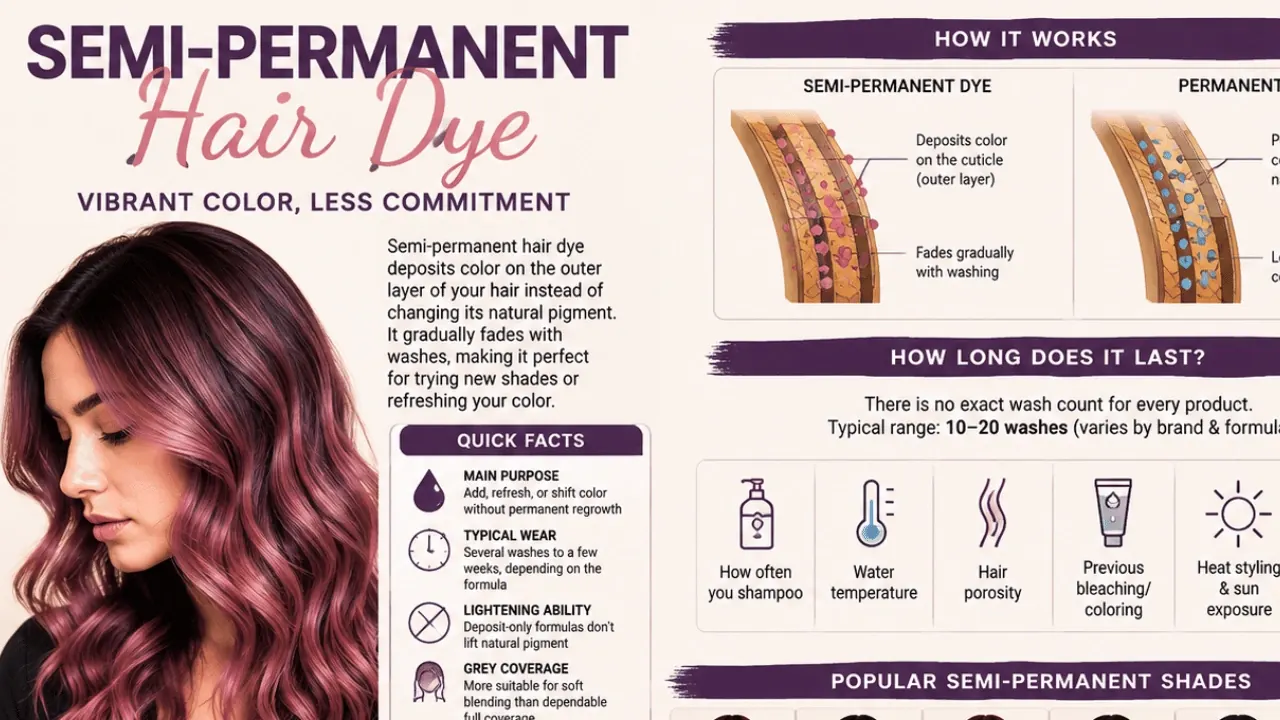
Semi-permanent colour deposits pigment on or near the outer layers of your hair rather than permanently changing its natural pigment. Most formulas fade with repeated washing and aren’t designed to lighten dark hair. Wear depends on the formula, shade, starting colour, porosity, and washing routine. Our related guide, Hair Brush, goes further into this.
| Quick fact | What to expect |
| Main purpose | Add, refresh, or shift colour without permanent regrowth. |
| Typical wear | Several washes to a few weeks, depending on the formula |
| Lightening ability | Deposit-only formulas don’t lift natural pigment. |
| Grey result | More suitable for soft blending than dependable full coverage |
| Good fit | Tone refreshes, vivid shades, pre-lightened hair, and colour experiments |
| Main caution | Porous or bleached areas may hold pigment more strongly. |
TL;DR: Choose this colour type when flexibility matters more than maximum longevity. Your starting shade strongly affects the result. Dark bases limit pale or pastel results, while light and bleached strands show colour more clearly. Always follow the product directions and complete the required sensitivity test.
What Is Semi-Permanent Hair Dye?
Semi-permanent formulas add pigment without producing the same lasting colour change as permanent formulas. Many direct-colour products work without a developer and keep most of the pigment close to the strand’s surface. That makes them useful for refreshing faded colour, deepening a shade, correcting tone, or experimenting with vivid colours.
L’Oréal Canada states that its semi-permanent options cannot lighten hair because they lack the oxidative action needed for meaningful lift. Your starting colour still matters. A bright pink can appear vivid on pale blonde hair. The same shade may create only a subtle reflection on deep brown hair.
How Long Does Semi-Permanent Colour Last?

Semi-permanent hair dye: There is no single wash count that applies to every product. Current Canadian guidance from L’Oréal cites about 12 washes as typical for some semi-permanent products. Its Colorista range lists different wear claims for specific formulas. Wella places some semi-permanent colour closer to the 10- to 20-wash range.
Those differences matter. The product’s own wear claim is more useful than a universal number.
Fading can also vary with:
- How often you shampoo
- Water temperature
- Hair porosity
- Previous bleaching or colouring
- Shade depth and pigment intensity
- Heat styling and sun exposure
Light, porous, or bleached strands can hold colour more strongly than expected. A fading formula should not be treated as a guarantee that every trace will disappear by a fixed date.
What Result Can You Expect Based on Your Starting Shade?
Your base colour determines how visible the result can become.
| Starting hair | Likely result | What to watch for |
| Pale blonde or bleached | Brightest and clearest colour payoff | Porous areas may grab pigment or fade unevenly |
| Dark blonde or light brown | Visible tonal change with medium or deeper shades | Pale pastels may appear weak |
| Medium or dark brown | Rich reds, coppers, purples, and deep tones show more easily | Light shades cannot lift the base |
| Black or very deep brown | Subtle reflection, sheen, or added depth | Deposit-only colour won’t create a blonde or pastel result |
| Grey or white strands | Can tint or soften contrast | Coverage may look less even than permanent colour |
Pre-lightened ends can also make vivid colour appear more noticeable on the ends than at the roots. If you like that graduated effect, StyleVanta’s ombre hair guide explains how lighter lengths can change the finished look.
A strand test is useful before a full application. It lets you see both the colour result and how strongly your hair holds the pigment.
Semi-Permanent vs Temporary, Demi-Permanent, and Permanent Colour
These categories differ in commitment, wear, and what they can realistically change.
| Colour type | Typical commitment | Lightening | Grey result | Suitable when |
| Temporary | Lowest | No | Surface coverage only | You need colour for a short event or a few washes |
| Semi-permanent | Low | No | Soft tinting or blending | You want a flexible tone change |
| Demi-permanent | Medium | Usually little or no lift | Stronger blending | You want longer wear without full permanence |
| Permanent | Highest | Formula-dependent lift is possible | Strongest coverage | You want lasting colour or dependable grey coverage |
L’Oréal describes temporary colour as shorter-lived than semi-permanent formulas. Wella describes demi-permanent colour as longer-wearing and better suited to stronger grey blending. For a one-day or short-event option, see StyleVanta’s temporary colour guide. If lasting coverage or a more permanent shade change is the goal, the permanent colour guide explains the higher-commitment option.
What Happens on Grey Hair?
A semi-permanent formula may tint grey strands or reduce the contrast between grey and pigmented hair. It is less dependable when your goal is complete, even coverage. Grey strands can also accept pigment differently from the rest of the hair. Check the manufacturer’s stated grey coverage level before choosing a product.
Demi-permanent colour often makes more sense when stronger blending is important. Wella, for example, offers demi formulas designed for substantially greater grey blending than its semi-permanent category. For dense or resistant grey, permanent colour may provide a more predictable result.
Can It Damage Hair or Cause a Reaction?
Deposit-only colour avoids the lightening step that removes natural pigment. That generally means less structural change than a process that combines colour with significant lightening.
Lower commitment does not Mean Zero Risk of Allergy
Health Canada says that permanent and semi-permanent dyes subject to its requirements must carry skin-irritation warnings and patch-test instructions. The agency advises repeating the test before each use because sensitivity can develop after earlier applications.
Do not use the product if the test area becomes red or itchy, or shows irritation, burning, or blistering. Health Canada also warns against using these products to colour eyebrows or eyelashes. Follow the directions supplied with the specific formula.
How to Choose a Shade That Can Work on Your Hair
Start with what your existing colour can realistically support. If you want a subtle refresh, choose a tone near your current depth. For a more visible result without lightening, richer or darker shades usually have more room to show. Pale pink, silver, lavender, and similar light shades need a light enough foundation. A deposit-only formula cannot create that pale base on dark natural hair. Think about the fade, too.
A shade that looks striking on day one should still suit you as it becomes softer. Before colouring, read the full instructions. Protect clothing and nearby surfaces, wear the recommended gloves, and follow the stated processing time.
How to Help the Colour Last Longer
Every wash removes some pigment, so aftercare can influence how quickly the shade changes. L’Oréal also identifies water temperature, heat, and sun exposure as factors that can affect colour longevity.
To slow fading:
- Wash only as often as your scalp needs.
- Use a cleanser intended to be gentle on coloured lengths.
- Choose comfortably cool or lukewarm water.
- Limit unnecessary high-heat styling.
- Protect coloured lengths during prolonged exposure to strong sun.
- Avoid frequent clarifying washes unless you need to remove buildup.
If frequent washing is unavoidable because your roots become oily quickly, StyleVanta’s shampoo for oily hair guide can help you balance scalp cleansing with gentler care for the lengths.
Who Is This Colour Type For?
Semi-permanent colour is a practical option when you want to change the tone without creating a strong permanent root line.
It can suit you if you want to:
- Refresh faded colour between longer-term services.
- Try a deeper or warmer version of your current shade.
- Experiment with vivid colour on light or pre-lightened hair
- Add a temporary tonal shift.
- Soften the appearance of a small amount of grey.
Choose demi-permanent or permanent colour when longer wear, stronger grey coverage, or a change requiring lift matters more. The key is matching your goal to your starting base. Doing that prevents two common disappointments: expecting pale colour on dark hair and expecting opaque grey coverage from a translucent formula.
Choose the Colour for the Result You Want
A fading colour formula works best when you want flexibility, tonal change, or a chance to experiment. It is less suitable when you need significant lightening or dependable full grey coverage. Check your starting shade first, then read the product’s wear and coverage claims. Complete the required sensitivity test before application. With realistic expectations and careful aftercare, you can enjoy the colour without treating a temporary change like a permanent decision.
Conclusion
Semi-permanent hair dye is a flexible choice for anyone who wants to refresh their colour, experiment with a new tone, or enjoy a temporary change without the commitment of permanent colour. Because these formulas mainly deposit pigment and are designed to fade with repeated washing, the final result depends heavily on your starting shade, hair porosity, chosen colour, and aftercare routine.
Before choosing a shade, consider what your natural or current hair colour can realistically support. Light and pre-lightened hair usually shows colour more clearly, while darker hair is better suited to deeper tones and subtle reflections unless lightening is involved.
Frequently Asked Questions
Does Semi-Permanent Hair Dye Wash Out Completely?
It is designed to fade with repeated washing, but the timing varies. Strong pigment may remain visible longer on light, porous, or previously bleached strands. Follow the manufacturer’s expected wear range rather than assuming a fixed number of washes.
Can Semi-Permanent Colour Lighten Dark Hair?
Deposit-only formulas are not designed to lift natural pigment. They can add tone, depth, or a coloured reflection to dark hair, but they cannot create a pale base.
Does It Cover Grey Hair?
It may tint or blend some grey strands, but full coverage is less predictable. Demi-permanent or permanent colour is usually a stronger option when dependable grey coverage is the goal.
Is Semi-Permanent the Same as Demi-Permanent Colour?
No. Demi-permanent products generally interact more deeply with the outer hair structure and last longer. Some also use a low-strength developer. Semi-permanent direct colour usually stays closer to the surface.
How Soon Can You Colour Again?
use the reapplication interval stated by the manufacturer. Formulas differ, so one schedule does not fit every product. Do not reapply over an irritated scalp or after a failed sensitivity test.